
As tax regulations evolve and compliance requirements become more complex, businesses are shifting from reactive, in-house processes to expert-led, scalable solutions. With outsource tax preparation services, businesses can save time, reduce errors, and make sure they follow the Internal Revenue Service’s (IRS) changing tax rules.
Instead of handling complicated workflows and filings in-house, businesses can hire experts who guide them with the latest laws and deductions. This improves accuracy and significantly lowers the risk of penalties and compliance gaps.
Additionally, it allows businesses to focus on core operations like growth, strategy, and customer experience rather than administrative tasks.
For startups and small business owners, outsourcing is a cost-effective way to access specialized expertise without hiring a full-time team. This makes tax management more efficient and scalable over time.

Tax Preparation In-House vs. Outsourcing for Businesses
Businesses that need help with their taxes need to know the differences to choose.
Here are the main differences between tax preparation partners who work in-house and experts who work for other companies.
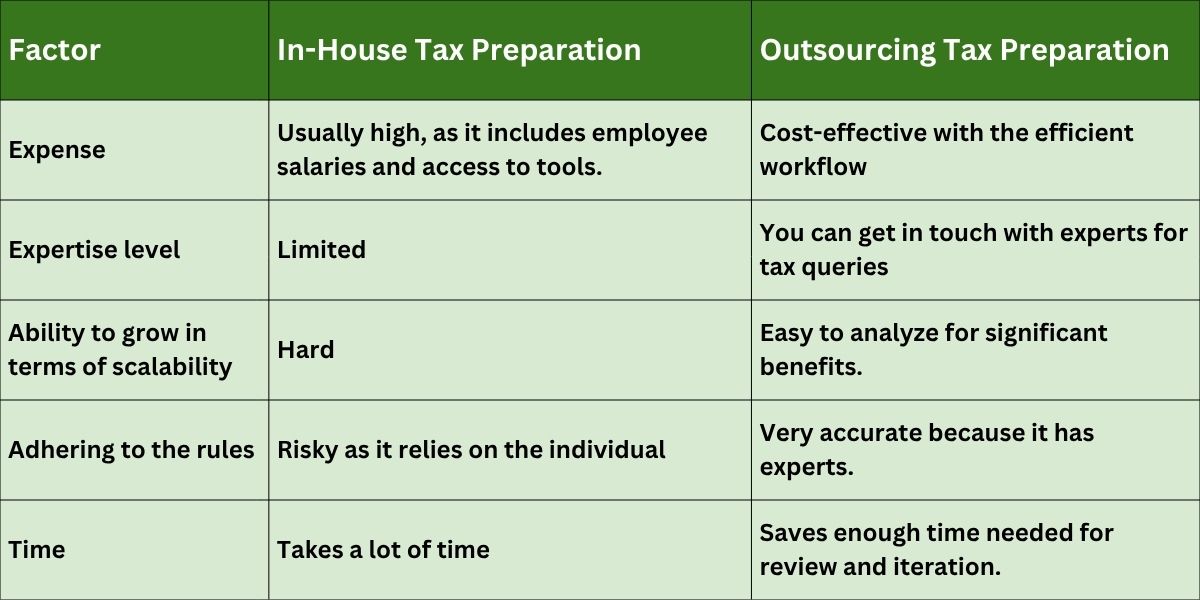
For most growing businesses, outsourcing offers a more resilient and future-ready approach.
Key Benefits to Outsource Tax Preparation Services

1. Improved Accuracy
Accuracy is vital in outsourcing tax preparation services. Even minor errors can lead to penalties or audits. Outsourcing ensures that experienced professionals handle your filings, reducing the likelihood of mistakes.
2. Regulatory Compliance
Tax laws are constantly changing, making it difficult for businesses to stay updated. Outsourcing partners specialize in compliance, ensuring that your business adheres to all relevant regulations and avoids legal complications.
3. Cost Efficiency
Maintaining an in-house tax team involves salaries, benefits, training, and software costs. Outsourcing eliminates these overhead expenses, offering expert services at a more affordable rate.
4. Time Savings
Tax preparation can be time-consuming, especially during peak seasons. By outsourcing, businesses can free up valuable time and focus on activities that drive growth and revenue.
5. Access to Expertise
Outsourcing gives you access to a team of professionals with profound knowledge of tax laws, industry practices, and financial strategies. This expertise can help optimize your tax planning and identify potential savings.
6. Reduced Risk of Penalties
Filing errors, missed deadlines, and non-compliance can result in significant penalties. With experts managing your tax processes, the risk of such issues is greatly minimized.
7. Scalability and Flexibility
As your business grows, your requirements become more complex. Outsourcing allows you to scale services up or down based on your needs without the hassle of hiring or restructuring internal teams. This becomes especially important for companies managing multi-state or global tax compliance regulations.
When To Consider Outsourcing Tax Preparation Services?
You must consider outsourcing services if
- Your business is growing rapidly.
- You don’t have any tax experts on staff.
- You want to lower the risks of not following the rules.
- You’re spending too much time on tax-related things, and
- You work in different parts of the world, each with its own tax laws.
Common Challenges Solved by Outsourcing
Outsourcing tax preparation helps address several common challenges faced by businesses:
- Lack of expertise: Access to skilled professionals eliminates knowledge gaps
- Time constraints: Delegating tasks frees up internal resources
- Compliance risks: Experts ensure adherence to changing regulations
- Operational inefficiencies: Streamlined processes improve overall productivity
By solving these challenges, outsourcing becomes a valuable long-term strategy rather than just a short-term solution.
How to Choose the Right Outsource Tax Preparation Service Partner
The most valuable tax partners are those who move beyond execution and contribute strategically to gain significant benefits. Along with completing filings, they help identify opportunities for tax optimization, support better cash flow planning, and align tax decisions with broader business objectives. In doing so, they transform tax preparation from a compliance function into a driver of financial efficiency and growth.
Choosing the right partner is very important for long-term success. Take into account these things:
- Experience and Expertise: Look for companies that have been in the business for a long time.
- Data Security: Make sure there are strong measures in place to protect and keep data private.
- Tools and Technology: Work with partners who use up-to-date tax software.
- Turnaround Time: Check to see if they can always meet deadlines.
- Clear pricing structures: Avoid extra costs by being clear about prices.
Ultimately, choosing the right tax preparation partner is about building a relationship that evolves with your business. This decision directly impacts your current tax management and determines your ability to scale and adapt confidently in the future.
Why Choose Profitjets?
Our secure systems and expert insights accelerate your back-office operations thereby saving you time, reducing errors, and helping you make smarter decisions. Whether you’re a startup or a growing business, Profitjets acts as your trusted financial partner so you can focus on scaling your business beyond managing paperwork.
Profitjets offers reliable tax outsourcing solutions that can grow with your business. By working with experienced professionals and having access to the latest tools, our team will make sure that all tax filings are correct, sent in on time, and adhering to the law.
We work to simplify complicated tax processes while still maintaining high levels of accuracy and efficiency. Profitjets can help businesses lower their operational costs and risks by focusing on long-term growth.
Commonly Asked Questions (FAQs)
Q1. Does outsourcing tax preparation improve decision-making?
Yes, outsourcing provides accurate, timely financial data and expert insights. This enables stakeholders to make informed decisions around cash flow, investments, and tax planning instead of relying on reactive or incomplete information.
Q2. Can outsourcing help businesses move from reactive to proactive tax planning?
Yes. In-house teams often focus on filing deadlines, while outsourcing partners bring a futuristic approach by identifying tax-saving opportunities, planning ahead for liabilities, and aligning tax strategy with business growth.
Q3. What risks do businesses face by keeping tax preparation fully in-house?
The biggest risks include dependency on limited expertise, missed regulatory updates, and process inefficiencies. Over time, these issues can lead to compliance gaps, penalties, and increased operational strain.
Q4. How does outsourcing support scalability in high-growth businesses?
As businesses scale, tax complexity increases across entities, geographies, and revenue streams. Outsourcing provides flexible infrastructure and expertise that can adapt instantly without the need to build or restructure internal teams.
Q5. Can outsourcing improve operational efficiency across finance teams?
Yes. By removing repetitive and time-intensive tax tasks, finance teams can focus on higher-value functions such as financial planning, analysis, and business strategy.
Q6. How should businesses evaluate the ROI of outsourcing tax preparation?
ROI should be measured beyond cost; consider time saved, reduced risk exposure, improved compliance, and the ability to reallocate internal resources to strategic initiatives.