
Most often, business owners track their overdue invoices qualitatively. Some clients are always late, one big customer pays when their account is settled, and, as long as a steady cash flow is maintained, everything is fine. The truth, however, is that cash flow issues usually stem not from emergencies but from day-to-day operations.
If receivables are not collected on time, they dry up the cash flow little by little, until one day, the company realizes that, despite having had a profitable month, there is not a single cent to pay salaries.
Days sales outstanding or DSO is a metric that, when calculated and analyzed, can help many businesses turn this situation around. It represents the number of days it takes a company to collect its accounts receivable after a sale has been made.
In other words, DSO tells you how quickly you can expect to receive the money you are owed after selling your product or service on credit. Comparing the number to your credit terms will give you an idea of your customers’ payment habits. And a monthly analysis of the metric will allow you to determine whether you are able to collect receivables more efficiently over time.
For any company that sells on credit, DSO is one of the most important cash flow indicators. In this article, you will learn how to calculate it, what the results mean, and how to reduce it if it is too high.
The DSO level that should worry an owner isn't a fixed number. It's the gap between DSO and your own payment terms, and whether that gap is growing. The single action that makes the biggest difference is almost always the most basic one: invoice the day the work is delivered and follow up the day an invoice becomes overdue. Most collection problems start with invoices that went out late.
Abhinav Gupta, CPA, CA, MBA · LinkedInDebt-to-Equity Ratio Formula
D/E Ratio = Total Liabilities / Total Shareholders' Equity
Or, using only interest-bearing debt:
D/E Ratio = Total Debt (interest-bearing loans) / Total Equity
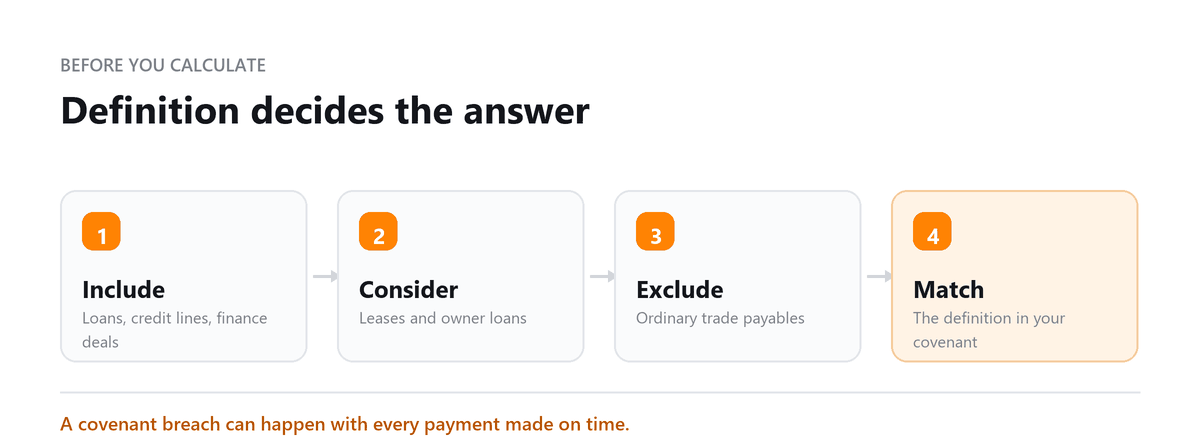
The first version (total liabilities) is more conservative and commonly used by analysts. The second (interest-bearing debt only) excludes trade payables and accruals that are not debt in the traditional sense.
Worked Example
| Balance Sheet Item | Amount |
|---|---|
| Total Liabilities | $180,000 |
| of which: Accounts Payable | $30,000 |
| of which: Short-term loans | $50,000 |
| of which: Long-term bank loan | $100,000 |
| Total Equity | $120,000 |
| D/E Ratio (total liabilities / equity) | $180,000 / $120,000 = 1.5x |
| D/E Ratio (interest-bearing debt only) | $150,000 / $120,000 = 1.25x |
What Does the D/E Ratio Tell You?
| D/E Ratio | Interpretation |
|---|---|
| Below 1.0x | More equity-funded than debt-funded, conservative; lower financial risk; may be underleveraged |
| 1.0x, 2.0x | Moderate leverage, typical for healthy SMEs; manageable debt load |
| 2.0x, 3.0x | Higher leverage, acceptable in capital-intensive industries (real estate, manufacturing); scrutinised by lenders |
| Above 3.0x | High leverage, significant financial risk; limits access to additional credit; watch debt service coverage |
| Negative equity | Total liabilities exceed total assets, technically insolvent; D/E ratio is not meaningful |
Industry Benchmarks
| Industry | Typical D/E Range | Notes |
|---|---|---|
| Financial services / Banks | 10x, 20x | Banks are highly leveraged by nature, different rules apply |
| Real estate / Property | 2x, 5x | Capital-intensive; long-term assets support higher leverage |
| Manufacturing | 0.5x, 2.0x | Moderate leverage for equipment financing |
| Retail | 0.5x, 2.0x | Higher for physical retail with property; lower for e-commerce |
| Professional Services | 0.2x, 0.8x | Low asset base; usually equity-light and debt-light |
| Technology / SaaS | 0.1x, 1.0x | Typically equity-funded; venture-backed companies may have no debt |
D/E Ratio and Financial Risk
- A high D/E ratio magnifies returns in good times (leverage effect) but magnifies losses in bad times
- Lenders use D/E ratio as a covenant in loan agreements, breaching a maximum D/E threshold can trigger early repayment demands
- Investors prefer businesses with manageable D/E ratios, excessive debt limits flexibility and increases bankruptcy risk
- Interest coverage ratio should always be reviewed alongside D/E, a business with 3x D/E but strong EBITDA may be fine; one with 1.5x D/E and weak earnings may be at risk.
How to Reduce DSO
- Invoice the day work is delivered. Every day an invoice waits to go out adds a day to DSO.
- Make invoices easy to pay. Include online payment links, clear due dates, purchase order numbers, and the right contact details.
- Automate reminders. Send a reminder before the due date, on the due date, and at set intervals after it's overdue.
- Follow up personally on large balances. A phone call about a significant overdue invoice usually works faster than another automated email.
- Take deposits on large projects. Collecting part of the fee upfront reduces how much sits in receivables.
- Tighten terms for slow payers. Shorten terms, require deposits, or pause work for customers with a pattern of late payment.
- Use early payment discounts carefully. A 2/10 Net 30 discount works out to roughly a 37% annualised cost. It can speed up collections, but it's expensive cash.
- Consider invoice financing. When large customers pay reliably but slowly, financing can bring the cash in sooner, at a cost.
Our customers were consistently paying well beyond our agreed terms, and our DSO had climbed to a point where it was putting pressure on our cash flow. Profitjets introduced a structured collections process with regular aging reviews, scheduled follow-ups, and clearer ownership of overdue accounts. Within a few months, our DSO dropped significantly, and we had a much more predictable collection cycle.
Book a free consultation and we will check where you stand first.
FAQs
What is a good DSO?
A DSO close to your payment terms is a good sign. If you bill on Net 30 and DSO is in the low 30s, customers are generally paying on time. A DSO that's well above your terms, or rising month after month, points to a collections problem worth fixing.
Can DSO be too low?
Rarely a problem for most small businesses. A very low DSO can sometimes mean terms are stricter than competitors offer, which could cost sales in markets where credit terms are expected. For most businesses, though, faster collection is simply better for cash flow.
Why did my DSO jump even though customers are paying on time?
Usually because of timing. A large invoice sent near month-end, a strong sales month, or a seasonal spike can all push DSO up temporarily. Check the AR aging report. If most balances are still current, the increase is timing, not late payment. A rolling three-month DSO will show whether the trend has actually changed.
What's the difference between DSO and AR turnover?
They measure the same thing in different ways. AR turnover is how many times a year you collect your average receivables balance, calculated as credit sales ÷ average receivables. DSO converts that into days. Most small businesses find DSO easier to interpret because it compares directly with payment terms.
How often should I calculate DSO?
Monthly, as part of the month-end close, with a rolling three-month figure alongside it. Review the AR aging report at the same time, so you can see not just whether DSO is changing but which customers are behind it.

Written by
Abhinav Gupta, CPA, CA, MBA
Abhinav works with business owners across the US on industry-specific bookkeeping, from dental practices and restaurants to construction and e-commerce. He writes about what each trade's books actually need. Connect on LinkedIn
Free consultation
Covenant Test Coming Up?
Book a free consultation and we will check where you stand first.