
Outsourcing payroll services is the process of allocating your payroll tasks, such as salary processing, tax filings, and compliance, to a third-party provider to improve accuracy, reduce risk, and save time.
When companies try to grow quickly, it becomes harder to keep up with payroll services. Particularly, managing the wages of employees, their tax withholdings, and multi-state compliance requires precision in details, followed by constant updates.
According to the Internal Revenue Service (IRS), 33% of employers make payroll errors each year, leading to penalties and compliance issues. What begins as a simple overseeing task often turns into time-consuming, high-risk processes. This makes it hard for a lot of US businesses, like startups, small businesses, and nonprofits, to meet their operational and compliance needs at the same time.
Outsourcing payroll services can help your business run more smoothly in a world that is becoming more and more complicated.

Why Outsourcing Payroll Services is a Smart Business Decision
1. Frees Up High-Value Time
Internal teams often spend enough time in managing calculations, deductions, and compliance checks. Outsourcing payroll services removes this operational burden, allowing teams to focus on strategic priorities like hiring, growth, and customer experience.
To further optimize time and efficiency, many businesses also integrate payroll with outsourced bookkeeping services, ensuring financial records remain accurate and up to date.
2. Reduces Hidden Costs
The true cost of payroll extends beyond salaries and software. It includes training, error correction, compliance risks, and administrative time. Outsourcing combines these into a predictable and optimized cost structure, improving overall financial efficiency.
Businesses looking to control costs holistically often pair payroll outsourcing with virtual CFO services to gain better financial visibility and cost planning.
3. Makes compliance stronger
Payroll compliance is constantly evolving. From federal regulations to state-specific laws, staying compliant requires continuous monitoring. Outsourcing ensures accurate filings, timely submissions, and alignment with the latest regulatory requirements.
For businesses dealing with complex tax environments, combining payroll outsourcing with tax preparation and filing services ensures end-to-end compliance and reduces audit risks.
4. Brings in Experts in Their Field
Payroll companies have specialized knowledge, set procedures, and cutting-edge tools. It’s hard for small and mid-sized businesses to get this level of specialization in-house.
Companies can get better accuracy and efficiency by outsourcing payroll services.
What Can You Gain from Outsourcing Payroll Services?
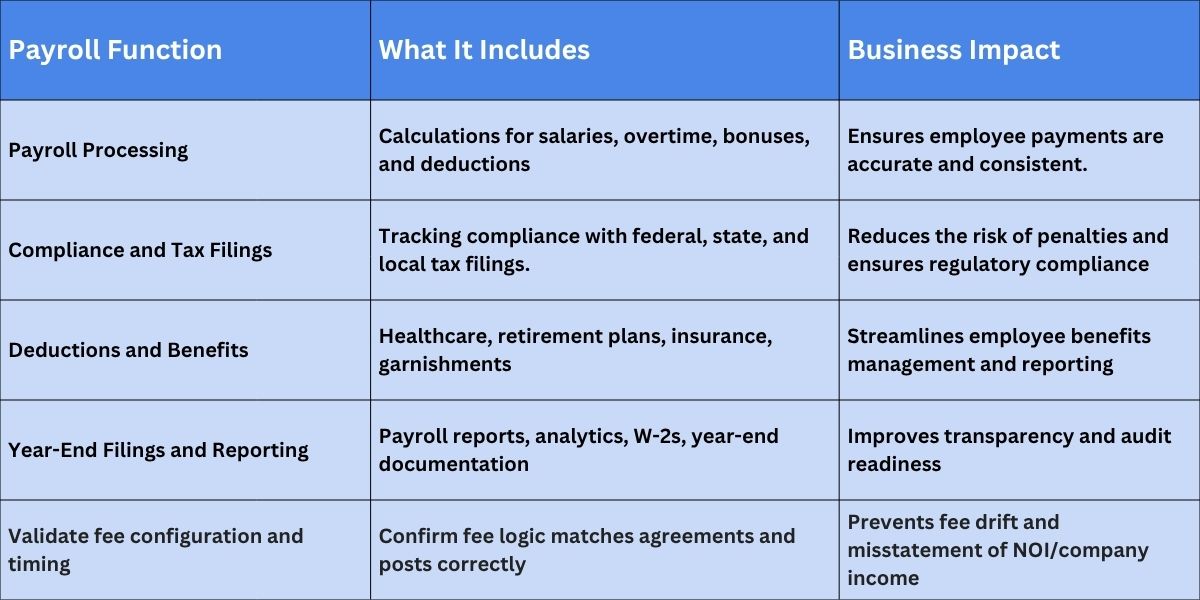
At a full-service level, outsourcing includes everything from salary calculations and tax filings to compliance monitoring and reporting. This model is ideal for businesses looking to minimize internal workload and eliminate compliance risks.
On the other hand, partial outsourcing allows businesses to retain control over simpler tasks while delegating complex, high-risk functions.
For example, a company might manage timesheets in the internal team but outsource tax filings and year-end reporting annually. This flexibility ensures that outsourcing aligns with both operational priorities and budget considerations.
Why does this matter?
By outsourcing payroll services, businesses move faster by working with specialized providers who have structured processes, regulatory knowledge, and advanced tools, instead of relying on their own teams to handle changing payroll needs.
This change not only makes things more accurate, but it also lowers the chance of penalties and compliance mistakes.
More importantly, it frees up internal resources to focus on growth, hiring, and strategic decision making areas that drive business outcomes.
How Much Does Outsourcing Payroll Services Cost?
Payroll outsourcing is often perceived as an additional expense, but in reality, it replaces several hidden and compounding costs associated with managing payroll in-house.
Most payroll providers follow a pricing model that includes a fixed monthly base fee along with a per-employee charge. Depending on business size and complexity, this typically ranges from $30–$150 per month as a base fee, plus $4–$12 per employee. While pricing varies, this model offers predictability compared to the fluctuating costs of in-house payroll.
Beyond direct expenses, businesses must also account for the true cost of internal payroll like staff time, software investments, ongoing training, and the financial impact of errors. According to the Internal Revenue Service, payroll mistakes are a leading cause of penalties, with a significant percentage of businesses facing fines due to inaccuracies or missed deadlines.
When these factors are considered, outsourcing often proves more cost-efficient over time.
Unique Benefits for Small Businesses and Nonprofits
While outsourcing delivers value across industries, its impact is particularly significant for small businesses and nonprofits.
- Reduces payroll errors and compliance risks
- Saves time on administrative tasks
- Ensures accurate tax filings and reporting
- Provides access to payroll expertise
- Improves operational efficiency and scalability
For small businesses, outsourcing reduces administrative overhead and introduces predictable costs. It allows founders and teams to focus on scaling operations rather than managing back-office functions.
For nonprofits, payroll often intersects with grant reporting, donor transparency, and compliance requirements. Outsourcing ensures accuracy while reducing administrative burden, allowing organizations to focus more resources on their mission.
In both cases, outsourcing enables lean teams to operate with the efficiency of a much larger organization.
Outsourcing Payroll vs In-House Payroll: Analytical Overview
Managing payroll in-house offers direct oversight but requires significant investment in time, tools, and expertise. It also places the burden of compliance entirely on internal teams, increasing the risk of errors and inefficiencies.
For most growing businesses, outsourcing provides a more practical and future-ready approach, especially as payroll complexity increases
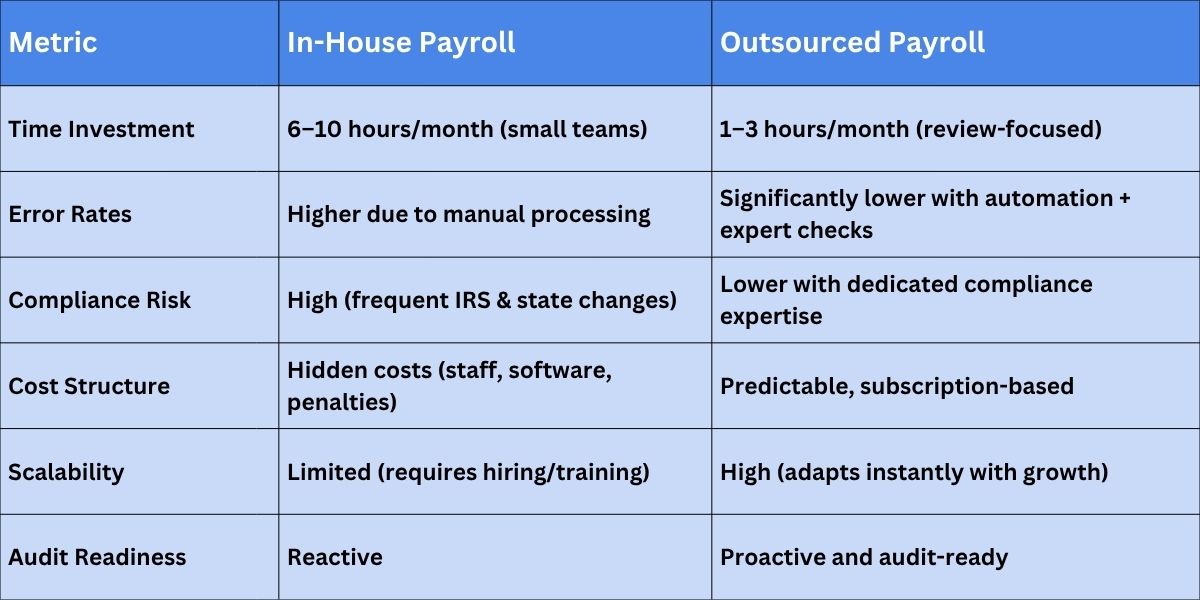
With one-third of businesses facing payroll errors and dozens of hours spent annually on compliance, outsourcing payroll services shifts the function from a risk-heavy task to a streamlined, expert-managed process.
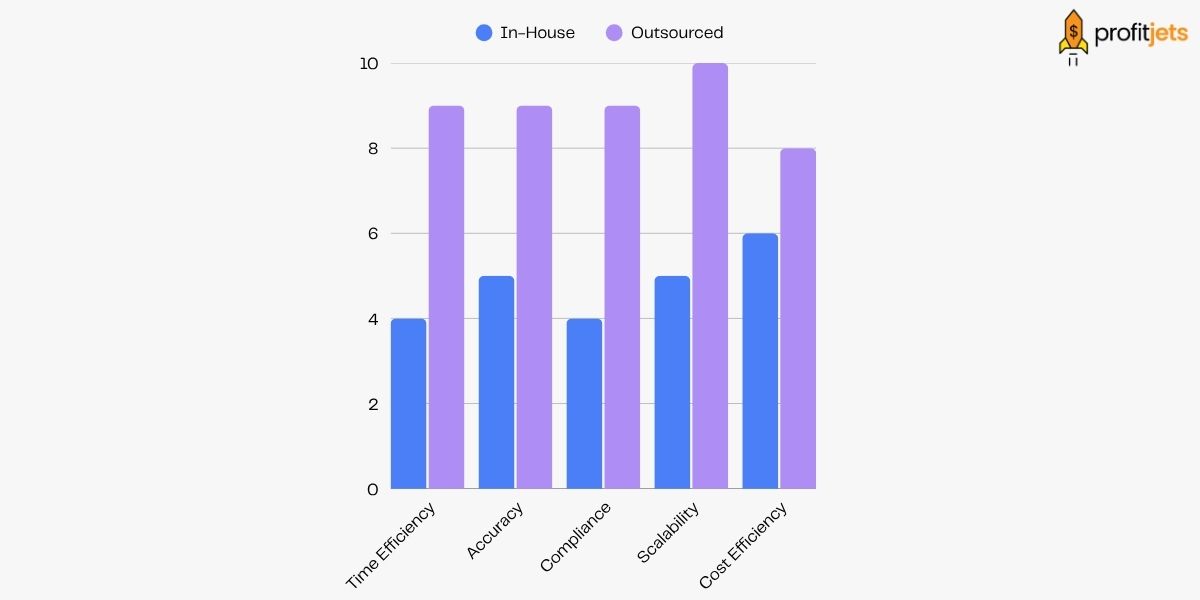
This comparison fig. 1 highlights how outsourcing payroll services significantly improves efficiency, accuracy, and compliance compared to in-house management.
As business complexity grows, outsourced payroll delivers a more scalable and reliable solution for long-term operational success.
Checklist to Choose the Right Payroll Service Partner
Choosing the right outsourcing payroll services partner is critical for ensuring accuracy, compliance, and long-term efficiency. Use this checklist to evaluate the best fit.
1. Business Fit & Industry Expertise
The right payroll partner understands your business model, industry nuances, and operational complexity to deliver aligned, scalable solutions.
2. Payroll Compliance & Risk Management
. The right provider proactively manages evolving IRS regulations and tax laws, minimizing risks, penalties, and operational disruptions.
3. Technology, Automation & Integration
Modern payroll demands more than manual processing. Look for partners who leverage automation, advanced tools, and seamless integrations to ensure accuracy and efficiency.
4. Data Security, Accuracy & Transparency
A reliable partner ensures strict data protection, consistent accuracy, and complete transparency in pricing and deliverables.
5. Scalability & Strategic Value
The right payroll partner grows with your business, offering flexibility, efficiency, and insights that support better decision-making and long-term financial planning.
Accelerating Payroll Workflow with Profitjets
Take control of your business finances with Profitjets. We provide technology-driven accounting, bookkeeping, payroll, and tax services for small and mid-sized businesses. From accurate daily bookkeeping and real-time financial reporting to timely tax filing and strategic virtual CFO support, we keep your finances organized, clear, and ready to grow.
Frequently Asked Questions(FAQs)
Q1. Is outsourcing payroll suitable for small businesses?
Yes, outsourcing is particularly beneficial for small businesses, as it reduces administrative workload, improves accuracy, and provides access to expertise without the cost of a full-time team.
Q2. How secure is outsourced payroll?
Reputable providers implement strict data security measures, including encryption and secure systems, to protect sensitive employee and financial information.
Q3. Can outsourcing handle multi-state payroll?
Yes, outsourcing providers are equipped to manage payroll across multiple states, ensuring compliance with varying tax laws and regulations.
Q4. Is outsourcing more cost-effective than in-house payroll?
In most cases, yes. Outsourcing eliminates hidden costs such as training, software, and compliance risks, making it a more efficient option.