
Choosing an accounting firm is hard because the thing you are buying is judgement, which is difficult to assess before you need it.
What can be assessed in advance is how a firm operates: how it communicates, whether it knows your sector, how it prices, and whether its clients stay. Those are visible before you sign and they predict a great deal.
This covers the traits that separate good firms from adequate ones, how smaller and larger firms differ, the questions worth asking a prospective firm, and the signals worth walking away from.
Not all CPA firms are created equal. The best ones do more than file taxes, they become strategic partners that help you grow, stay compliant, and make smarter financial decisions year-round. Here are the five traits that separate top-tier CPA firms from the rest.
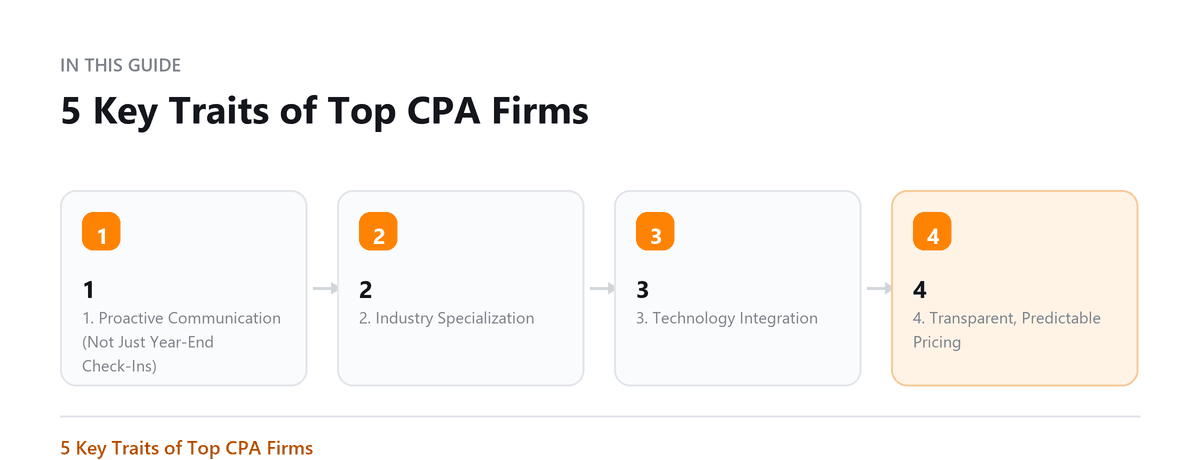
1. Proactive Communication (Not Just Year-End Check-Ins)
Top CPA firms don't go dark between March and October. They reach out when tax law changes, when your estimated payments are due, and when they spot something unusual in your books.
- Monthly or quarterly check-ins, not just tax season calls
- Email alerts on IRS changes that affect your business
- Proactive tax-saving suggestions before year-end (not after)
- Clear turnaround times for emails and calls
Pro Tip: Ask any prospective CPA: 'How often will you contact me outside of tax season?' A vague answer is a red flag.
Ask who will actually do your work and what else they carry. A firm can be excellent and still be wrong for you, usually because your account is small enough to be handled by whoever is free rather than by somebody who knows your business.
Abhinav Gupta, CPA, CA, MBA · LinkedIn2. Industry Specialization
A CPA who works with law firms, e-commerce sellers, and medical practices all at once probably isn't deeply expert in any of them. The best firms specialize, and it shows in their advice.
- They know the deductions and pitfalls specific to your industry
- They understand how revenue recognition or inventory works in your business
- They've seen IRS issues your industry faces and know how to handle them
- They can benchmark your margins against industry peers
| Industry | Specialized CPA Needs |
|---|---|
| Restaurants | Tip reporting, food inventory, COGS |
| E-commerce | Sales tax nexus, platform fee netting, returns |
| Lawyers | IOLTA trust accounts, 1099 for settlements |
| Real estate | 1031 exchanges, passive activity rules, depreciation |
| SaaS/Tech | R&D credits, deferred revenue, stock options |
3. Technology Integration
A modern CPA firm uses cloud-based tools, not manila folders. Look for firms that have integrated secure client portals, e-signatures, and bank feeds into their workflow.
- Cloud accounting platforms: QuickBooks Online, Xero, Sage
- Secure document portals: SafeSend, SmartVault, ShareFile
- E-signature: DocuSign, Adobe Sign
- Tax software: UltraTax, Lacerte, Drake
- Client dashboards showing real-time financial health
Pro Tip: If a CPA still emails you PDFs asking for a 'wet signature' by fax, they haven't modernized their practice.
4. Transparent, Predictable Pricing
Billing surprises are one of the top reasons clients switch CPA firms. Top firms publish or clearly explain their fee structure upfront.
Common Pricing Models
| Model | Best For |
|---|---|
| Hourly ($150-$400/hr) | Complex one-off projects, IRS audits |
| Fixed monthly retainer | Ongoing bookkeeping + tax planning |
| Fixed annual fee | Tax prep + planning bundled |
| Value-based pricing | High-complexity, high-stakes advisory work |
- Always get an engagement letter before work begins
- Ask what triggers out-of-scope billing
- Understand whether bookkeeping is included or separate
5. Strong Client Retention and References
The best CPA firms retain clients for years, sometimes decades. High turnover is a warning sign.
- Ask for two or three client references, and actually call them
- Check Google Reviews, Yelp, and Clutch.co
- Ask how long their average client relationship lasts
- Check if they've won any industry awards or been listed in top-firm rankings
Small Business CPA Firms vs. Enterprise CPA Firms
The traits above apply across the board, but the fit matters. Small business owners typically need a CPA firm that is responsive, affordable, and genuinely interested in your goals, not one that treats you as a low-priority account.
| Factor | Small Business CPA vs. Big Firm |
|---|---|
| Responsiveness | Local/boutique firms often faster; large firms may assign junior staff |
| Specialization | Boutique firms may specialize deeply; big 4 cover everything broadly |
| Cost | Boutique: $150-$300/hr; Big 4/regional: $300-$600/hr+ |
| Relationship | Principal-level access at boutique; may be hard at large firms |
| Technology | Both can be tech-forward; varies by firm culture |
Questions to Ask a Prospective CPA Firm
- How many clients do you serve in my industry?
- Who will be my primary contact, a partner, manager, or staff accountant?
- What is your typical response time for emails and calls?
- How do you communicate tax law changes that affect me?
- What accounting software do you use, and can I access it directly?
- Can you provide three client references?
- What does your engagement letter cover, and what triggers additional billing?
- Do you offer tax planning, or only tax preparation?
Red Flags to Watch For
- Guarantees of large refunds before reviewing your situation
- No written engagement letter
- Won't share pricing until after they've done the work
- Can't name a single client in your industry
- Doesn't use cloud-based tools or secure portals
- Slow to return calls during tax season
- History of IRS sanctions or disciplinary actions
Book a free consultation and we will bring them current.
Frequently Asked Questions
How do I find a top CPA firm near me?
Start with referrals from trusted business owners in your network, then verify credentials on the AICPA directory or your state CPA society website. Interview at least two or three firms before committing.
Should I use a local CPA or a national virtual CPA firm?
Both can be excellent. Local CPAs may be easier for in-person meetings; virtual firms often offer lower fees and broader availability. The key is specialization and communication quality, not geography.
What's the difference between a CPA and a bookkeeper?
A bookkeeper records day-to-day transactions. A CPA is a licensed professional who can prepare taxes, give financial advice, and represent you before the IRS. Many clients need both.
How often should my CPA contact me?
At minimum, before quarterly estimated tax deadlines, at year-end for planning, and whenever there's a significant law change. Monthly check-ins are ideal for growing businesses.
How do we tell a good fit from a good firm?
By asking who will actually do your work and how often you will hear from them. A firm can be excellent and still be wrong for you, usually because your account is small enough to be handled by whoever is free rather than by someone who knows your business. Ask to meet the person who will run the relationship, ask how many clients they carry, and ask what happens when they are away. The answers tell you more than the firm's size does.

Written by
Abhinav Gupta, CPA, CA, MBA
Abhinav works with business owners across the US on industry-specific bookkeeping, from dental practices and restaurants to construction and e-commerce. He writes about what each trade's books actually need. Connect on LinkedIn
Free consultation
Books Behind?
Book a free consultation and we will bring them current.