
Most investors can tell you what each property rents for, but far fewer know what each one actually earns. Rent arrives, the mortgage goes out, and repairs get paid from whichever account has money. At year-end, everything is lumped together on one tax return. The portfolio may look profitable overall while one property quietly drains cash, a security deposit goes unrecorded, or a new roof gets deducted when it should have been depreciated.
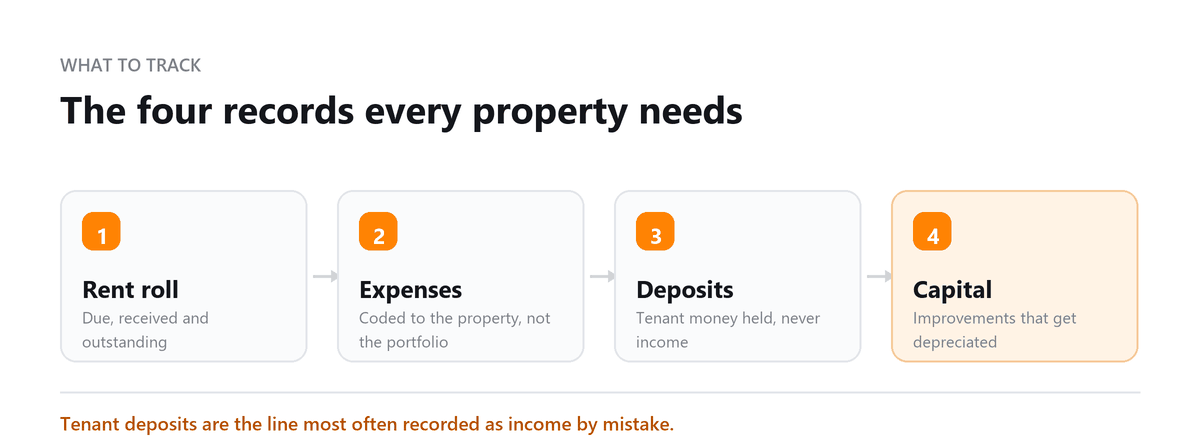
Good real estate accounting starts with tracking the right things from the start. That means rental income and expenses by property, security deposits held for tenants, mortgage principal and interest, the split between land and building at purchase, capital improvements, and depreciation.
With those records in place, you can see which properties earn their keep, support refinancing and sales with reliable numbers, and file taxes without scrambling to rebuild a year of transactions.
Expert Perspective
Significance of Real Estate Accounting
Accounting is the backbone of every profitable real estate business. It monitors income and expenses across every property you own, measures financial performance through net income and return on investment, prepares you for tax obligations throughout the year rather than scrambling in April, and gives you the data to manage your portfolio strategically.
Without proper accounting, a real estate investor has no reliable basis for deciding whether to buy, sell, refinance, or hold. The numbers you track today are the decisions you make tomorrow.
The mistake I see constantly is mixing repairs and capital improvements. Replacing a broken window = repair, deduct immediately. Replacing all windows in the building = capital improvement, depreciate over 27.5 years. That distinction is worth thousands in tax savings every year if you track it correctly.
Abhinav Gupta, CPA, CA, MBA · LinkedInWhat To Track
Effective real estate accounting is built on tracking the right categories consistently, across every property, every month. Here is what every property investor needs to monitor:
Rental Income and Fees
Track every dollar of revenue generated by each property: gross rent received, late fees charged and collected, application fees, pet fees, parking fees, and any other ancillary income. Record all income by property and by unit, not just in aggregate. This granularity lets you identify which units are underperforming, which tenants have chronic late payments, and where your true revenue per square foot sits.
Property-Related Expenses
Fixed and recurring costs must be tracked against each property: mortgage principal and interest payments, property taxes, insurance premiums, HOA fees, and utilities paid by the owner. Separating these by property gives you the operating expense ratio for each asset, a key metric for assessing efficiency and for conversations with lenders.
Maintenance and Repair Costs
The critical discipline here is distinguishing repairs from capital improvements. A repair restores a property to its previous condition, fix a broken furnace, patch a roof leak, and is fully expensed in the year incurred. A capital improvement adds value or extends useful life, a new HVAC system, a kitchen renovation, a new roof, and must be capitalized and depreciated over the applicable recovery period. The tax treatment is dramatically different, and misclassification is one of the most common (and audited) errors in real estate accounting.
Cash Flow Statements
Track monthly net operating income (NOI) for each property: gross rental income, minus vacancy allowance, minus all operating expenses (excluding mortgage payments and depreciation). NOI is what lenders use to underwrite loans and what buyers use to value your property. Cash-on-cash return, annual pre-tax cash flow divided by total cash invested, tells you what your actual cash yield is on each investment, not just what the property is worth on paper.
Tax Obligations
Maintain a dedicated tax tracking record for each property: depreciation schedules (27.5 years for residential, 39 years for commercial), documentation for any 1031 exchanges, Schedule E income and expense summaries, and state and local property tax payment records. Having these records organized throughout the year, not assembled retroactively before the tax deadline, is what separates investors who maximize deductions from those who leave money on the table.
Loan Payments and Interest
Every mortgage payment must be split between principal reduction (which reduces your loan balance, not a tax deduction) and interest expense (which is tax-deductible). Track the outstanding mortgage balance for each property separately. This data feeds your debt service coverage ratio calculations and is essential for refinancing conversations with lenders.
Security Deposits
Security deposits are not income, they are liabilities (money you owe back to the tenant). Record them as a liability when received, held in a separate trust or escrow account where required by state law. When the tenancy ends, document any deductions for damages as income and expense, and return the remainder. Commingling security deposits with operating funds is both an accounting error and, in many states, a legal violation.
Vacancy and Occupancy Rates
Track the number of occupied versus vacant units at all times, and calculate your vacancy rate by property and by portfolio. High vacancy directly reduces revenue projections and signals a market, pricing, or management issue. Lenders and buyers will ask for your historical vacancy rate, if you haven't been tracking it, you won't have a credible answer.
Tracking Tools and Systems
The right tools depend on portfolio size and complexity. For portfolios under 10 units, accounting software with property-level tracking (QuickBooks Online with class tracking, Xero with location tracking) is sufficient. For 10-100 units, purpose-built property management platforms like Buildium or AppFolio integrate accounting directly with lease management and tenant communications. For all portfolios, maintain a separate bank account for each property or each LLC, commingling funds across properties is the fastest route to accounting chaos and legal exposure.
Profitjets Solution for Real Estate Accounting
Profitjets provides structured real estate accounting services that establish the right tracking systems from the start property-level chart of accounts, depreciation schedules, monthly reconciliation routines, and tax-ready reports. Whether you own two rental units or a portfolio of 50, having a professional accounting framework in place means you always know what each property is actually earning.
Profitjets currently supports 500+ businesses with bookkeeping and accounting services, including real estate companies, with services covering property-level financial tracking, rental income management, and monthly financial reporting.
We worked with a real estate client who had multiple properties but lacked a consistent way to track income and expenses for each one. We reorganized the books by property, separated rental income from operating and property-related costs, and created consistent monthly reports. This gave the client a clearer view of property-level performance and cash flow and made it easier to identify where expenses were increasing.
Conclusion
Real estate accounting starts with knowing what to track and tracking it consistently. Rental income, expenses, cash flow, loan payments, tax obligations, and security deposits each category has its own rules, its own tax implications, and its own role in the financial health of your portfolio. Investors who track these categories meticulously are the ones who make better decisions, pay less in taxes, and build portfolios that actually perform.
Book a free consultation and we will set the accounts up for you.
Frequently Asked Questions
How do I track rental income from multiple properties?
Set up a separate bank account for each property (or at minimum each LLC), and use accounting software that allows property-level or class tracking. QuickBooks Online and Xero both support classes/locations for this purpose. Buildium and AppFolio are purpose-built for multi-property management.
What is the difference between a repair and a capital improvement for tax purposes?
A repair restores a property to its original condition (fix a leaking pipe) and is expensed in the current year. A capital improvement adds value, extends useful life, or adapts the property to a new use (new roof, HVAC system, kitchen renovation) and must be capitalized and depreciated over time. The distinction significantly affects your tax liability.
How should I handle security deposits in my accounting?
Security deposits are not income they are liabilities (money you owe back to the tenant). Record them as a liability when received. When the tenancy ends, apply any deductions for damages (record as income and expense) and return the remainder. Never mix security deposits with your operating account.
What is net operating income (NOI) and why does it matter?
NOI is gross rental income minus vacancy losses minus operating expenses (excluding mortgage payments and depreciation). It is the primary metric lenders use to evaluate rental property loans and investors use to assess property value (through cap rate). A property's value is often estimated as NOI divided by the local cap rate.
How often should a real estate investor reconcile their accounts?
Monthly reconciliation is the standard. Each month: reconcile bank statements for each property account, update rent roll, categorize all expenses, and review cash flow by property. Annual reconciliation alone misses errors, timing issues, and security deposit discrepancies that compound over time.

Written by
Abhinav Gupta, CPA, CA, MBA
Abhinav works with business owners across the US on industry-specific bookkeeping, from dental practices and restaurants to construction and e-commerce. He writes about what each trade's books actually need. Connect on LinkedIn
Free consultation
Not Sure What You Should Be Tracking?
Book a free consultation and we will set the accounts up for you.