
Accounts payable management doesn't get much thought before the month a business realises that it's been paying a cancelled subscription for a year or that the same supplier exists twice in the ledger and has been paid twice for the same work.
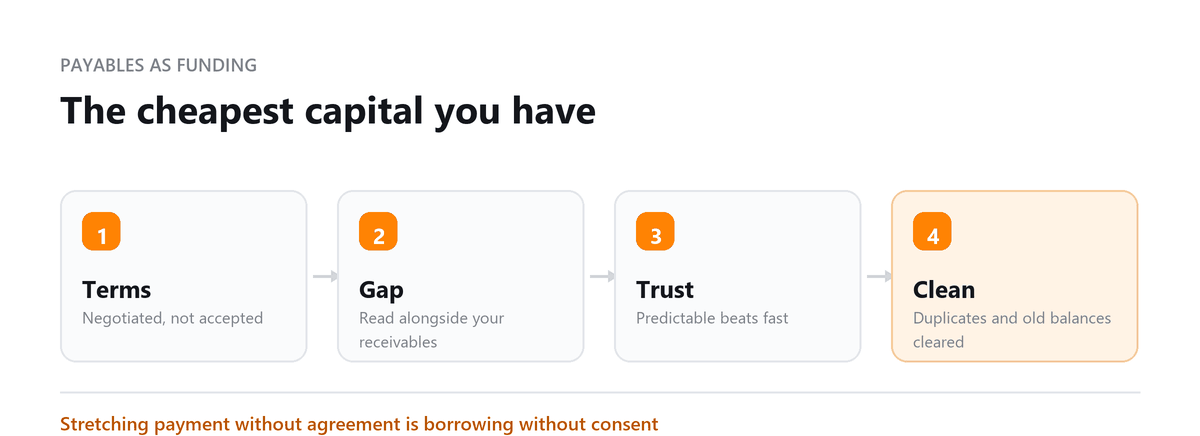
It's not about how much cash is in AP processing faster, but three things: paying on terms and not when an invoice surfaces, catching that which should not have been paid at all, and keeping enough of a record that your AP balance means something when you look it over. Businesses that get them right can keep the working capital a little longer and the goodwill of their suppliers who they may need to lean on some later and close their books without a week of archaeology over it.
This guide covers everything an AP management entails, what practices actually do a difference to a small business and where the standard advice needs to be adjusted for a company with no finance department.
The biggest single number I've seen come out of an AP review wasn't a discount or an efficiency gain, it was services nobody had cancelled. Software, retainers, subscriptions that lapsed in usefulness but never in billing. It sits in the ledger looking exactly like a legitimate recurring payment, because it was one, and no approval workflow catches it because the invoice is genuine. Only a human comparing the vendor list against what the business actually uses finds it.
Ankit Sagatani, MBA, B.Com · LinkedInWhat Is Accounts Payable Management?
AP management is the set of processes and controls a business uses to manage its outstanding supplier invoices from receipt through to payment and reconciliation. It encompasses: invoice verification and approval, payment timing strategy, supplier master maintenance, month-end reconciliation, and AP reporting.
Accounts payable management is not just about paying bills, it is a lever for working capital optimisation, supplier relationship strategy, and fraud prevention. Businesses that manage AP proactively pay less in fees, capture more discounts, maintain better credit terms with suppliers, and have cleaner financial records at audit time.
Why AP Management Matters More Than Ever in 2026
- Supplier pricing power: suppliers increasingly offer pricing advantages, discounts, priority allocation, extended payment terms, to buyers who pay reliably. Poor AP management erodes these advantages
- Working capital: strategically timing payments within agreed terms (not paying early unless capturing a discount, not paying late and incurring penalties) directly improves cash conversion cycle
- Fraud risk: AP is the most common vector for financial fraud in small businesses, vendor impersonation, fictitious invoices, and employee expense fraud are all AP-layer risks
- Audit complexity: unreconciled AP is a leading source of audit adjustments. Clean AP records reduce audit cost and time significantly
Profitjets first-month AP reviews identify unreconciled items for 40% of new clients, while AP management clients see an average 30-day improvement in DPO after the process is restructured.
Best Practices for Managing AP
- Centralise invoice receipt: one email address or supplier portal, not individual employee inboxes
- Three-way match: always match invoice to PO and goods receipt before approving
- Approval thresholds: document in writing which amounts need which level of approval
- Separate duties: the approver should not also process the payment
- Reconcile monthly: compare AP sub-ledger to supplier statements every month-end
- Review aged AP: invoices outstanding more than 60 days beyond due date need investigation, either a dispute, a lost invoice, or a cash flow issue
Key AP Metrics You Should Track
| Metric | Formula | Target |
|---|---|---|
| Days Payable Outstanding (DPO) | AP balance / (COGS / 365) | 30 to 60 days |
| On-time payment rate | Invoices paid by due date / total invoices | >95% |
| Early payment discount capture rate | Discounts captured / discounts available | >80% |
| AP error rate | Invoices with errors / total invoices processed | <2% |
| Cost per invoice | Total AP cost / invoices processed | <$8 (automated) |
AP automation typically reduces processing costs by 60-70% and decreases invoice cycle time by up to 80%, moving from a 15-day average cycle to under 3-7 days.
Common AP Mistakes and How to Avoid Them
| Mistake | Consequence | Fix |
|---|---|---|
| Paying invoices without a PO | Overpayments, unauthorised purchases, budget overruns | Require PO for all purchases above a threshold (e.g. $500) |
| No vendor master maintenance | Duplicate vendors → duplicate payments | Review and deduplicate vendor master quarterly |
| Approving without reviewing | Fraud and errors slip through | Enforce three-way match; require approver to confirm they reviewed the invoice |
| Missing early payment discounts | Lost savings (2% per invoice = 37% annualised) | Set an approval SLA shorter than the discount window |
| Not reconciling to supplier statements | Errors accumulate; disputes arise late | Reconcile monthly, before month-end close |
Book a free consultation and we will look at both ledgers together.
Frequently Asked Questions
What is a healthy DPO?
Somewhere in the 30 to 60 day range for most industries, though it varies widely, construction and manufacturing sit differently to services. Under 20 days usually means you're paying faster than your terms require, which is working capital handed over for nothing. Over 90 suggests either cash pressure or terms you've stretched past what suppliers agreed to. The figure itself matters less than whether it's the result of a decision or an accident.
How do I set up AP controls in a small business?
Centralised invoice receipt, one approval threshold in writing, and monthly reconciliation. Those three cover most of the risk and cost nothing but discipline. Add segregation of duties as soon as you have enough people to split approval from payment, and phone verification for any bank detail change from day one that last one needs no infrastructure at all.
What's the difference between AP management and AP automation?
Automation is a tool for executing the process faster and with fewer errors. Management is deciding what the process should be, who approves, at what threshold, when you pay, what gets checked. Automating a process you haven't decided on produces errors at speed, which is why the sequence matters: fix intake and approval rules first, then automate.
How often should I review aged AP?
Monthly, at close, alongside reconciliation. Anything past 60 days beyond its due date needs a specific answer: disputed, lost, or deliberately held for cash reasons. Each of those is a legitimate state to be in; what causes damage is the item sitting there for six months with nobody able to say which one it is.
Can outsourced bookkeeping manage AP for a small business?
It can, and it often solves the segregation problem for businesses too small to split duties internally: you keep approval authority, the provider handles intake, coding, matching, scheduling and reconciliation. What it depends on entirely is you telling them when something changes: a new supplier, a cancelled service, a change in who can approve what. Outsourced AP is only as accurate as the information flowing into it.

Written by
Ankit Sagatani, MBA, B.Com
Ankit works with business owners across the US on industry-specific bookkeeping, from real estate to construction and retail. He writes about what each trade's books actually need. Connect on LinkedIn Connect on LinkedIn
Free consultation
Cash Tighter Than It Should Be?
Book a free consultation and we will look at both ledgers together.