
Insurance is unlike most other industries in that it is backward looking. You get paid for the product before you know the true cost of it, sometimes years later when the claims come in. That dynamic alone has an impact on everything the finance department does, and it takes many executive-level professionals in other industries several years to understand how to approach this particular business.
An insurance CFO has to deal with reserves that do not reflect actual experience, have billions of dollars of premiums outstanding that will turn into claims liabilities, and has to produce financial statements based on two sets of accounting rules.
State insurance regulators, credit rating agencies, and reinsurers all take a close, constant look at the balance sheet for just reasons.
When these things go wrong, the consequences are often severe. Under-reserving makes the company look healthier than it really is until the claims come due. Assets in the investment portfolio can drop below the level needed to make the capitalization accounts payable to the state insurance department.
And a poorly managed investment portfolio can destroy income that would have been necessary to offset the losses of a bad underwriting year.
This guide covers what an insurance CFO does, how statutory accounting, reserves, investments, and reinsurance shape the job, and the authority the role typically carries.
What is a CFO in Insurance?
An insurance CFO is a senior financial executive responsible for all financial functions of an insurance carrier, reinsurer, or insurance holding company. What makes this role unique is the requirement for expertise across statutory accounting (SAP), a separate accounting framework from GAAP prescribed by state insurance regulators, combined with reserve adequacy management, investment portfolio oversight, and regulatory capital compliance. These requirements do not exist in the same form in any other industry.
Insurance companies operate with a business model fundamentally different from other financial services firms: they collect premiums upfront and pay claims later, sometimes years later. This structure creates large investment portfolios (the 'float') and complex liability estimation requirements (loss reserves) that sit at the core of the CFO's financial management challenge.
Insurance CFOs live in two accounting worlds at the same time: GAAP for investors and analysts, statutory accounting for regulators. The two sets of numbers often tell different stories, and the CFO has to explain both clearly to very different audiences. That's a skill most CFOs coming in from other industries don't have on day one.
Abhinav Gupta, CPA, CA, MBA · LinkedInImportance of a CFO in Insurance Companies
Insurance CFOs operate in one of the most heavily regulated financial industries. State insurance department oversight, risk-based capital (RBC) requirements, AM Best and Moody's ratings, reinsurance arrangements, and claims reserve adequacy all require specialized financial leadership that a general corporate CFO cannot provide without deep industry experience.
The consequences of CFO failure in insurance are severe: inadequate reserves result in financial restatements and regulatory intervention; RBC ratios falling below minimums trigger state department action; investment portfolio mismanagement destroys the profitability of the float. Strong CFO leadership is not just a corporate governance best practice in insurance, it is a regulatory and competitive necessity.
Role of a CFO in an Insurance Company
Underwriting Performance and the Combined Ratio
Insurance FP&A revolves around premium forecasting, loss ratios, expense ratios, and above all the combined ratio. The loss ratio is losses plus loss adjustment expenses as a share of earned premium. Add underwriting expenses and divide by net earned premiums, and you get the combined ratio.
For property and casualty insurers, it's the main measure of underwriting efficiency. Under 100% means the company makes money on underwriting alone. Over 100% means it pays out more in claims and expenses than it takes in as premium, so it needs investment income to turn a profit overall.
The CFO breaks the combined ratio down by line of business and region, and those numbers feed directly into pricing and underwriting decisions.
Reserve Adequacy
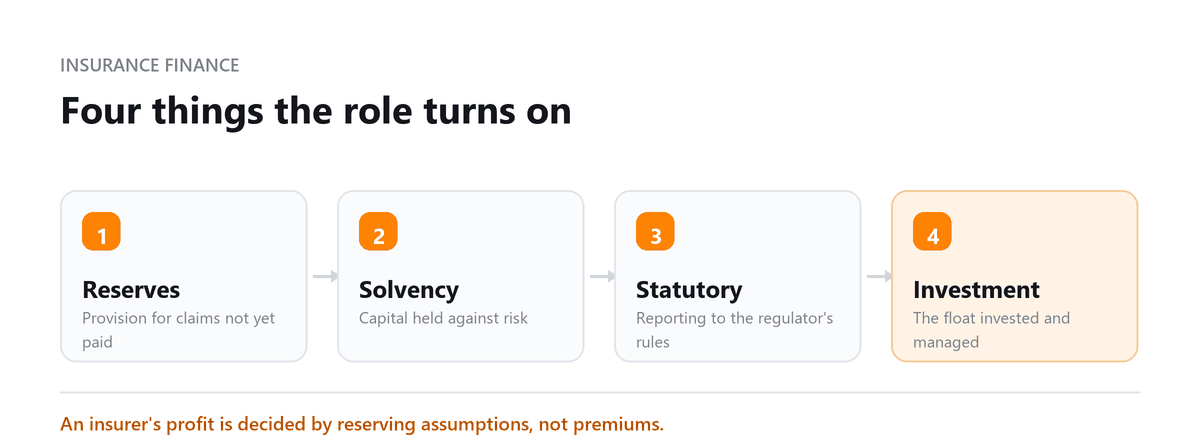
Setting loss reserves is probably the most important judgment an insurance CFO makes. Reserves are management's best estimate of what it will eventually pay on claims tied to policies already written.
Getting the number wrong hurts either way. Reserve too little and profits look inflated while solvency risk quietly builds. Reserve too much and earnings are understated for no good reason. The CFO works with the actuarial team to set and test reserve levels and then defends those estimates to the board, auditors, and regulators.
Regulatory Capital and Examinations
Insurers have to hold capital above risk-based capital (RBC) minimums that reflect the risks in their business. The CFO monitors RBC ratios on an ongoing basis and manages capital so the company stays comfortably above the thresholds that would trigger regulatory action.
State insurance department examinations, which typically happen every three to five years, are major events that the CFO prepares for well in advance. Carriers operating internationally may also face Solvency II requirements, which bring their own capital and reporting rules.
Investment Portfolio Management
Premiums collected before claims are paid get invested, and that portfolio is often a big part of how insurers make money. For life and annuity companies, it can be the main source of profit.
The CFO, often alongside a chief investment officer, sets investment policy. That policy covers liquidity for claims expected soon, matching the duration of investments to when claims are likely to be paid, credit quality limits to control default risk, and a return target that supports overall profitability.
Reinsurance Strategy and Accounting
Reinsurance is insurance that insurers buy for themselves. By passing part of their risk to reinsurers, carriers smooth out volatile results and protect their capital against large losses or catastrophes.
The CFO works with actuaries to decide how much risk to cede and in what structure. They also handle the accounting that comes with it, including ceded premiums, reinsurance receivables, and loss recoveries, and they keep an eye on the financial strength of reinsurance partners, since a recovery is only as good as the counterparty paying it.
Rating Agency Relationships
Ratings from AM Best, Moody's, and S&P directly affect an insurer's ability to win business, especially in commercial lines where buyers and brokers often have minimum rating requirements. The CFO leads those relationships, presenting capital strength, reserve positions, and strategy, and making sure major decisions are weighed for their potential rating impact.
Mergers and Acquisitions
Insurance deals come with their own due diligence. Actuarial review of the target's reserves matters as much as the financial statements. Deals need approval from state insurance departments, which adds time and complexity. And the target's reinsurance program has to be reviewed to see whether its risk protection actually holds up.
The CFO leads the financial side of acquisitions and then manages the integration of financial systems and reporting afterward.
Technology and Data
InsurTech is changing the economics of the business. Telematics data supports usage-based auto pricing, AI helps speed up claims handling and catch fraud, and digital distribution lowers the cost of acquiring customers.
The CFO evaluates the financial case for these investments, models the return on InsurTech partnerships, assesses cyber risk both as an exposure and as a product opportunity, and brings new data sources into financial reporting.
Authorities of a CFO in Insurance Companies
The insurance CFO holds signing authority on reinsurance contracts and investment transactions above defined thresholds. The CFO approves reserve methodologies in collaboration with the actuarial team. The role includes oversight of statutory financial statements filed with state regulators, documents that carry regulatory and legal weight beyond standard financial reporting. The CFO serves as the board finance committee and audit committee liaison, presenting financial results and capital adequacy to directors.
Conclusion
An insurance CFO operates at the convergence of two distinct accounting frameworks, complex actuarial judgments, and heavily regulated capital requirements. The role demands expertise that goes well beyond general financial leadership, it requires deep knowledge of statutory accounting, reserve methodology, investment portfolio management, and reinsurance structures. Organizations with strong insurance CFO leadership are better positioned to maintain regulatory standing, manage rating agency relationships, and execute M&A in a consolidating industry.
Profitjets provides CFO-level financial support to insurance businesses, including financial planning, risk-focused reporting, cash-flow management, and profitability analysis.
In insurance, I’ve found that financial leadership has to connect the numbers with the timing and risk behind them. In one engagement, we worked through cash-flow projections, claims-related obligations, operating costs, and profitability to give management a clearer picture of the business’s financial position. Bringing those numbers into a consistent forecasting and reporting process made it easier for the team to plan ahead rather than react to cash-flow pressure.
Book a free consultation and we will cover the accounting behind it.
Frequently Asked Questions
What is statutory accounting, and why do insurance CFOs use it?
Statutory Accounting Principles are the accounting rules set by state insurance regulators. They're more conservative than GAAP and focus on whether the insurer can pay its claims. Insurers file SAP statements with regulators and often prepare GAAP statements for investors and lenders too, and the CFO is responsible for both.
What is risk-based capital, and why does it matter?
Risk-based capital is a regulatory framework that sets minimum capital levels for insurers based on the risks in their business. If an insurer's RBC ratio drops below certain levels, regulators step in. The CFO tracks RBC continuously and manages capital to stay well above those levels.
What is the combined ratio in insurance?
It's the main efficiency measure for property and casualty insurers, calculated as losses plus loss adjustment expenses plus underwriting expenses, divided by net earned premiums. A result below 100% means the insurer makes a profit on underwriting. Above 100% means it's paying out more than it earns in premiums and relying on investment income to stay profitable.
How does an insurance CFO manage the investment portfolio?
Insurers invest the premiums they collect, the float, until claims are paid. The CFO sets investment policy with the investment team, balancing liquidity for upcoming claims, matching investment timing to expected claim payments, limiting credit risk, and targeting a return that supports profitability.
What is reinsurance, and how does it affect the CFO's work?
Reinsurance lets insurers pass part of their risk to other companies, which reduces volatility and protects capital. The CFO helps choose the reinsurance structure with the actuarial team, handles the accounting for ceded premiums, receivables, and recoveries, and monitors the financial strength of the reinsurers involved.

Written by
Abhinav Gupta, CPA, CA, MBA
Abhinav works with business owners across the US on industry-specific bookkeeping, from dental practices and restaurants to construction and e-commerce. He writes about what each trade's books actually need. Connect on LinkedIn
Free consultation
Need Insurance-Grade Reporting?
Book a free consultation and we will cover the accounting behind it.