
What is a CFO in Construction?
A construction CFO is a financial executive with expertise in project-based accounting which is a fundamentally different model from the period-based accounting used in most other industries.
Construction CFOs must master percentage-of-completion revenue recognition (or completed-contract methods), bonding and surety relationships that govern the contractor's ability to win public work, and the cyclical, weather-driven cash flow patterns that define construction economics.
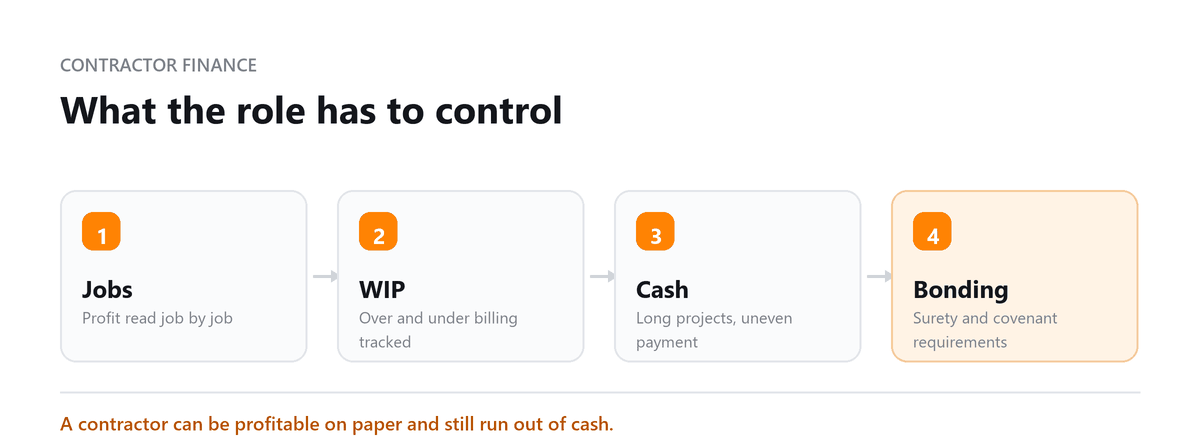
The construction industry is among the most financially complex for a CFO to navigate. Projects span months or years, costs are front-loaded, billing is slow, retainage is withheld, and the difference between a profitable backlog and a money-losing one can turn on a few cost-to-complete estimates.
The CFO is the financial architect who turns project-level data into organizational financial health.
Expert Perspective
The WIP schedule is the heartbeat of construction finance. If a construction CFO can't produce an accurate WIP schedule: showing over-billings, under-billings, and cost-to-complete by project as they can't manage cash flow, can't satisfy the surety, and can't give management an accurate picture of where the business actually stands.
Abhinav Gupta, CPA, CA, MBA · LinkedInThe Role of a CFO in a Construction Company
Project-Centric Financial Planning and Analysis
The work-in-progress (WIP) schedule is the most critical financial report in construction. It shows, for every open project: the contract value, costs incurred to date, estimated total costs, revenue recognized to date using percentage-of-completion, and the resulting overbilling or underbilling position.
Sureties and lenders require WIP schedules to evaluate a contractor's financial health. A CFO who produces an inaccurate WIP schedule loses credibility with the surety and, with it, the bonding capacity needed to win new work.
Construction FP&A works at the project level, not the company level. That's the core structural difference from corporate FP&A, and it shapes everything else below.
Job cost accounting. The CFO tracks every cost to its specific project: labor, materials, subcontractors, and equipment, rather than to the company as a whole.
Budget-to-actual by project. This is the early warning system. It flags a project trending toward a loss while there's still time to act, not after the fact.
Cost-to-complete forecasting. The judgment call that matters most here, and it cuts two ways:
- Underestimate remaining costs: inflates revenue recognition and creates real restatement risk
- Overestimate remaining costs: understates profitability the business actually earned
Risk Management and Mitigation
Construction contract risk is one of the CFO's most important responsibilities. Fixed-price contracts transfer cost risk to the contractor; cost-plus contracts transfer it to the owner; guaranteed maximum price (GMP) contracts create hybrid risk profiles.
The CFO reviews contract terms for risk allocation, liquidated damages provisions, differing site conditions clauses, escalation protections, and advises on pricing and bid strategy accordingly.
Subcontractor default risk is a constant threat in construction. The CFO monitors subcontractor financial health and ensures performance and payment bonds are in place on material subcontracts.
Bonding capacity management is ongoing: the CFO maintains the surety relationship through regular financial statements and WIP submission, ensuring the contractor's bonding limit supports the size of the work in the backlog.
Strategic Planning and Investment Decisions
Construction strategy involves capital-intensive decisions: equipment purchases versus rental, geographic market expansion, bid capacity relative to bonding limits, and joint venture structuring for large projects.
Capital-intensive calls the CFO models the financial implications of:
- Equipment purchase vs. rental: ROI analysis
- Geographic market expansion: expected returns
- Bid capacity relative to bonding limits
- Joint venture structuring: profit-sharing terms
Bid/no-bid analysis deserves its own mention. It's the CFO ensuring the company pursues work where it holds a genuine cost advantage, rather than filling the backlog with low-margin jobs just to stay busy.
Financial Reporting and Compliance
Three recurring obligations:
- Revenue recognition under ASC 606. Percentage-of-completion, calculated from cost incurred relative to total estimated cost. The CFO owns making sure the underlying cost-to-complete estimate is genuinely well-supported.
- Monthly WIP schedule preparation for surety and lender review, on a fixed cadence.
- AIA billing documentation: pay applications, stored materials schedules, lien waivers. Errors here directly delay contractor payment.
Technology Adoption and Digital Transformation
Construction ERP selection is a significant CFO decision platforms like Viewpoint Vista, Sage 300 CRE, and Foundation Software are designed specifically for construction accounting and include job cost, WIP, and payroll modules that general-purpose ERP systems lack.
Integration with project management systems:Procore, Autodesk Construction Cloud that allows field cost data to flow into financial reporting in near real-time, reducing the lag that historically made construction financial management reactive rather than proactive.
Sustainability and Green Building Initiatives
LEED certification and sustainability requirements are increasingly present in institutional construction contracts. The CFO analyzes the cost premium of green building practices against contract incentives and long-term client demand.
ESG reporting requirements from institutional project owners and green bond financing for sustainable infrastructure projects are creating new financial management demands that progressive construction CFOs are building capabilities to address.
The Rise of Fractional CFOs in Construction
Smaller contractors those with $5 million to $50 million in annual revenue increasingly use fractional CFO services for the specific functions where the CFO adds most value: WIP reporting accuracy, surety financial package preparation, bank relationship management, and job cost system optimization.
A fractional CFO delivers these capabilities at a fraction of the full-time executive cost, making sophisticated financial management accessible to mid-market contractors who cannot justify a full-time hire.
The Evolving Landscape of the Construction CFO
The construction CFO role is evolving under several simultaneous pressures.
Public infrastructure investment: roads, bridges, transit, broadband, is driving increased project volume, but also increased complexity in public procurement and prevailing wage compliance.
Labor cost inflation, particularly for skilled trades, requires tighter job cost controls and more sophisticated workforce planning.
Supply chain volatility: material cost spikes and lead time uncertainty is making cost-to-complete estimation more difficult and contract risk management more important.
Private equity consolidation of mid-market contractors is driving demand for CFOs who can produce the financial reporting and analytical depth that institutional investors require.
Where the Role Is Heading
Four pressures are reshaping this job at once:
| Pressure | Effect on the CFO |
|---|---|
| Public infrastructure investment | More project volume, more procurement and prevailing-wage complexity |
| Skilled trades labor inflation | Tighter job cost controls, more sophisticated workforce planning |
| Supply chain volatility | Harder cost-to-complete estimation, higher-stakes contract risk management |
| PE consolidation of mid-market contractors | Rising bar for the reporting depth institutional investors expect |
The construction CFO occupies a uniquely challenging position: managing financial risk on a portfolio of projects, each a temporary business with its own cost structure, contract risk, and cash flow profile.
The skills required are WIP accounting, surety relationship management, percentage-of-completion revenue recognition, and job cost analysis are specific to the industry and take years to develop.
Organizations that invest in experienced construction CFO leadership are better positioned to grow backlog, protect margins, and satisfy the financial stakeholders: sureties, banks, and owners whose support is essential to sustainable growth.
Profitjets provides CFO-level financial support to construction businesses, with a focus on project profitability, cash-flow planning, budgeting, cost control, and financial reporting.
In construction, I’ve found that financial reporting needs to go beyond the overall P&L. Project-level costs, billing schedules, cash requirements, and changes in margins can tell a very different story, so I focus on connecting those numbers to each project and giving management a clear view of where profitability and cash flow are heading.
Surety bonds,bid bonds, performance bonds, payment bonds are required on most public construction projects. A surety company evaluates the contractor's financial strength: working capital, equity, bonding history, and WIP to set a bonding limit.
The CFO manages the surety relationship by providing regular financial statements and WIP schedules, and by structuring the balance sheet to maximize bonding capacity.
Construction projects are typically front-loaded with costs (mobilization, materials, labor) before revenue is collected. Payment cycles are slow: AIA billing, surety approvals, retainage holdbacks (often 5 to 10 percent of contract value).
A construction CFO actively manages billing timing, retainage release strategy, and lines of credit to smooth these cash flow gaps.
General contractors with over $50 million in annual revenue, significant bonding requirements, multiple active projects, or private equity backing typically need a full-time CFO.
Smaller contractors ($5M to $50M) often benefit from fractional CFO services particularly for surety support, bank reporting, and WIP schedule management at a fraction of the full-time cost.
Book a free consultation and we will get job-level reporting in place.
Frequently Asked Questions
What is a WIP schedule in construction accounting?
A Work-In-Progress (WIP) schedule is a financial report showing the status of all open construction projects including the contract value, costs incurred to date, estimated costs to complete, revenue recognized to date and the resulting over-billing or under-billing position. Sureties and lenders require WIP schedules to evaluate a contractor's financial health.
What is percentage-of-completion accounting and how does it affect the CFO?
Under ASC 606, most construction companies recognize revenue as work is performed rather than when a project is complete. The percentage-of-completion method calculates revenue as: (costs incurred to date / total estimated costs) x total contract value. The CFO must ensure cost-to-complete estimates are accurate underestimating costs inflates revenue recognition and creates financial restatement risk.
How does bonding capacity affect a construction CFO's work?
Why is cash flow management especially challenging in construction?
When does a construction company need a full-time CFO vs. a fractional CFO?

Written by
Abhinav Gupta, CPA, CA, MBA
Abhinav works with business owners across the US on industry-specific bookkeeping, from dental practices and restaurants to construction and e-commerce. He writes about what each trade's books actually need. Connect on LinkedIn
Free consultation
Running Construction Projects?
Book a free consultation and we will get job-level reporting in place.