

Many real estate operators find themselves managing a portfolio of 5-10 properties with a bookkeeper, a separate outside accountant, and a myriad of Excel spreadsheets. This is often the point in a business’s growth when one realizes the need for a CFO.
A real estate CFO does not simply perform the same responsibilities as a senior bookkeeper, but at a higher pay grade.
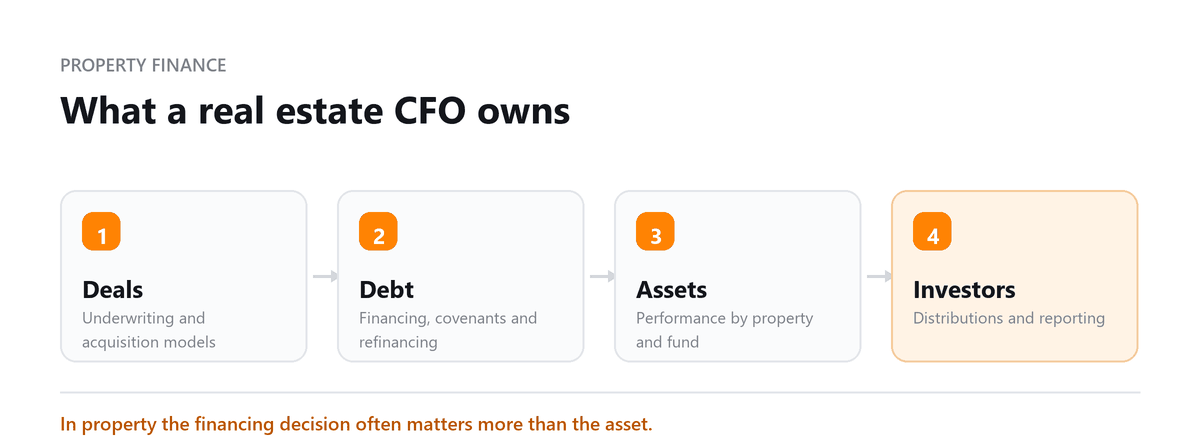
The responsibilities of a CFO-level executive are unique to the real estate industry and pertain specifically to real estate asset financing and capital structure decisions, including financing of each individual asset as well as the portfolio as a whole, covenant management in a changing interest rate environment, and providing the rationale behind a given set of assets to buyers and lenders.
The importance of these functions to a real estate operator is difficult to overestimate due to the high levels of leverage typical for real estate businesses of any size. A single error in financing (e.g., covenant breach) or purchase price financing (e.g., inaccurate DSCR calculation) can wipe out years of value creation by a business owning a single asset.
This guide covers what a real estate CFO does, the authority the role typically holds, how the job is changing, and what a strong real estate finance team looks like.
Who is a CFO in Real Estate?
A CFO in a real estate organization is a senior finance executive responsible for capital structure, asset financing strategy, investor reporting, REIT compliance where applicable, and portfolio-level profit and loss management. This is a fundamentally different role from a real estate bookkeeper or accountant: the real estate CFO operates at the executive level, making decisions about how assets are financed, how capital is allocated across the portfolio, and how the company's financial story is communicated to investors and lenders.
Real estate CFOs work in a world where assets don't get priced by the market every day like public stocks do. NAV, cap rate assumptions, and fair value estimates all come down to judgment, and the CFO is the one defending those judgments in front of investors. That's a different kind of accountability from what most corporate CFOs carry.
Abhinav Gupta, CPA, CA, MBA · LinkedInRole of a CFO in Real Estate Companies
Financial Planning and Analysis
The real estate CFO tracks profit and loss by asset class, whether that's office, industrial, multifamily, or retail, and builds net operating income (NOI) models for each property and for the portfolio as a whole.
Debt service coverage ratio (DSCR) is a big part of this. The CFO watches covenant compliance on every leveraged property so that a softening tenant base doesn't turn into a lender problem. Capital expenditure planning also sits here, including decisions on major renovations and repositioning a property for a different market.
Capital Markets and Financing
Raising and managing debt is one of the defining parts of the job. The CFO structures and negotiates construction loans, permanent mortgages, and mezzanine financing, and keeps relationships with lenders, rating agencies, and other capital partners in good shape over time.
In fund structures, the CFO also leads equity raises and handles REIT distributions in line with regulatory requirements.
Investor and Board Reporting
Real estate investor reporting has its own language. The CFO prepares quarterly investor letters, fund-level financial statements on both a GAAP and tax basis, net asset value (NAV) reports, and distribution calculations for REITs and funds.
One recurring challenge is explaining the gap between GAAP income and how the properties are actually performing. Depreciation and other non-cash items can make a profitable portfolio look weak on paper, and the CFO has to bridge that for investors.
Risk Management and Compliance
A real estate CFO manages several kinds of risk at once. There's interest rate risk on variable-rate debt, often hedged with swaps or caps. There's market risk across property types and locations, and tenant credit risk across the rent roll.
For REITs, there's ongoing compliance testing covering asset tests, income tests, and distribution requirements. Publicly traded REITs add SOX compliance and SEC reporting on top of that.
Mergers, Acquisitions, and Dispositions
On acquisitions, the CFO leads financial due diligence. That means going through the rent roll, operating expense history, lease terms, existing debt, and any environmental liabilities attached to the property.
The CFO's main deliverable in a deal is the acquisition pro forma: projected NOI, cash-on-cash return, and IRR under different exit cap rates. They also structure the financing for the purchase and lead tax planning when properties are sold, including 1031 exchanges.
Authority of a CFO in Real Estate Companies
Because so much capital and risk flows through the finance function, the real estate CFO usually holds specific decision-making authority. That typically includes signing authority on financing agreements and refinancings, approval of capital expenditures above a set threshold, and control over accounting policies, reporting standards, and the audit.
The CFO also oversees external auditors, tax advisors, and legal counsel on financial matters, and runs treasury operations, including cash management, lender compliance reporting, and reserve accounts.
Authorities of a CFO in Real Estate Companies
The real estate CFO typically holds specific decision-making authorities that reflect the financial complexity and risk of the business. These include: signing authority on financing agreements and refinancing transactions; capital expenditure approval authority above a defined threshold; authority over accounting policies, financial reporting standards, and audit management; oversight of external auditors, tax advisors, and legal counsel on financial matters; and oversight of treasury operations including cash management, lender compliance reporting, and reserve account management.
The Evolving Landscape of the Real Estate CFO Role
The real estate CFO role is evolving along several dimensions. PropTech adoption is expanding: real estate CFOs now oversee technology-driven asset management systems, data analytics platforms for portfolio optimization, and automated lease abstraction tools. Sustainability and ESG reporting is emerging as a core CFO function, with institutional investors demanding portfolio-level carbon footprint reporting and alignment with frameworks like GRESB. Rising interest rates have elevated DSCR management from a routine covenant check to a daily risk management priority across leveraged portfolios.
And the fractional CFO model is increasingly viable for smaller real estate funds and operators who need senior financial expertise without the overhead of a full-time executive hire.
Building a Strong Real Estate Finance Team
A capable real estate CFO builds a team with specific skills. That usually includes asset management analysts who track property performance and NOI variances, fund accountants who handle GAAP and tax-basis reporting, investor relations staff who manage LP communications and data requests, and tax advisors who know real estate taxation well, including depreciation, 1031 exchanges, and REIT elections.
For senior hires across the team, real estate-specific accounting experience matters a lot, particularly around acquisition accounting, depreciation, and lease accounting under ASC 842. REIT experience is a strong plus.
How Profitjets Helps Real Estate CFO Functions
Profitjets provides CFO-level financial support to real estate operators, developers, and fund managers. Our services include portfolio-level financial modelling, investor reporting packages, NOI analysis, DSCR monitoring, and acquisition due diligence support, delivered by professionals with direct real estate finance experience.
In real estate, I’ve found that a strong P&L alone doesn't give owners enough visibility. In one engagement, we worked through property-level cash flow, debt obligations, and DSCR to understand how upcoming payments would affect liquidity. Once those numbers were brought into the regular reporting process, management had a much clearer view of which properties were generating enough cash to support their debt and where action was needed.
Book a free consultation and we will bring CFO-level reporting to it.
Frequently Asked Questions
How is a real estate CFO different from a general CFO?
A real estate CFO specializes in asset-based finance. That includes capital structures built around property collateral, valuing properties using NOI and cap rates, managing debt service coverage, depreciation schedules, 1031 exchange planning, and REIT compliance where it applies. Most corporate CFOs don't build these skills unless they've spent time in real estate.
What is NOI and why does it matter so much to a real estate CFO?
Net operating income is rental income minus vacancy losses and operating expenses, before debt service and depreciation. It's the clearest measure of how much cash a property produces, and it drives valuation through the cap rate formula: value equals NOI divided by the cap rate. The CFO tracks and works to improve NOI across the whole portfolio.
Does a REIT need a full-time CFO?
A publicly traded REIT does. It has to file with the SEC, meet strict reporting standards, pass REIT qualification tests, and comply with SOX, all of which call for a full-time CFO with public company and REIT experience. Private real estate funds have more flexibility and often use fractional or outsourced CFO services.
What is DSCR and why does the CFO manage it?
Debt service coverage ratio compares a property's NOI to its total debt payments, principal plus interest. Most lenders want to see at least 1.20x to 1.25x. The CFO keeps an eye on DSCR across every financed property to stay within loan covenants and to spot any property that's drifting toward a breach before the lender does.
What role does a real estate CFO play in acquisitions?
The CFO leads the financial due diligence, reviewing the rent roll, expense history, lease terms, and existing debt. They build the pro forma with projected NOI, cash-on-cash return, and IRR, structure the financing, and plan for what happens after closing. They're usually one of the key voices in deciding whether a deal goes ahead.

Written by
Abhinav Gupta, CPA, CA, MBA
Abhinav works with business owners across the US on industry-specific bookkeeping, from dental practices and restaurants to construction and e-commerce. He writes about what each trade's books actually need. Connect on LinkedIn
Free consultation
Running a Property Portfolio?
Book a free consultation and we will bring CFO-level reporting to it.