
The owner spends a weekend in January, making a detailed Excel sheet, convincing himself that he finally has a good plan, and promptly forgets about it by March. He checks his bank account to see how much money is available, decides if an upcoming purchase is reasonable, and crosses his fingers that everything else will work out for the rest of the year.
The issue is not that the owner is not disciplined; the budget was created in a manner that made it useless to him.
The revenue was probably guessed at, rather than based on realistic projections, costs were copied from the previous year, without considering changes, and major purchases were not even considered, so the first equipment repair completely dismantled beliefs about accurate budgeting.
A good budget should become a standard for comparison and be used as a tool for evaluating the performance of each purchase and the overall performance of the business at the end of the year. Here are seven steps to creating a realistic and flexible budget that actually works as a planning tool for the entire year.
Expert Perspective
The number you most need to get right is revenue, because everything else in the budget hangs off it. Variable costs are calculated from it, hiring plans depend on it. If revenue is forecast 20 percent too high, the whole plan is wrong in the same direction, and the business spends money it was never going to earn. That's why I always build revenue from the ground up, one segment at a time, rather than starting with a target and working backwards.
Ankit Sagatani, MBA, B.Com · LinkedInThis guide walks through the three parts of budget planning and the seven steps to build a budget that holds up once the year begins.
The Budget Planning of a Business
A business budget is a forward-looking financial plan that estimates revenue and maps planned spending, built before the period begins so every actual result can be compared against a benchmark. Budget planning for a business involves three distinct activities: building the budget (once per year), monitoring against actuals (monthly), and updating the forecast (quarterly). All three are necessary for the budget to have value.
Seven Steps to Create the Best Business Budget
Step 1: Define the Budget Period
Most small businesses budget on a 12-month annual basis, broken into 12 monthly periods. Some also build a rolling 13-week cash flow budget for short-term liquidity management. Define your period first the rest of the budget structure follows from this.
Step 2: Gather and Review Historical Data
Pull the last 12-24 months of profit and loss statements from your accounting software. Identify the trend: which revenue lines are growing, which costs are rising faster than revenue, which months are seasonally high or low. This historical pattern is the foundation of your forward projections.
Step 3: Forecast Revenue by Segment
Break revenue into its component parts: product lines, service types, customer segments, or sales channels. Project each segment separately based on historical growth rates, pipeline, and any known changes (new product launches, lost customers, price increases). Sum the segments for total revenue. Do not start with a total and work backwards.
Across Profitjets construction accounting engagements, approximately 40% of clients have identified a material discrepancy between their recorded job costs and WIP reports during the initial review. On average, correcting job-cost classifications and WIP tracking has improved month-end close time by 25%, giving management a clearer view of project profitability and cash requirements.
Step 4: List Fixed Costs
Fixed costs are your floor, what the business spends regardless of how much it sells. List every recurring fixed commitment: rent, insurance, loan payments, minimum salaries, software subscriptions. These are non-negotiable in the short term and define the minimum revenue required to break even.
Step 5: Estimate Variable Costs
Variable costs scale with revenue. Calculate them as a % of projected revenue based on historical data. If COGS has averaged 38% of revenue over the past 2 years, use 38% as the base, then adjust if you have specific information suggesting the ratio will change (new suppliers, efficiency improvements, price changes).
Step 6: Plan for One-Off and Capital Expenses
Capital expenses, equipment, vehicles, major improvements, are not captured in a standard P&L budget but must be planned for cash flow purposes. Create a separate capital expenditure (CapEx) plan alongside the operating budget. One-off items (a planned move, a marketing campaign, a system implementation) should be explicitly budgeted in the month they are expected to occur.
Step 7: Calculate and Review the Projected Net Profit
Revenue - Fixed costs - Variable costs - One-off items - Debt service - Owner's draw = Projected net profit. If the result is negative, revisit assumptions: is the revenue forecast realistic? Can any fixed costs be reduced? Is the owner's draw sustainable given the projected profit? Build at least three scenarios, conservative, base, and optimistic, so you understand the range of outcomes before the year begins.
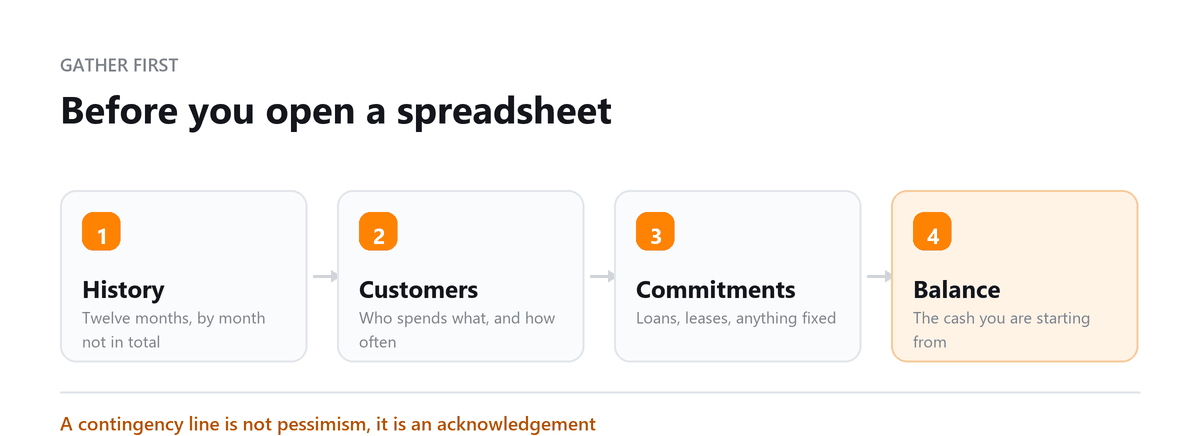
Gather This Before You Start
Most of the frustration in building a first budget comes from starting before the information is assembled, then estimating what should have been looked up.
- Twelve months of actual figures, by month rather than in total
- Your current customer list with what each typically spends and how often
- Every recurring cost, including annual ones that do not appear monthly
- Current headcount and pay, plus anything already committed
- Loan schedules, lease commitments and anything else contractually fixed
- The bank balance you are starting from
That last item is the one people skip, and it converts the exercise from a profit projection into something that tells you whether the plan is affordable.
Where First Budgets Go Wrong
The errors are consistent enough to check against, and all of them make the budget more optimistic than it should be.
Revenue assumed to arrive evenly when the business has a seasonal pattern. Costs that scale with activity budgeted as though they were fixed. Annual costs forgotten because they did not appear in the month being used as a template. A new hire budgeted at salary rather than at fully loaded cost. And no allowance at all for the things that always happen and cannot be predicted individually.
Building in a contingency line is not pessimism. It is the acknowledgement that something unbudgeted will occur, which it does every year without fail.
Who Should See It
A budget kept by one person in one spreadsheet influences very little. A budget people know about changes decisions.
The parts that matter can be shared without disclosing everything. A manager who knows the figure for their own area will make different choices from one who does not, and the conversation about why a number is what it is often improves the number.
It is also worth having outside the business. A lender or an investor reading a budget alongside a track record of hitting previous ones takes the business considerably more seriously than one presenting a projection for the first time with nothing behind it.
Book a free consultation and we will work through it together.
Frequently Asked Questions
What is the most common budgeting mistake small businesses make?
Forecasting revenue too optimistically while underestimating costs, especially variable costs that grow faster than expected as sales increase. Build your budget around conservative revenue assumptions and realistic costs, then compare it to actual results every month so you can adjust early.
Do I need accounting software to create a business budget?
No. A well-structured spreadsheet can work perfectly well for building a budget. Accounting software like QuickBooks Online or Xero makes the monthly comparison much easier, though, because actual figures come straight from your books instead of being pieced together by hand from bank statements.
How far ahead should a small business budget?
Twelve months is standard, broken into monthly periods and aligned with your fiscal year. Many businesses add a rolling 13-week cash flow forecast for short-term planning. If you're planning a major investment or loan, a longer three-year projection can also be useful, though it'll be less detailed.
Should owner's draws be included in the budget?
Yes, but not as a business expense. Draws don't reduce profit on the P&L, but they do take cash out of the business. Include them in your cash plan so you can confirm the business can support what you're planning to take out.
What should I do if my budget shows a loss?
Treat it as an early warning rather than a failure. Recheck your revenue assumptions, look for fixed costs that can be reduced or delayed, and review whether planned one-off spending can be phased. If the loss is intentional, such as investing ahead of growth, make sure you have enough cash or financing to cover it.

Written by
Ankit Sagatani, MBA, B.Com
Ankit works with business owners across the US on industry-specific bookkeeping, from real estate to construction and retail. He writes about what each trade's books actually need. Connect on LinkedIn Connect on LinkedIn
Free consultation
Building Your First Budget?
Book a free consultation and we will work through it together.