
The small business owners get their profit and loss statements annually, which usually appear on the tax day, from their accountants. They quickly scan the final number, rejoice or moan in frustration, stuff it in a drawer, and move on.
The P&L statement is a tax document, a grade on the business performance, a once-a-year snapshot of the business that only comes due when it is too late to actually do anything about the results.
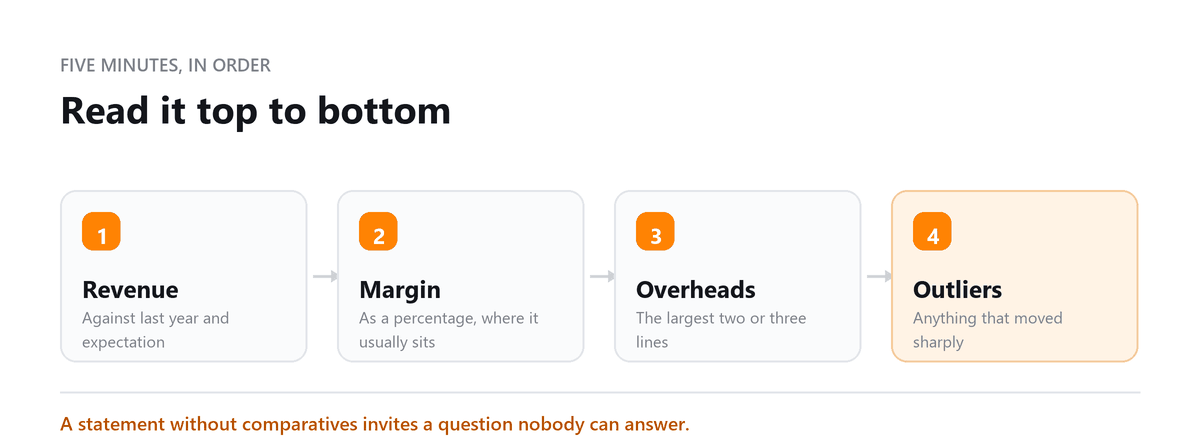
This is why a P&L that gets reviewed once a year is actually an almost useless document; a P&L that gets monthly reviewed is one of the most powerful tools that a manager can have at his disposal.
It tells him if his prices are actually covering his costs, which expenditures are out of control, and if he is actually making money. It will not tell him everything, because it does not make a distinction between cash and credit purchases or sales and receivables, but it will answer the most basic question that any businessman should ask himself: Are we making money?
A profit and loss statement (also income statement) is a summary of revenues, costs, and profits over a given period of time. This guide will explain each item on the statement, walk through an example, and show you how to read one.
What Does a P&L Statement Show?
The P&L answers one question: did the business make money during this period? It covers a specific time range: a month, quarter, or financial year. Unlike the balance sheet (a point-in-time snapshot), the P&L is a period report, it flows from revenue at the top to net income at the bottom.
A profit and loss (P&L) statement is the starting point for understanding profitability, managing costs, and making informed decisions about pricing, hiring, and growth. This guide explains every line of the P&L and what each number tells you.
The Structure of a P&L Statement
| Section | What It Shows | Example Lines |
|---|---|---|
| Revenue | Total sales before any deductions | Product sales, service fees, subscription revenue |
| Cost of Goods Sold (COGS) | Direct costs of producing goods or delivering services | Raw materials, direct labour, packaging, delivery |
| Gross Profit | Revenue minus COGS, what remains to cover overheads | Gross Profit = Revenue − COGS |
| Operating Expenses | Overhead costs of running the business (not tied to specific units sold) | Staff salaries, rent, utilities, marketing, software, depreciation |
| Operating Profit (EBIT) | Gross Profit minus Operating Expenses | Core business earnings before interest and tax |
| Interest Expense | Cost of borrowing, loan interest, finance charges | Bank loan interest, overdraft fees |
| Income Tax Expense | Tax on taxable profit for the period | Corporate tax, income tax |
| Net Profit / Net Loss | The bottom line, what the business kept (or lost) | Positive = profit; Negative = loss |
For a sole proprietorship, partnership, LLC, or S corporation, there's usually no income tax line. Profit passes through to the owners' personal tax returns, so the business's net profit would be $50,000 and the owners would pay income tax on it personally.
What Each Section Tells You
- Gross profit: whether your prices cover the direct cost of what you sell, and by how much. A falling gross margin usually means costs are rising faster than prices, or discounts are growing.
- Operating expenses: whether overhead is under control. Watch each major category as a percentage of revenue. If overhead grows faster than sales, margins shrink.
- Operating profit: whether the core business makes money before financing and taxes. This is the clearest test of whether the business model works.
- Net profit: what the business earned after all costs. It's profit, not cash, so it doesn't show whether that money is in the bank.
Sample P&L Statement
| Line Item | Amount |
|---|---|
| Revenue | $250,000 |
| Cost of Goods Sold | ($90,000) |
| GROSS PROFIT | $160,000 (64% gross margin) |
| Staff Salaries (non-production) | ($65,000) |
| Rent and Utilities | ($18,000) |
| Marketing | ($12,000) |
| Software and Subscriptions | ($5,000) |
| Depreciation | ($4,000) |
| Total Operating Expenses | ($104,000) |
| OPERATING PROFIT | $56,000 (22.4% operating margin) |
| Interest Expense | ($6,000) |
| Income Tax Expense | ($12,500) |
| NET PROFIT | $37,500 (15% net margin) |
What Each Section Tells a Small Business Owner
- Gross Profit: Is your pricing covering your direct costs, and by how much? A shrinking gross margin over time = input costs rising or prices not keeping up
- Operating Expenses: Are your overheads under control? Compare operating expenses as a % of revenue over time. If they grow faster than revenue, margins compress
- Operating Profit: Is the core business profitable before financing decisions? This is the number that shows whether the business model works
- Net Profit: After paying the bank and the tax authority, how much did the business actually keep?
This is why a sole proprietor's P&L can show $120,000 of profit when the owner only took home $60,000. The rest may still be in the business, or it may have gone to loan repayments, equipment, or taxes. It also means comparing the net profit of a sole proprietorship with that of an S corporation can be misleading unless owner pay is accounted for.
The P&L line owners ignore most is gross profit. They look at revenue, then jump straight to net profit, and skip the line that tells them whether the business model works. If gross margin is slipping, every other problem on the P&L gets harder, because there's less money left to cover rent, salaries, and the owner's pay.
I ask every new client the same question: what was your gross margin last year, and what is it now? Most don't know. The ones who track it monthly tend to catch pricing and cost problems a year earlier than everyone else.
Abhinav Gupta, CPA, CA, MBA · LinkedInHow Often Should You Review Your P&L?
| Frequency | What to Look For |
|---|---|
| Monthly | Revenue vs prior month and prior year (YoY); gross margin trend; any sudden cost spikes |
| Quarterly | Operating margin trend; cost category benchmarking; comparison to budget |
| Annually | Full-year profitability; tax position; retained earnings; year-over-year comparison |
CLIENT QUOTE:
I had always judged the business by how much money was in the bank, so I didn't really know what our monthly P&L was telling us. Our first proper review with Profitjets showed that contractor and software costs had grown much faster than revenue, even though the bank balance still looked healthy. We used that information to renegotiate a few contracts, reduce unnecessary subscriptions, and set a more realistic hiring budget.
Book a free consultation and we will get you a monthly one.
FAQs
What's the difference between a P&L and a balance sheet?
The P&L covers a period of time and shows revenue, costs, and profit. The balance sheet shows what the business owns, owes, and the owners' stake on a single date. Net profit from the P&L flows into equity on the balance sheet, which is how the two statements connect.
How do I read a P&L if my business is losing money?
Start with gross profit. If gross profit is healthy but the business still loses money, the problem is overhead, financing costs, or both. If gross profit is low or negative, the problem is in pricing or direct costs, meaning the business isn't earning enough on each sale. Each diagnosis calls for a different fix.
Why is my P&L profit different from the cash in my bank account?
The P&L records revenue when earned and expenses when incurred, not when cash moves. Unpaid invoices, inventory purchases, loan principal repayments, equipment purchases, and owner draws all affect cash without matching changes in profit. The balance sheet and cash flow statement explain the difference.
Is a P&L the same as an income statement?
Yes. Profit and loss statement, P&L, income statement, and statement of operations all describe the same report. Small businesses tend to say P&L, while larger companies and formal financial statements usually say income statement.
Should my P&L be on a cash or accrual basis?
For managing the business, accrual gives a more accurate picture, because it matches revenue with the costs of earning it in the same period. Many small businesses file taxes on a cash basis but review an accrual P&L for decisions. Most accounting software can produce both from the same records.

Written by
Abhinav Gupta, CPA, CA, MBA
Abhinav works with business owners across the US on industry-specific bookkeeping, from dental practices and restaurants to construction and e-commerce. He writes about what each trade's books actually need. Connect on LinkedIn
Free consultation
Only See a P&L at Year End?
Book a free consultation and we will get you a monthly one.