
The word accountant covers a range of services a business buys at different stages, and most owners buy them in roughly the same order without ever being shown the map.
Knowing the map matters because the services differ in what they require, what they cost and who can perform them, and because buying the wrong one is how businesses end up paying senior rates for data entry.
This covers each service in turn, what it involves, what it is for, and how to work out which ones your business actually needs right now.
The accounting and CPA world covers a wide range of services, and you probably don't need all of them, especially early on. This guide breaks down each service type, when you need it, and whether to handle it in-house or outsource.
1. Basic Bookkeeping
Recording day-to-day transactions: income, expenses, bank reconciliations. The foundation of all financial reporting.
- Who needs it: every business with more than a handful of transactions per month
- Who provides it: bookkeepers, accounting clerks, virtual bookkeeping firms
- In-house or outsource: outsource unless you have a high-volume operation that warrants an in-house hire
- Typical cost: $200-$1,500/month outsourced
One firm is simpler and usually cheaper, because the same people already hold the context. The argument for splitting is independence: the firm that prepares your numbers is not ideally placed to give an opinion on them, and at the point somebody external needs assurance, that work sits elsewhere.
Abhinav Gupta, CPA, CA, MBA · LinkedIn2. Write-Up Services
Summarizing financial activity into monthly or quarterly reports. Common for businesses that send raw data to a CPA firm to organize.
- CPA firm takes your bank statements and receipts and produces financial statements
- More manual than automated bookkeeping, usually more expensive per hour
- Being replaced by cloud accounting and bank feeds in most modern practices
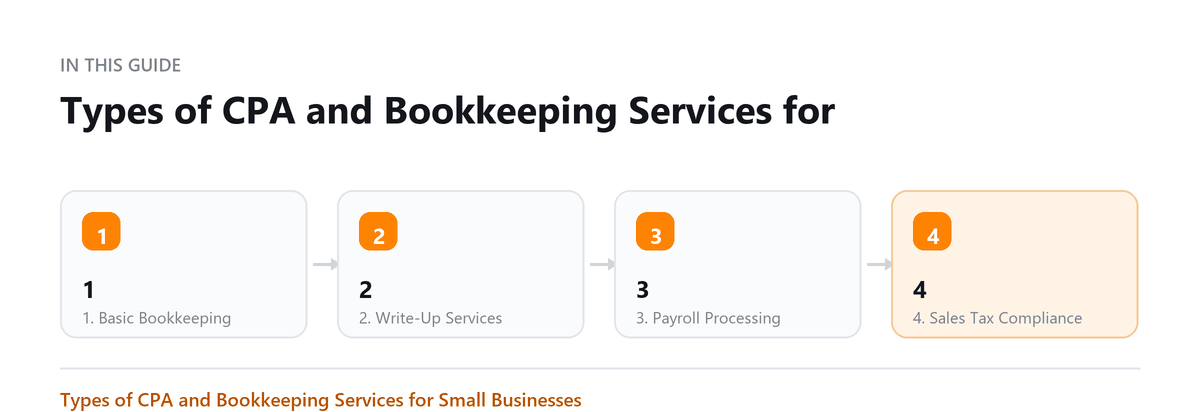
3. Payroll Processing
Running payroll, calculating withholdings, filing payroll taxes, and issuing W-2s.
- Options: do it yourself (QBO Payroll, Gusto), use a payroll service (ADP, Paychex), or include with your bookkeeper
- Payroll taxes are a high-risk area, penalties for late deposits are steep
- Employer tax filing (941, 940, state) must be on-time even for small employers
- Typical cost: $50-$200/month for 1-5 employees through a payroll service
4. Sales Tax Compliance
Calculating, collecting, and remitting sales tax to multiple states, a growing burden since economic nexus rules expanded post-Wayfair.
- Required once you cross nexus thresholds (typically $100,000 or 200 transactions in a state)
- Tools: TaxJar, Avalara automate calculation and filing
- CPA or sales tax specialist can handle registration and audit defense
- Penalties for non-collection can be retroactive and significant
5. Tax Preparation
Preparing and filing federal and state income tax returns.
- Who needs a CPA: businesses with any complexity, S-corps, partnerships, multi-state, inventory
- Who can use software: W-2 employees with simple returns
- Best practice: use the same firm for bookkeeping and tax, they know your numbers
- Cost: $400-$5,000+ depending on entity type and complexity
6. Tax Planning
Proactive strategies to reduce your tax liability legally, before year-end, not after.
- Retirement contribution maximization (Solo 401k, SEP-IRA, defined benefit)
- Section 179 / bonus depreciation for equipment purchases
- S-corp reasonable salary optimization to reduce self-employment tax
- Timing of income and deductions across tax years
- Hiring family members, home office, vehicle deductions
Pro Tip: Tax planning is where a CPA pays for themselves. A CPA who only files returns but never plans is leaving money on the table.
7. Fractional CFO Services
Part-time CFO-level strategic finance support, cash flow forecasting, fundraising prep, board reporting, financial modeling.
- Who needs it: growing businesses ($1M-$20M revenue) that need CFO-level thinking without a full-time hire
- Cost: $2,000-$10,000/month depending on scope and hours
- Profitjets offers fractional CFO alongside bookkeeping and tax
8. Audit / Attest Services
Audits, reviews, and compilations of financial statements, typically required by lenders, investors, or grant programs.
- Compilation: CPA presents financials without verifying, basic credibility
- Review: limited assurance, CPA inquires and analyzes but doesn't audit
- Audit: highest assurance, CPA independently verifies all material balances
- Only licensed CPAs can provide attest services
| Service Level | When Required |
|---|---|
| Compilation | Many bank loans, informal investor requests |
| Review | Some SBA loans, smaller private placements |
| Audit | SEC reporting, large loan covenants, government grants |
9. Business Advisory
Strategic guidance on business structure, exit planning, M&A, succession, and insurance, beyond pure accounting.
- Entity structure: LLC vs. S-corp vs. C-corp for your situation
- Exit planning: tax-efficient business sale structure
- Succession planning: family business transition
- KPI design: which financial metrics to track for your business model
Which Services Do You Need, And When?
| Business Stage | Recommended Services |
|---|---|
| Freelancer / pre-revenue | Basic bookkeeping (DIY or software only) |
| $0-$250K revenue | Bookkeeping + tax preparation |
| $250K-$1M revenue | Bookkeeping + payroll + tax prep + planning |
| $1M-$5M revenue | All of above + fractional CFO + sales tax compliance |
| $5M+ revenue | Full outsourced accounting team or in-house controller |
Book a free consultation and we will bring them current.
Frequently Asked Questions
What's the difference between a bookkeeper and a CPA?
A bookkeeper records and organizes financial transactions. A CPA (Certified Public Accountant) is a licensed professional who can prepare taxes, give financial advice, perform audits, and represent you before the IRS. You often need both.
Do I need a CPA if I use QuickBooks?
QuickBooks is a tool for recording transactions, not a replacement for professional judgment. You still need a CPA for tax filing, planning, and interpreting what your financials mean for your business.
When should I hire a fractional CFO?
When you're making decisions that require financial modeling, fundraising, acquisitions, pricing strategy, or managing cash flow through rapid growth. Typically relevant from $500K revenue upward.
Can one firm handle all my accounting and tax needs?
Yes, many full-service firms (like Profitjets) provide bookkeeping, payroll, tax prep, tax planning, and fractional CFO services. The advantage is a unified view of your finances and one point of contact.
Is it better to buy these from one firm or several?
One firm is simpler and usually cheaper, because the same people already hold the context and the work does not have to be handed over. The argument for splitting is independence: the firm that prepares your numbers is not ideally placed to give an opinion on them, and at the point where somebody external needs assurance over the accounts, that work generally has to sit elsewhere. Below that threshold, consolidating is the practical answer.

Written by
Abhinav Gupta, CPA, CA, MBA
Abhinav works with business owners across the US on industry-specific bookkeeping, from dental practices and restaurants to construction and e-commerce. He writes about what each trade's books actually need. Connect on LinkedIn
Free consultation
Books Behind?
Book a free consultation and we will bring them current.