
Form 1099 is a set of tax forms needed by businesses to report payments to outside contractors or payees. Corporations are required to file Form 1099-NEC for each independent contractor paid more than 600 USD per annum. Understanding the details about completing the form will allow firms to remain tax-compliant, fulfill the e-filing requirements for at least 10 forms, and avoid significant penalties imposed by the IRS.
Being aware of statutory thresholds and digital reporting mandates facilitates uninterrupted accounts payable operations from one period to the next. In addition, having knowledge of filing requirements makes it possible for businesses to meet tax reporting deadlines with the IRS with ease and confidence.
Form 1099 comprises a series of IRS information returns that report income paid to individuals outside of employment. If your business pays a contractor, freelancer, or service provider $600 or more in a year, you are likely required to issue a 1099. This guide covers the main 1099 variants, deadlines, thresholds, and 2025/2026 filing updates.
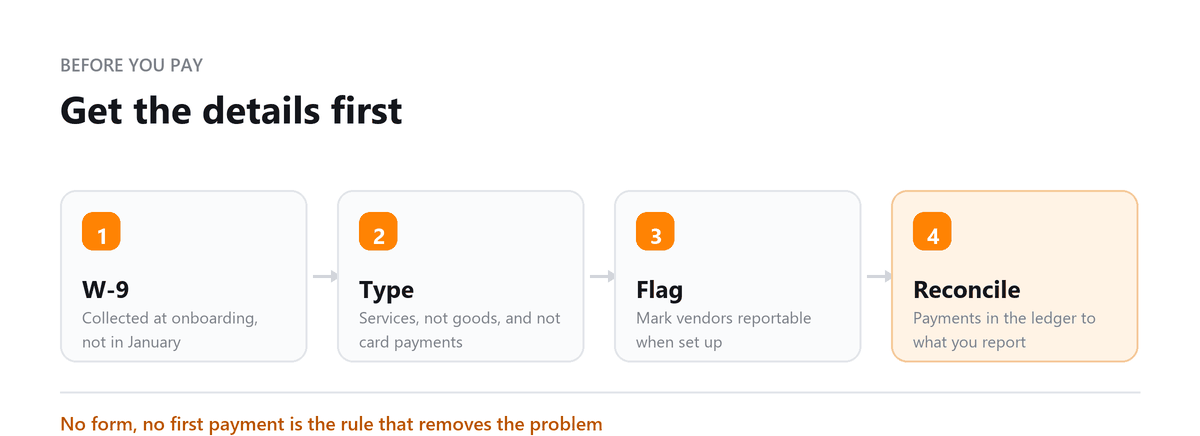
The most frequent 1099 mistake small businesses make is waiting until January to collect W-9 forms, leaving them scrambling for taxpayer identification numbers right at the filing deadline and opening themselves up to mandatory backup withholding penalties.
Ankit Sarawagi, CPA, CA, MBA · LinkedInWhat Is Form 1099?
Form 1099 is an information return, a tax document that reports income paid to someone other than an employee. The payer files with the IRS and sends a copy to the recipient, who must report the income on their own return. There are over 20 variants of Form 1099, each designed for a different income type.
The Most Common 1099 Variants
| Form | What It Reports | Filing Threshold |
|---|---|---|
| 1099-NEC | Non-employee compensation (contractors, freelancers) | $600 |
| 1099-MISC | Miscellaneous income: rent, prizes, awards, attorney fees | $600 (some items have no threshold) |
| 1099-INT | Interest income paid by banks/financial institutions | $10 |
| 1099-DIV | Dividends and distributions from investments | $10 |
| 1099-K | Payment card and third-party network transactions | $2,500 for TY2025 (see below) |
| 1099-R | Distributions from retirement accounts, pensions, IRAs | $10 |
| 1099-S | Proceeds from real estate transactions | Any amount |
| 1099-DA | Digital asset transactions (new, first reporting year 2025) | Varies by asset type |
What Is the Difference Between Form 1099-NEC and Form 1099-MISC?
Prior to 2020, non-employee compensation was reported on Form 1099-MISC (Box 7). The IRS reintroduced Form 1099-NEC in 2020 specifically for non-employee compensation. The split:
- Form 1099-NEC: Use for payments to freelancers, independent contractors, sole proprietors, and attorneys (for legal services) of $600 or more in a calendar year
- Form 1099-MISC: Use for rent, prizes, medical and healthcare payments, attorney fees for non-legal services, fishing boat proceeds, and other miscellaneous income
If you paid a contractor for services, use 1099-NEC. If you paid your landlord rent, use 1099-MISC.
Profitjets manages over 12,000 annual 1099 information returns across its client base, achieving a 100% on-time e-filing compliance rate.
1099-K Threshold: What Applies Now
| Tax Year | 1099-K Threshold |
|---|---|
| 2022 and before | $20,000 AND more than 200 transactions |
| 2023 | $20,000 (IRS delayed the new rule) |
| 2024 | $20,000 and more than 200 transactions (restored retroactively by the 2025 Act) |
| 2025 | $20,000 and more than 200 transactions |
| 2026 and beyond | $20,000 and more than 200 transactions |
New: 1099-DA for Digital Asset Transactions
Beginning with the 2025 tax year (forms furnished in early 2026), digital asset brokers including crypto exchanges, hosted wallets, and NFT marketplaces must issue Form 1099-DA. For 2025 transactions, brokers are required to report gross proceeds from digital asset dispositions (with mandatory cost basis reporting taking effect in 2026). Taxpayers who receive Form 1099-DA must reconcile these proceeds against their cost basis using Form 8949 and Schedule D.
E-Filing Threshold: Now 10+ Returns
According to Treasury Decision 9972, businesses that are required to file more than 10 information returns (in aggregate across all information return form types) are required to e-file. Thus, the 250-return threshold (per form type) was eliminated. If a business is required to file more than 10 returns of any form types (including 1099-NEC, 1099-MISC, W-2, 1099-INT, etc.) in aggregate, it should e-file using either IRIS or FIRE.
1099 Filing Deadlines
| Form | To Recipient By | To IRS (Paper) By | To IRS (Electronic) By |
|---|---|---|---|
| 1099-NEC | January 31 | January 31 | January 31 |
| 1099-MISC (Box 8/10) | February 15 | February 28 | March 31 |
| 1099-MISC (other boxes) | January 31 | February 28 | March 31 |
| 1099-K | January 31 | February 28 | March 31 |
| 1099-R | January 31 | February 28 | March 31 |
| 1099-DA (new 2025) | January 31 | February 28 | March 31 |
For 2025 tax year returns: the 1099-NEC deadline to both recipients and IRS is January 31, 2026. Mark this date, it is simultaneous, unlike 1099-MISC where recipient and IRS deadlines differ.
What Happens If You Miss the Deadline?
| When You File / Correct | Penalty Per Form |
|---|---|
| Within 30 days of deadline | $60 |
| 31 days to August 1 | $130 |
| After August 1 or not filed | $330 |
| Intentional disregard | $660 |
Annual caps apply per business size, small businesses (average gross receipts ≤ $5M over 3 years) have lower maximums. Penalties are per form, so volume filers face significant exposure.
In 2025 client onboarding audits, Profitjets identified that 34% of mid-sized firms lacked completed W-9s for active vendors, exposing them to potential 24% backup withholding liabilities.
How to File a 1099 Form
- Collect W-9 from every contractor or vendor before payment, do not wait until January
- Use IRS FIRE system for e-filing if issuing 10+ information returns (mandatory)
- Use IRS Form 1096 as a transmittal if submitting paper forms
- Use third-party payroll/1099 software (Gusto, QuickBooks, Track1099, Tax1099) for volume filers
During an onboarding review for an agency client at Profitjets, we discovered they had failed to issue 1099-NEC forms to 18 independent contractors due to missing TINs, exposing them to over $5,000 in late-filing and failure-to-furnish penalties.
We implemented an automated W-9 onboarding workflow integrated into their accounts payable system, preventing vendor payments until tax documentation is verified and ensuring complete compliance.
Book a free consultation and we will put the process in place.
FAQs
Who needs to file a 1099-NEC in 2026?
Businesses generally must issue Form 1099-NEC when they pay $600 or more during the calendar year to a nonemployee for services performed in the course of a trade or business. Payments to corporations are generally exempt, but certain payments, including qualifying attorney fees, are reportable regardless of the attorney's business structure.
What is the 1099-K threshold?
For 2026, payment settlement entities generally must report payments on Form 1099-K when gross payments exceed $20,000 and the number of transactions exceeds 200 under the federal threshold. However, state requirements or payment-platform policies may result in a form being issued at a lower threshold. Receiving a 1099-K does not itself determine whether the income is taxable.
Do I need to file 1099 forms electronically in 2026?
Yes, businesses generally must e-file information returns when they have 10 or more returns in aggregate during the calendar year. The 10-return threshold applies across applicable information-return types rather than separately to each form.
When are 1099-NEC forms due in 2026?
Form 1099-NEC is generally due to both the recipient and the IRS by January 31 following the year in which the payments were made. If January 31 falls on a weekend or legal holiday, the deadline moves to the next business day.
Do I need to issue a 1099 to every independent contractor I pay?
Not necessarily. The reporting requirement generally applies when your business pays a nonemployee $600 or more for qualifying services during the year. Certain payments and recipients are subject to exceptions, so businesses should review the payment type, recipient's tax classification, and applicable reporting rules before issuing a 1099.

Written by
Ankit Sarawagi, CPA, CA, MBA
Ankit leads the finance team at Profitjets, where he has worked with 500+ businesses across the US on bookkeeping, tax and CFO-level strategy. He writes about the habits that keep small business books accurate all year. Connect on LinkedIn
Free consultation
Chasing W-9s Every January?
Book a free consultation and we will put the process in place.