
How to File a Business Tax Extension: Form 7004 Complete Guide
Overview: Business Tax Extensions Are Entity-Specific, Extension Deadlines by Entity Type, and How to File Form 7004
Business extensions are not one request. They depend on the entity type, and a business with more than one entity has more than one obligation.
The part that catches groups out is that extending a parent does nothing for its subsidiaries, and a federal extension does not automatically carry to the states each entity is registered in.
This covers which entities file what and when, how the request is made and paid alongside, how the state position is handled, and why the consequences of filing late and of paying late are not the same thing.
Overview: Business Tax Extensions Are Entity-Specific
Unlike personal returns (Form 4868), business tax extensions depend on your entity type. Each entity uses IRS Form 7004, Automatic Extension of Time to File Certain Business Income Tax, Information, and Other Returns.
Groups get caught here more than single companies. Every entity has its own obligation and its own extension, in every state it is registered in, and extending the parent does nothing for the subsidiaries. One list of every entity and every jurisdiction prevents the whole problem.
Ankit Sarawagi, CPA, CA, MBA · LinkedInExtension Deadlines by Entity Type
| Entity Type | Original Deadline / Extension Deadline |
|---|---|
| S-Corporation (Form 1120-S) | March 15 / September 15 |
| Partnership (Form 1065) | March 15 / September 15 |
| C-Corporation (Form 1120, calendar year) | April 15 / October 15 |
| C-Corporation (fiscal year-end) | 15th day of 4th month after year-end / 6 months later |
| Sole Proprietor (Schedule C on Form 1040) | April 15 / October 15 (use Form 4868, not 7004) |
| Single-member LLC (taxed as sole prop) | April 15 / October 15 (use Form 4868) |
| Multi-member LLC (taxed as partnership) | March 15 / September 15 (Form 7004) |
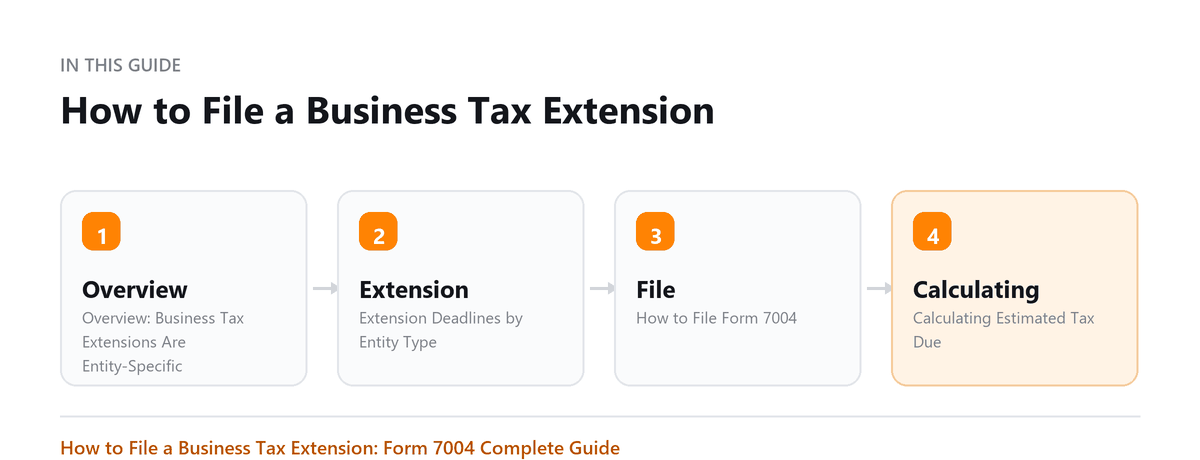
How to File Form 7004
- Identify your entity type and the applicable return code on Form 7004.
- Estimate your tax liability for the year.
- Pay any estimated tax due with the extension.
- File Form 7004 electronically (e-file is available) or by mail before the original due date.
Form 7004 is automatic, you do not need to explain why you need more time. As long as you file on time and pay what is estimated to be owed, the extension is granted.
Calculating Estimated Tax Due
An extension of time to file is NOT an extension of time to pay. You must estimate and pay any tax owed by the original deadline. Steps:
- Estimate your taxable income for the year using available financial data.
- Calculate approximate tax at the applicable rate.
- Subtract payments already made (quarterly estimated payments, withholding).
- Pay the balance with Form 7004.
Paying With EFTPS
The Electronic Federal Tax Payment System (EFTPS) at eftps.gov is the recommended way to make business tax payments, including extension payments. You can also mail a check with a payment voucher.
Late Filing vs. Late Payment Penalties
| Penalty Type | Rate |
|---|---|
| Failure to file (late filing) | 5% of unpaid tax per month, max 25% |
| Failure to pay (late payment) | 0.5% of unpaid tax per month, max 25% |
| Interest on unpaid tax | Federal short-term rate + 3% (changes quarterly) |
The failure-to-file penalty is 10 times larger than the failure-to-pay penalty. Filing an extension eliminates the failure-to-file penalty as long as you file by the extended deadline.
S-Corp and Partnership Specific Notes
S-corps and partnerships are pass-through entities. The entity itself may not owe much tax, but the deadline still matters because K-1s (used by shareholders/partners to file their own returns) depend on the entity return being complete.
Pro Tip: S-corp and partnership returns are due March 15, one month before the April 15 individual deadline, specifically so shareholders and partners have their K-1s in time to file their own returns.
Book a free consultation and we will take the return off your desk.
Frequently Asked Questions
Does a state extension automatically come with a federal extension?
No. Most states require a separate extension request. Some states accept a copy of the federal extension; others have their own form. Check your state's tax authority.
Can I file Form 7004 electronically?
Yes. Form 7004 can be e-filed through tax software or a professional tax preparer. E-filing is faster and provides confirmation of receipt.
What if I miss the extension deadline?
If you miss both the original and extended deadline, the failure-to-file penalty begins accruing from the original due date. File as soon as possible to stop the penalty from growing.
Does every entity in a group need its own extension?
Generally yes, because the obligation attaches to the entity. A group of related companies, or an operating company with holding entities, will each have their own filing requirement and their own extension to request. The same applies to each state each entity is registered in. Keeping a single list of every entity, every jurisdiction and every date is the only reliable way to avoid extending one and forgetting another.
What do the owners need to know if we extend?
That their own filing may now depend on information they will receive later. Where an entity passes results through to its owners, extending the entity's return delays the statement the owners need, and they may have to extend their personal filings as a consequence. Telling them early is a courtesy that avoids a much less comfortable conversation close to their own deadline.

Written by
Ankit Sarawagi, CPA, CA, MBA
Ankit leads the finance team at Profitjets, where he has worked with 500+ businesses across the US on bookkeeping, tax and CFO-level strategy. He writes about the habits that keep small business books accurate all year. Connect on LinkedIn
Free consultation
Want the Filing Handled?
Book a free consultation and we will take the return off your desk.