
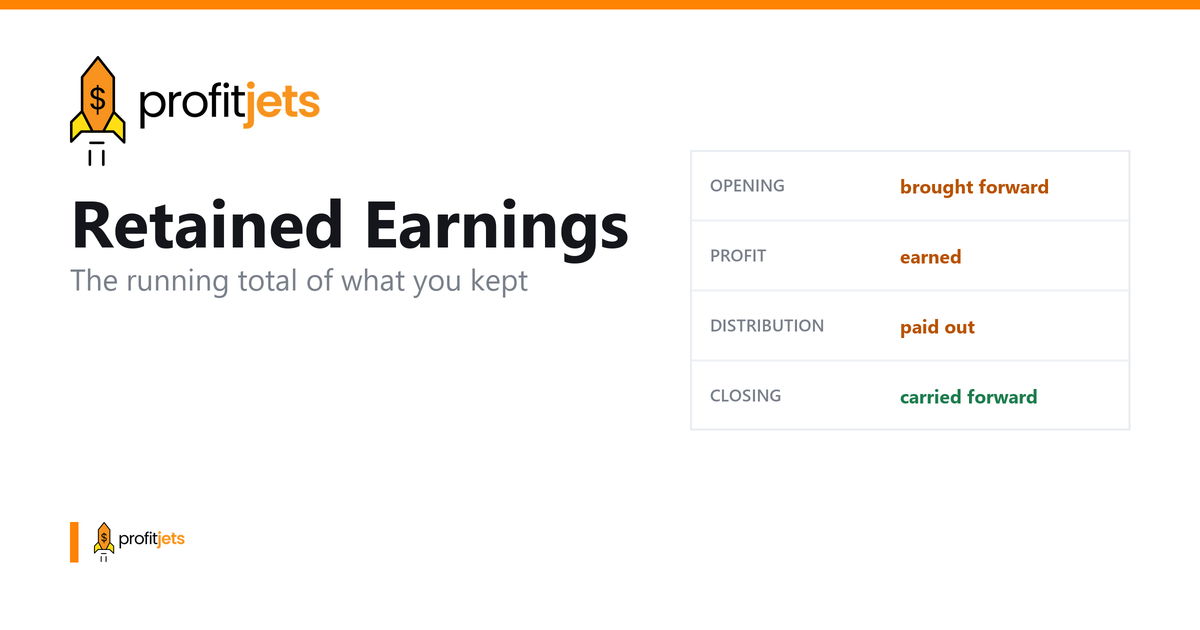
The retained earnings are a statistic that many a business owner thinks of when looking at the equity section of the balance sheet but knows little of how it was attained. This statistic is often larger than the cash on hand, has little relation to profits of the period just ended, and rarely matches the previous year figure.
With that, the questions asked are very straightforward. How is it calculated? Why isn't it equal to what's in the account? Why did it decrease if the company made a profit?
The answers lie in the calculation itself, which is simple, and an understanding of what the figure represents. The latter is a simple matter of articulating that retained earnings represent cumulative profits less distributions to owners.
The former requires only that the three components of the calculation be identified and where to find them. With that information, it becomes a trivial task to calculate the figure and provides a good reality check on whether the business is really retaining the profits it earns.
Expert Perspective
Lenders and investors don't read retained earnings in isolation. They look at it alongside total equity and debt, usually through the debt-to-equity ratio, and they look at how it's moved over several years. A business earning healthy profits while retained earnings stay flat is telling them the owners are taking everything out. That doesn't disqualify a loan, but it does change the conversation about how much cushion the business really has.
Abhinav Gupta, CPA, CA, MBA · LinkedInThis guide covers what retained earnings are, what increases and decreases them, how to calculate them step by step, where they appear on the balance sheet, and how they differ from net income.
What Are Retained Earnings?
Retained earnings are the cumulative net profits a business has earned since it began, minus all the dividends or distributions paid to its owners. They represent the profit the business has kept and reinvested.
Retained earnings are a balance sheet account, not a cash account. A high balance tells you the business has been profitable over time and kept those profits, but it doesn't mean the money is sitting in the bank. In most businesses, retained profit has already been put to work in inventory, equipment, customer receivables, or paying down debt.
It also helps to separate retained earnings from net income. Net income is the profit earned in a single period. Retained earnings is the running total, updated at the end of each period by adding that period's net income and subtracting any distributions.
What Goes Into Retained Earnings?
| Item | Effect on Retained Earnings |
|---|---|
| Net income (profit) | + Increases retained earnings |
| Net loss | - Decreases retained earnings (retained deficit) |
| Dividends paid (C-corps) | - Decreases retained earnings |
| Owner's draw (sole props / LLCs) | - Decreases retained earnings |
| Prior period adjustments | +/- Corrects an error in a prior period's earnings |
How to Calculate Retained Earnings
- Retained Earnings Formula: Beginning Retained Earnings + Net Income (Loss) - Dividends / Distributions = Ending Retained Earnings
- Example from live page: $100,000 beginning RE + $30,000 net income - $5,000 distributions = $125,000 ending retained earnings.
- Where to find the inputs: Beginning RE = prior year balance sheet (shareholders' equity section). Net income = current P&L statement (bottom line). Dividends / distributions = from the cash flow statement (financing activities) or directly from corporate records.
Where to Find Retained Earnings on the Balance Sheet
Retained earnings appear in the equity section of the balance sheet (also called 'shareholders' equity' for corporations or 'owner's equity' for sole proprietorships and partnerships):
| Equity Section | Example |
|---|---|
| Common stock / paid-in capital | $50,000 |
| Retained earnings | $125,000 |
| Total shareholders' equity | $175,000 |
Note: 'Retained earnings' in this context means the cumulative total. A negative retained earnings balance is called a 'retained deficit' and indicates the business has lost more money cumulatively than it has earned.
Retained Earnings vs Net Income
| Retained Earnings | Net Income | |
|---|---|---|
| What it is | Cumulative profits kept in the business since inception | Profit earned in the current period only |
| Where it appears | Balance sheet (equity section) | Income statement (bottom line) |
| Period | All-time cumulative total | Current period (month, quarter, year) |
| Effect of distributions | Reduced by dividends/draws taken | Not affected by distributions |
| Can it be negative? | Yes, if cumulative losses exceed profits | Yes, if expenses exceed revenue in the period |
The Balance Can Be Negative
Retained earnings accumulates every profit the business has made and not distributed, which means it also accumulates every loss. A business that has lost more than it has earned carries a negative balance, and that is a fact rather than an error.
It is common in early-stage businesses and in any business that has had a difficult period, and it is one of the first things an outside reader looks at, because it summarises the whole history in a single figure.
- Distributions reduce it, so a business can be profitable and still see it fall
- It is cumulative, so a single good year does not erase a run of losses
- A negative balance can restrict what may be distributed in some structures
- It is not cash, and a healthy balance says nothing about the bank account
Where It Comes From, and Where It Goes
Following the figure connects the two statements and explains why the balance sheet continues to balance year after year.
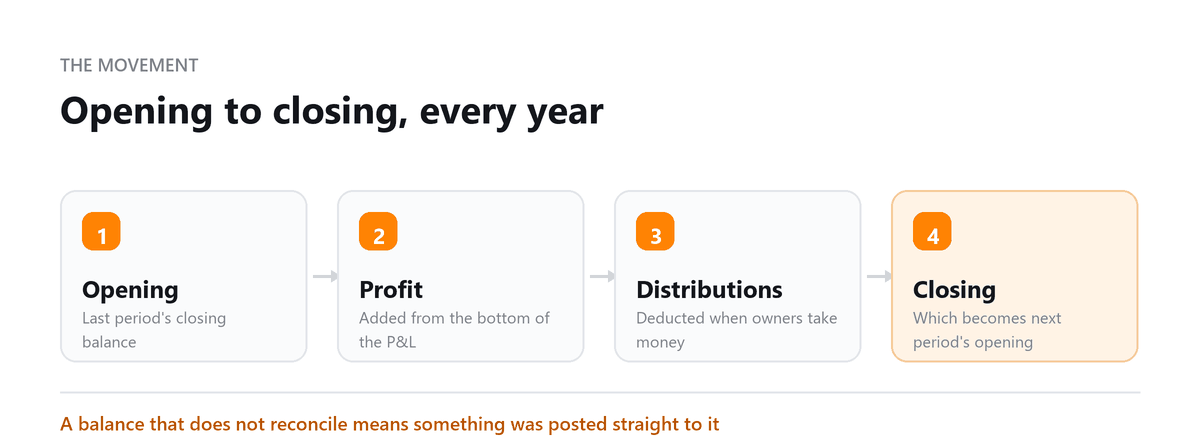
The profit for the period, from the bottom of the profit and loss, is added to the opening balance. Distributions to owners are deducted. The result is the closing balance, which becomes next period's opening figure.
That simple movement is worth checking every year, because it is where errors in the accounts most often surface. A retained earnings balance that does not reconcile from opening to closing means something was posted directly to it, which is almost always a mistake and is worth tracing while it is recent.
Book a free consultation and we will trace it back.
Frequently Asked Questions
Are retained earnings taxed?
Not on their own. The profit that became retained earnings has already been taxed, either at the business level or on the owners personal returns. C corporations are the exception to watch. If a C corporation holds on to earnings beyond its reasonable business needs to help shareholders avoid dividend taxes, the IRS can impose the accumulated earnings tax. A tax advisor can help if your company is keeping large amounts of profit without a clear business purpose.
Can a business have positive retained earnings and negative cash flow?
Yes. Retained earnings and cash are separate measures. A business with $200,000 in retained earnings might have only $15,000 in the bank if those profits have gone into inventory, equipment, or customer receivables. That's why cash flow should always be reviewed separately from the retained earnings balance.
Why did my retained earnings go down in a profitable year?
Almost always because distributions were larger than net income. If the business earned $50,000 and the owners took out $70,000, retained earnings fall by $20,000 even though the year was profitable. A prior period adjustment correcting an earlier error can also reduce the balance.
Do S corporations have retained earnings?
S corporations track accumulated profit much like other corporations, and distributions reduce that balance. For tax purposes, they also keep a separate account called the accumulated adjustments account, which affects how distributions are taxed. Your CPA will typically reconcile both at year-end.
How often should retained earnings be updated?
Retained earnings are formally updated whenever the books are closed for a reporting period. Most small businesses review them monthly as part of the balance sheet and do the full year-end close, including any adjustments, once a year.

Written by
Abhinav Gupta, CPA, CA, MBA
Abhinav works with business owners across the US on industry-specific bookkeeping, from dental practices and restaurants to construction and e-commerce. He writes about what each trade's books actually need. Connect on LinkedIn
Free consultation
Balance Sheet Not Reconciling?
Book a free consultation and we will trace it back.