
What is Accounting?
Accounting is the systematic process of recording, classifying, and summarising financial transactions to produce accurate financial records and reports. In practice, accounting covers maintaining the general ledger, processing accounts payable and receivable, reconciling bank statements, managing payroll, and preparing the income statement, balance sheet, and cash flow statement at period end.
Accounting answers the question: 'What happened financially in this business, and is it recorded accurately?' Its outputs are governed by standardised frameworks, GAAP in the United States, IFRS internationally, that make financial records comparable, auditable, and useful to the external parties who rely on them.
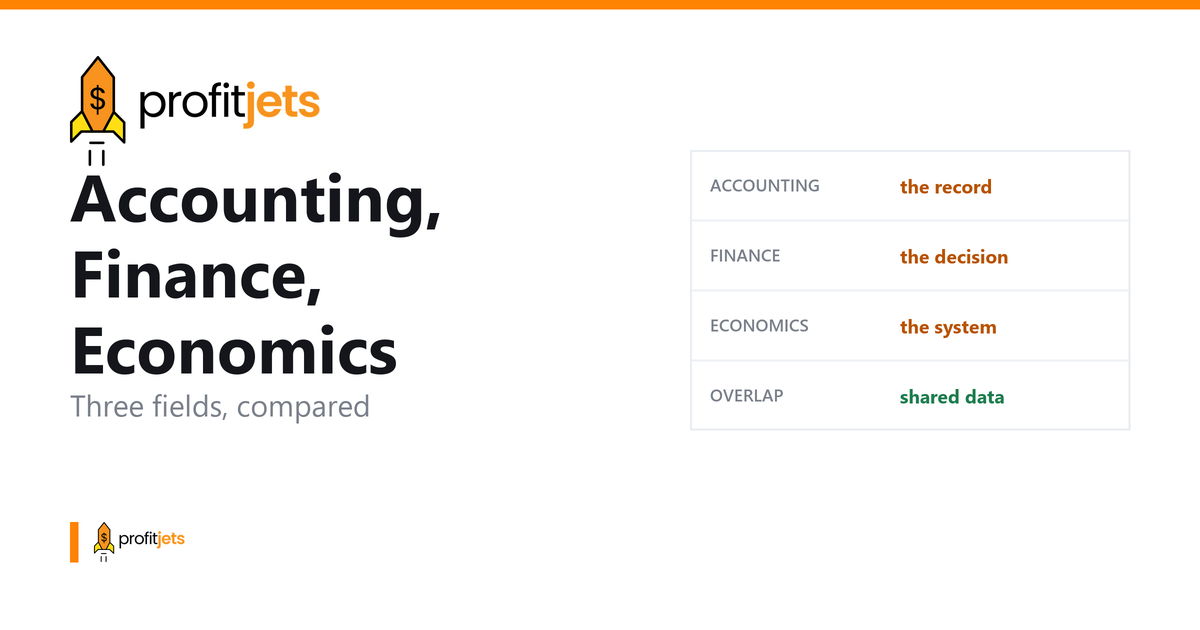
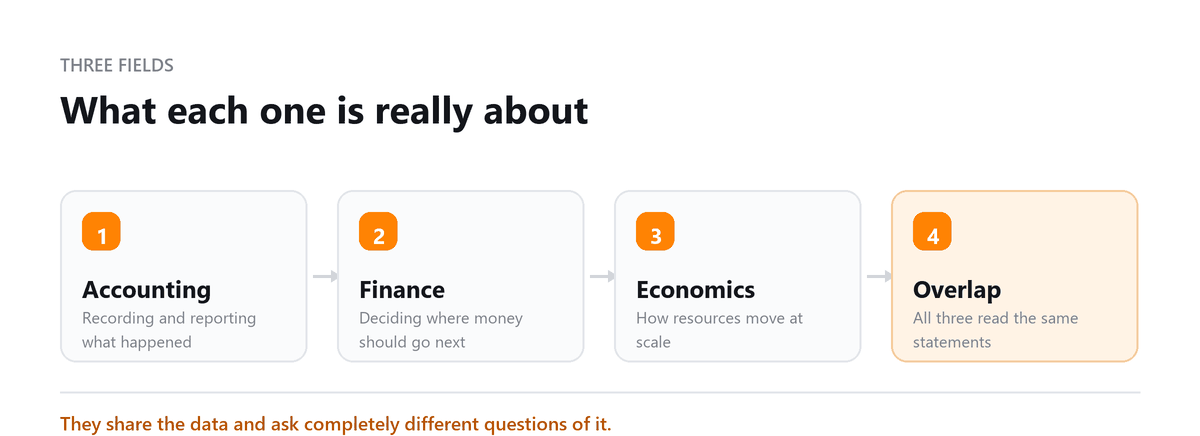
Accounting tells you what happened in your business. Finance tells you what should happen next. Economics tells you why the environment around your business is moving the way it is. The most effective business leaders are fluent in all three.
Ankit Sarawagi, CPA, CA, MBA · LinkedInWhat is Finance?
Finance builds on the data produced by accounting and uses it to inform strategic decisions about the future. Where accounting focuses on accurate historical recordkeeping, finance focuses on forecasting, investment analysis, capital budgeting, and risk management, determining how to allocate the company's financial resources to maximise value. Finance professionals work with projected cash flows, asset valuations, cost of capital calculations, and investment return models. They use accounting data as their raw material but transform it through analysis and judgment into forward-looking recommendations.
Finance answers the question: 'How should we deploy our financial resources to grow and protect value over time?'
What is Economics?
Economics is a broader social science discipline examining how individuals, organisations, and governments allocate scarce resources. It encompasses macroeconomics (the study of aggregate economic behaviour, inflation, interest rates, GDP growth, monetary policy) and microeconomics (the study of individual and firm-level decisions, supply and demand, pricing, market structure, consumer behaviour). Economics provides the environmental context in which business and finance operate: understanding how market conditions affect demand for your products, how interest rate changes affect your cost of capital, and how policy shifts affect your industry requires economic literacy.
Economics answers the question: 'Why is the world around our business moving the way it is?'
Accounting vs Finance: Key Differences
| Factor | Accounting | Finance |
|---|---|---|
| Focus | Past records, accuracy | Future-oriented planning |
| Data type | Historical transactions | Projections and valuations |
| Output | Financial statements | Investment decisions, strategies |
| Professionals | Accountants, CPAs, bookkeepers | Financial analysts, CFOs, bankers |
| Standards | GAAP/IFRS compliance | No mandatory reporting standard |
Accounting vs Economics: Differences
While accounting operates at the firm level, tracking a specific company's transactions and financial position, economics operates at the system level, analysing markets, industries, and economies. Accounting is transactional and precise: every journal entry balances to the cent. Economics is theoretical and probabilistic: models describe tendencies and relationships rather than exact outcomes. Accounting informs management: it tells business owners how their specific company has performed. Economics informs policy: it tells governments, central banks, and regulators how market conditions are evolving and what interventions might improve outcomes.
For a business owner, accounting is immediately actionable; economics provides valuable context for strategic planning.
Accountant vs Economist: What Do They Do?
An accountant's day-to-day work centres on the accuracy and completeness of financial records: preparing and reviewing journal entries, reconciling accounts, generating financial statements, filing tax returns, and ensuring compliance with applicable accounting standards. The work is grounded in specific transactions and requires precision and regulatory knowledge.
An economist's work is more analytical and theoretical: building models of market behaviour, analysing macroeconomic data to identify trends and forecast conditions, evaluating the likely effects of policy changes on different sectors, and advising organisations on strategic positioning given anticipated economic conditions. Economists employed by businesses typically work in research, strategy, or pricing roles.
Accountant vs Economist: Similarities
Despite their different domains, accountants and economists share three important similarities. Both rely heavily on data analysis, accountants on financial transaction data, economists on macroeconomic and market data. Both inform decision-making: accountants directly (through the financial information they produce) and economists contextually (through the market analysis that shapes strategy). And both apply quantitative reasoning, using numbers, models, and analytical frameworks to produce insights that cannot be derived from intuition alone.
The Role of Accounting Software
Modern accounting software has significantly changed the relationship between accounting, finance, and business decision-making. Platforms like QuickBooks Online, Xero, and Sage automate data entry through bank feeds and integrations, generate financial statements in real time, and increasingly offer built-in budgeting and forecasting tools that bridge the gap between accounting and finance functions. For small businesses, this means that the same system that captures daily transactions can also produce the forward-looking analyses that were previously only available to businesses with dedicated finance teams.
Accounting software does not replace financial judgment, but it dramatically reduces the manual work involved in producing the data that judgment requires.
Conclusion
Accounting, finance, and economics are three distinct but interconnected disciplines that together provide a complete picture of business and market reality. Accounting produces the accurate historical record that every other analysis depends on. Finance uses that record to inform strategic resource allocation and investment decisions. Economics provides the market and macro context that shapes the environment in which those decisions play out. For business owners, building literacy across all three disciplines, even at a foundational level, substantially improves the quality of decisions about growth, capital allocation, pricing, and risk.
Profitjets provides the accounting and financial infrastructure that makes that literacy actionable.
Book a free consultation and we will take the record-keeping off your hands.
Frequently Asked Questions
Should a business owner study accounting, finance, or economics?
For running a business day-to-day, accounting fundamentals are most immediately useful, understanding financial statements, cash flow, and bookkeeping. Finance skills become critical as you grow and make capital allocation decisions. Economics provides context but is less directly applied to daily operations.
What's the difference between a financial accountant and a financial analyst?
A financial accountant records and reports historical financial data under GAAP standards. A financial analyst uses that data (plus market research and modelling) to evaluate investments, assess company performance, and make forward-looking recommendations.
Is economics useful for small business owners?
Yes, understanding basic economics helps you anticipate how market conditions (inflation, interest rates, consumer demand) affect your business. But most small business owners don't need a deep economics background; they benefit more from accounting and financial literacy.
Do finance professionals need to understand accounting?
Absolutely. Finance work, valuing companies, modelling cash flows, assessing creditworthiness, is built entirely on accounting data. A financial analyst who doesn't understand how financial statements are constructed will misread them and make flawed recommendations.
Can accounting software replace the need for financial analysis?
No, accounting software automates data capture and report generation. Financial analysis requires human judgment: identifying trends, building scenarios, assessing risks, and recommending decisions. Software provides the inputs; analysis provides the insights.

Written by
Ankit Sarawagi, CPA, CA, MBA
Ankit leads the finance team at Profitjets, where he has worked with 500+ businesses across the US on bookkeeping, tax and CFO-level strategy. He writes about the habits that keep small business books accurate all year. Connect on LinkedIn
Free consultation
Need the Accounting Side Covered?
Book a free consultation and we will take the record-keeping off your hands.