
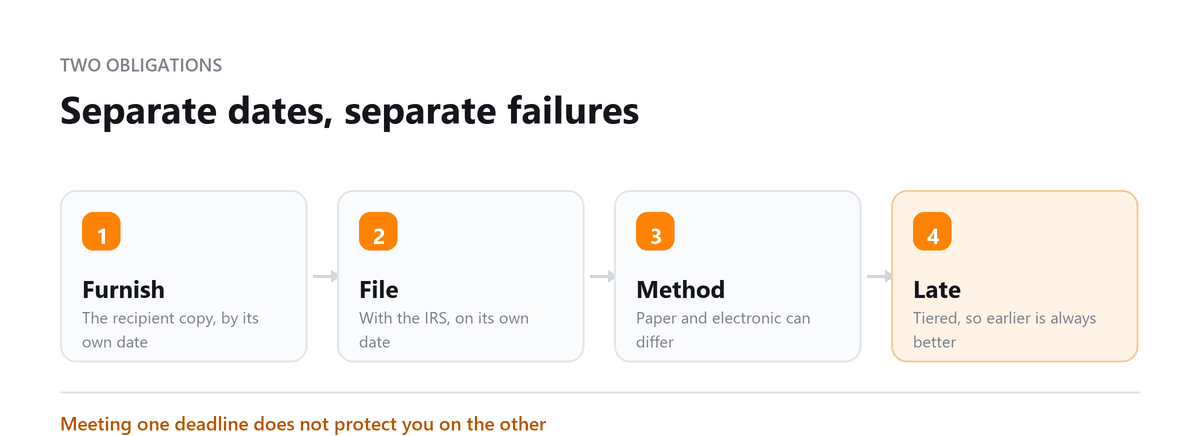
January is the most crowded month in small business accounting. The books need closing, W-2s are due, and 1099s are due on the same day. For Form 1099-NEC, there's no gap between the recipient deadline and the IRS deadline, and no automatic extension. Businesses that start pulling contractor totals together in the final week of January regularly miss it.
The deadline is only part of the picture. You need to use the right form for each payment type, apply the correct reporting threshold, have a valid taxpayer ID for every recipient, file electronically once you pass the IRS e-file threshold, and meet any separate state filing requirements. Several of these rules have changed in recent years, so last year's process isn't always enough.
The businesses that file on time every year treat 1099s as a year-round process rather than a January project. They collect a W-9 before paying any new vendor, flag 1099-eligible vendors in the accounting system from day one, keep card and payment app payments separate, and review totals in December. This guide lays out the deadlines, requirements, and habits that make filing routine.
Expert Perspective
The best 1099 practice is a boring one. No vendor gets paid until there's a W-9 on file, and every vendor is marked in the accounting system as 1099-eligible or not the day they're set up. When that's in place, January is a report and a quick review. When it isn't, it's two weeks of chasing tax IDs from contractors who stopped answering emails months ago.
Ankit Sarawagi, CPA, CA, MBA · LinkedInThis guide covers 1099 filing deadlines, extension rules, electronic filing requirements, state filing obligations, and best practices for filing accurately and on time.
What Is a 1099 Form?
A 1099 is an IRS information return, a document that reports income paid outside of a W-2 employment relationship. The payer files with the IRS and provides a copy to the income recipient. Over 20 variants exist; the most common for businesses are 1099-NEC and 1099-MISC.
Critical Differences Between 1099-MISC and 1099-NEC
| Factor | 1099-NEC | 1099-MISC |
|---|---|---|
| Use for | Non-employee compensation (contractors, freelancers, service providers) | Rent, prizes, awards, medical payments, attorney fees (non-legal services) |
| Threshold | $600 per payee per year | $600 (most boxes); $10 (fishing boat proceeds) |
| Recipient deadline | January 31 | January 31 (most boxes); February 15 (Box 8/10) |
| IRS paper deadline | January 31 | February 28 |
| IRS e-file deadline | January 31 | March 31 |
When Is the Deadline to Send Out 1099 Forms? (TY2025 Returns)
| Form | To Recipient | To IRS (Paper) | To IRS (E-file) |
|---|---|---|---|
| 1099-NEC | January 31, 2026 | January 31, 2026 | January 31, 2026 |
| 1099-MISC (most boxes) | January 31, 2026 | February 28, 2026 | March 31, 2026 |
| 1099-MISC (Box 8/10) | February 15, 2026 | February 28, 2026 | March 31, 2026 |
| 1099-K | January 31, 2026 | February 28, 2026 | March 31, 2026 |
| 1099-INT | January 31, 2026 | February 28, 2026 | March 31, 2026 |
| 1099-DIV | January 31, 2026 | February 28, 2026 | March 31, 2026 |
| 1099-R | January 31, 2026 | February 28, 2026 | March 31, 2026 |
| 1099-DA | January 31, 2026 | February 28, 2026 | March 31, 2026 |
Form 1099-K Reporting Threshold for 2025 and 2026
If you're paid through PayPal, Venmo, Stripe, Square, Etsy, eBay, or a similar platform, you may receive Form 1099-K instead of, or alongside, a 1099-NEC or 1099-MISC. Form 1099-K reports the gross amount of payments you received through a payment card or third-party payment network during the year.
For 2025 and 2026, third-party payment networks generally must issue Form 1099-K only when payments to you are more than $20,000 and there are more than 200 transactions in the year. Payment card processors, the companies handling credit and debit card payments directly, report card payments regardless of amount or number of transactions.
The rules shifted several times in recent years. Legislation passed in 2021 would have lowered the threshold to $600, and the IRS phased that in gradually, setting transitional thresholds of $5,000 for 2024 and $2,500 for 2025. Legislation passed in 2025 repealed the $600 rule and restored the original $20,000 and 200-transaction threshold, so the lower transitional amounts no longer apply.
Some states still set lower reporting thresholds, so a platform may send you a 1099-K even when the federal threshold isn't met.
A lower reporting threshold never changed what's taxable. All business income is reportable, whether or not you receive a 1099-K. Personal transfers, such as splitting a dinner bill with friends or selling a personal item for less than you paid for it, aren't taxable income, even if they show up on a 1099-K.
Avoiding Double Reporting
If a client pays you through PayPal or by card, that payment is reported on Form 1099-K, and the client shouldn't also include it on a 1099-NEC. When you receive both forms, reconcile them against your records before filing. Report your total business income once, and don't add the 1099-K and 1099-NEC amounts together if they cover the same payments.
Tax Brackets and the Impact on 1099 Income
| Rate | TY2025 Taxable Income, Single Filer |
|---|---|
| 10% | $0 to $11,925 |
| 12% | $11,925 to $48,475 |
| 22% | $48,475 to $103,350 |
| 24% | $103,350 to $197,300 |
| 32% | $197,300 to $250,525 |
| 35% | $250,525 to $626,350 |
| 37% | Over $626,350 |
1099 income is fully self-reported and taxed at marginal rates. Unlike W-2 income where taxes are withheld, 1099 recipients must pay estimated taxes quarterly (April 15, June 15, September 15, January 15) or face underpayment penalties.
Can You Deduct Business Expenses on Your 1099 Income?
Yes, independent contractors and sole proprietors report 1099 income on Schedule C and may deduct all ordinary and necessary business expenses: home office, equipment, vehicle use, software, professional development, and business insurance. Self-employment tax (15.3% on net earnings up to the Social Security wage base, then 2.9% above) is calculated on Schedule SE and added to the total tax liability.
Do You Need a W-9 to Issue a 1099?
Yes. The W-9 collects the payee's name, address, and TIN (SSN or EIN). Without a W-9, you cannot correctly complete the 1099 form, and if the payee refuses to provide one, you are required to withhold 24% of payments as backup withholding and remit to the IRS. Collect W-9 forms before making the first payment not at year-end.
Profitjets files more than 3,500 Forms 1099 annually for clients and uses proactive deadline tracking to identify missing W-9s and vendor information before filing season. Early collection of tax information helps reduce last-minute corrections, missing TINs, and potential backup withholding issues.
We reached January and realized several of our contractors had never provided W-9s, leaving us scrambling to collect TINs before the 1099 deadline and concerned about potential backup-withholding requirements. Profitjets helped us contact the contractors, identify the missing information, and set up a W-9 collection process during onboarding so new vendors provide their tax details before payments begin.
Book a free consultation and we will file them for you.
FAQs
When are 1099 forms due?
Form 1099-NEC is due to both the recipient and the IRS by January 31. Form 1099-MISC is generally due to recipients by January 31, or February 15 for certain boxes, and to the IRS by the end of February on paper or March 31 if filed electronically. When a due date falls on a weekend or legal holiday, it moves to the next business day.
Can I get an extension to file 1099s?
For most information returns, filing Form 8809 by the original due date gives an automatic 30-day extension to file with the IRS. Form 1099-NEC is different: an extension isn't automatic and is granted only in limited circumstances, so plan to file it on time. Extensions for sending copies to recipients are requested separately by letter to the IRS.
Do I have to file 1099s electronically?
If you file 10 or more information returns in total during the calendar year, you're generally required to file electronically. The count includes all information return types combined, such as Forms 1099 and W-2, not each type separately. The IRS offers online filing, and most accounting and payroll software can e-file for you.
Do I also need to file 1099s with my state?
Many states require copies of 1099s, particularly Form 1099-NEC. Some participate in the IRS Combined Federal/State Filing Program, which forwards certain forms to them automatically. Others require you to file directly with the state, sometimes with different deadlines or reconciliation forms. Check the rules in every state where you have payees or tax obligations.
What information do I need before filing a 1099?
For each recipient, you need their legal name, taxpayer identification number, address, and federal tax classification, all from a signed Form W-9. You also need the total paid during the year by payment type, with card and payment app transactions excluded, and any federal tax withheld under backup withholding. Running an IRS TIN match before filing can catch name and number mismatches early.

Written by
Ankit Sarawagi, CPA, CA, MBA
Ankit leads the finance team at Profitjets, where he has worked with 500+ businesses across the US on bookkeeping, tax and CFO-level strategy. He writes about the habits that keep small business books accurate all year. Connect on LinkedIn
Free consultation
Deadline Approaching?
Book a free consultation and we will file them for you.