

Most small business owners are great at what they do, but terrible at managing their finances. They understand the details of the product they sell and their customers’ preferences inside out.
The same cannot be said about their cash flow. Small business owners often send out invoices too late, use their business bank account as their personal wallet, do not track their expenses regularly and only update it a few times a year. They hire someone new when the business does well and then suddenly run out of money three months later with no idea where all the cash went.
Adequate financial management is the central issue because businesses typically fail not because their owners are poor at selling but because they do not have an accurate overview of the money situation at any given time. Cash binds the whole operation, and the disorganized flow of funds leads to poor business-related decisions.
Luckily, there is no need to study years to become a finance expert and revamp the company’s accounting system. Following a set of guidelines may help business owners to start seeing the bigger picture instead of desperately trying to chase every penny. The five financial management tips listed below are the most common among small businesses and can be the backbone of the accounting system.
This guide covers five practical finance tips every small business owner should follow, from managing cash flow to knowing when to bring in professional help.
1. Make Cash Flow Your Top Priority
A business can be profitable on paper and still run out of cash. Profit tells you whether you're earning more than you spend over time. Cash flow tells you whether the money arrives before the bills are due.
Managing cash flow means knowing when money is coming in from customers and when it's going out for suppliers, payroll, loan payments, and taxes. The most useful tool for this is a rolling 13-week cash flow forecast, updated weekly, which shows a shortfall weeks before it happens.
A few habits make a big difference:
Invoice immediately. Send invoices as soon as work is delivered or products ship, not at the end of the week or month.
Automate reminders. Set up reminders a few days before an invoice is due, on the due date, and about a week after. Follow up personally on anything more than 30 days overdue.
Ask for better supplier terms. If you're paying on Net 15, ask whether Net 30 is possible. It gives you two more weeks of cash at no cost, as long as you keep paying on time.
Build a cash reserve. Aim for three to six months of operating expenses over time. It's the buffer that turns a slow month into an inconvenience instead of a crisis.
Profitjets initial cash-flow reviews find that approximately 40% of new clients have experienced at least one unexpected cash shortfall in the previous 12 months. For clients using ongoing cash-flow management, average DSO has improved from around 65 days at onboarding to 48 days within six months, improving working-capital visibility and liquidity.
2. Create and Stick to a Budget
A budget is not a constraint, it is a plan. Without a budget, every spending decision is made based on what is in the bank account today, with no reference to whether the business can sustain it over 12 months. With a budget, you can see in advance whether planned spending will result in profit or loss, and make proactive adjustments.
- Build a 12-month budget before the year starts, revenue by segment, fixed costs by category, variable costs as a % of revenue
- Review actual vs budget monthly within 5 business days of month-end
- Investigate every significant variance, both positive (overstated revenue) and negative (cost overrun)
- Update the rolling forecast quarterly based on actual year-to-date performance
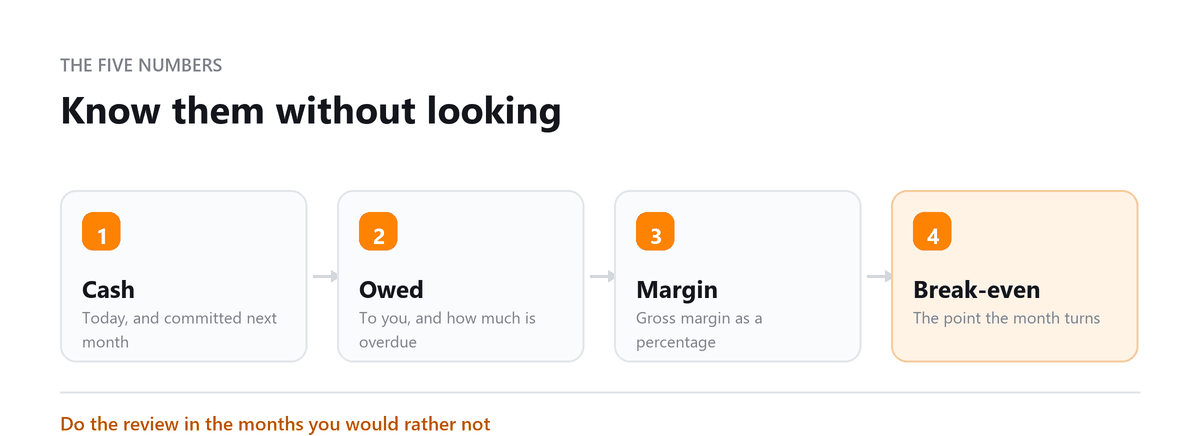
The habit that most reliably separates thriving small businesses from struggling ones is a monthly review of the numbers. Not a glance at the bank balance, but an hour with the P&L, the balance sheet, and a cash forecast. Owners who start doing it stop being surprised. They see margin slipping before it hurts, they spot the customer who's always paying late, and they make hiring decisions based on what the business can actually carry.
Ankit Sagatani, MBA, B.Com · LinkedIn3. Separate Personal and Business Finances
Using the same bank account for personal and business transactions is one of the most expensive financial mistakes a small business owner can make. It makes accounting slower, creates tax risks (personal expenses deducted as business expenses), and destroys the audit trail. Separate accounts are non-negotiable.
- Open a dedicated business checking account, no personal transactions, ever
- Get a business credit card for business spending, the statements become your expense record
- Pay yourself a defined owner's draw on a schedule, not ad hoc transfers whenever the business balance looks healthy
- If you have invested personal money in the business, record it as a capital contribution, not a casual transfer
4. Stay on Top of Financial Reporting
You cannot manage what you do not measure. Monthly financial reporting, profit and loss statement, balance sheet, and cash flow statement, gives you the information to see trends before they become problems and make informed decisions about growth, hiring, and investment.
- Close the month within 5-7 business days of month-end, stale financials are as useful as no financials
- Review revenue by segment: which products/services are growing, which are declining?
- Review gross margin: is cost of goods sold growing faster than revenue? Why?
- Review operating expenses: are any categories trending up without a corresponding revenue increase?
- Review the balance sheet quarterly: is equity growing? Is cash position healthy? Are receivables ageing well?
Consider switching to professional bookkeeping/accounting services when your transaction volume reaches 30-50 transactions per month, at that level, the cost of inaccurate DIY accounting exceeds the cost of professional help.
5. Invest in Professional Financial Services
A professional bookkeeper or outsourced accounting team does more than record transactions, they ensure your financial statements are accurate, flag variances and anomalies, keep you compliant with tax deadlines, and give you the reliable data needed to make good business decisions.
- Bookkeeper: handles transaction recording, reconciliation, and month-end close
- Accountant/CPA: handles tax returns, year-end adjustments, and strategic tax planning
- Fractional CFO: higher-level financial strategy, cash flow modelling, fundraising support, and board/investor reporting
For most small businesses, the combination of an outsourced bookkeeper and an annual CPA relationship provides most of the financial management infrastructure they need at a fraction of the cost of in-house finance staff.
Book a free consultation and we will tell you what concerns us.
Frequently Asked Questions
When should a small business hire a CFO?
Most small businesses don't need a full-time CFO until they reach significant scale, often somewhere in the $5 million to $10 million revenue range or when they're raising substantial outside capital. Before that, a fractional CFO working a few days a month can provide cash flow modeling, fundraising support, board reporting, and oversight of your finance function at a much lower cost.
How do I know if my business is financially healthy?
A few indicators give a good picture. Operating cash flow should be consistently positive. Current assets should comfortably cover current liabilities, with a current ratio below 1 a warning sign. Gross margin should be stable or improving. Customers should be paying reasonably close to your stated terms. And you should have a cash reserve covering at least a few months of operating expenses. Compare these with your own trend and industry benchmarks rather than relying on any single number.
How much should a small business spend on accounting services?
It depends on transaction volume, complexity, and how much support you need. Basic outsourced bookkeeping for a small business can cost a few hundred dollars a month, while businesses with more complex operations or added services like payroll, tax, and CFO support will pay more. The right comparison is against the time you'd spend doing it yourself and the cost of mistakes.
What financial reports should a small business owner review every month
At a minimum, review your profit and loss statement, balance sheet, and cash flow statement. It's also worth checking your accounts receivable aging, accounts payable aging, and a comparison of actual results against your budget. Together, they cover profitability, cash, and anything that needs attention.
What's the most common financial mistake small business owners make?
Treating the bank balance as a measure of how the business is doing. A healthy balance can hide unpaid tax obligations, upcoming loan payments, and customers who owe you money. Without regular financial reports and a cash forecast, it's easy to spend money that's already committed elsewhere.

Written by
Ankit Sagatani, MBA, B.Com
Ankit works with business owners across the US on industry-specific bookkeeping, from real estate to construction and retail. He writes about what each trade's books actually need. Connect on LinkedIn Connect on LinkedIn
Free consultation
Want Someone to Challenge the Numbers?
Book a free consultation and we will tell you what concerns us.