
The decision between an LLC and a C Corporation boils down to a single question: are you going to raise institutional capital?
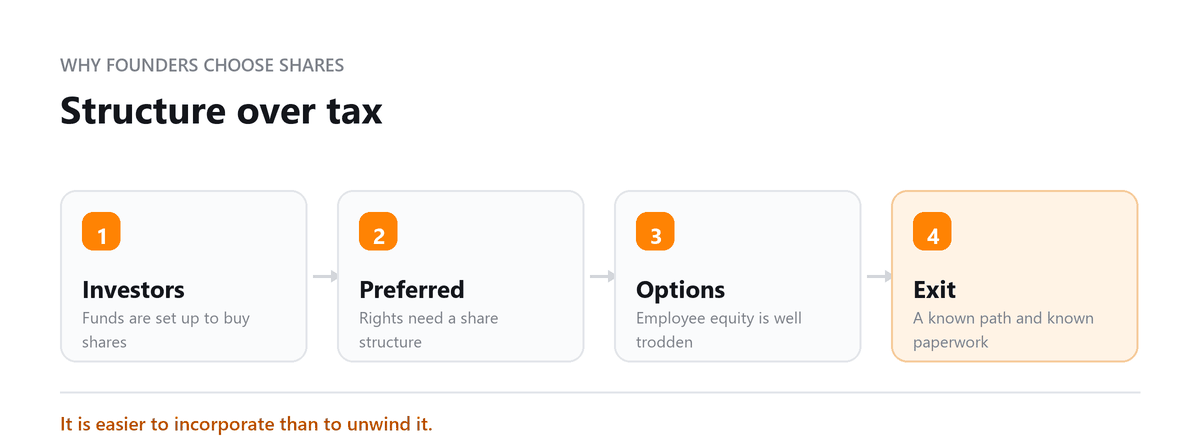
If yes, you need a Delaware C Corporation (and almost all of what follows is moot, because venture funds invest via preferred stock, which doesn't exist in an LLC, and most are explicitly prohibited by their own fund docs from holding LLC interests at all; they will require conversion at your expense and on their timeline before closing).
If no, an LLC is much simpler to operate (cheaper to maintain, and avoids a layer of taxation).
Where it gets interesting is in the middle: people who may raise, or may sell, and have to make the decision now. There's a tax provision which only applies to C-Corp stock, and which can be worth more at exit than all of the above combined; most comparisons miss it entirely.
The expensive mistake is founders choosing an LLC for the tax simplicity without thinking about exit. If you build something and sell it five or more years later, C-Corp stock may qualify for an exclusion that LLC interests never can. I've seen founders convert eighteen months before a sale and discover the holding period restarts. The LLC was the right call for their first two years and it cost them at the end, that's a decision you can only make properly at the start.
Anu Gupta, CA, EA, B.Tech · LinkedInCore Comparison
| Feature | LLC | C Corporation |
|---|---|---|
| Taxation | Pass-through, income taxed once at member/owner level | Double taxation, 21% corporate tax + shareholder dividend tax |
| Ownership | Members (no stock certificates by default) | Shareholders (stock certificates; multiple classes permitted) |
| Investor Compatibility | Difficult, institutional VCs generally will not invest in LLCs | VC-preferred, can issue preferred stock, SAFEs, convertible notes |
| Management Structure | Flexible, member-managed or manager-managed | Formal, Board of Directors, Officers, annual meetings required |
| Compliance | Minimal formalities, operating agreement, annual state report | Significant, bylaws, board minutes, officer appointments, annual meetings |
| Profit Distribution | Flexible, any agreed allocation among members | Dividends, proportional to share ownership |
| Capital Raising | Cannot issue stock, relies on member contributions or loans | Can issue multiple stock classes; attracts angel/VC investment |
| IPO | Must convert to C-Corp before going public | Can pursue IPO directly |
| Pass-Through Election | Default for single/multi-member LLCs | Not available, C-Corps cannot elect pass-through treatment |
| S-Corp Treatment | LLC can elect S-Corp taxation (Form 2553) | Can elect S-Corp status (Form 2553), subject to S-Corp restrictions (100 shareholders, US citizens only, one class of stock) |
Taxation, The Double Taxation Explained
A C-Corp earns $1,000,000 in profit:
| Step | Amount | Rate |
|---|---|---|
| Corporate income tax | $210,000 | 21% federal corporate tax rate |
| After-tax profit | $790,000 | , |
| Shareholder dividend tax (if distributed) | $118,500 to $158,000 | 15 to 20% qualified dividend rate (depends on individual income) |
| Net received by shareholders | $632,000 to $671,500 | Effective combined rate: 37 to 37%+ |
Two qualifications that matter more than the table.
A C-Corp doesn't have to distribute. Earnings retained in the company are taxed once at 21% and nothing further is due until money comes out. For a startup reinvesting everything, that 21% may be lower than the founders' personal marginal rate, which makes a C-Corp more efficient during the growth phase. The second layer isn't avoided, it's deferred, and if the eventual exit is a stock sale rather than a distribution, it may never arrive in that form at all.
And LLC members pay self-employment tax on their share of income, which C-Corp shareholders don't on dividends. Comparing headline rates without accounting for that misstates the comparison.
QSBS: the thing most comparisons omit
Section 1202 qualified small business stock allows founders and early shareholders to exclude a substantial portion of the gain on a sale of C-Corp stock, subject to conditions, the company must be a domestic C-Corporation meeting an asset test, the stock must be acquired at original issue, the business must be in a qualifying activity, and there's a minimum holding period.
Three points hold regardless of the detail:
It only exists for C-Corp stock. LLC interests never qualify, in any form.
The clock starts when the stock is issued. Converting from an LLC to a C-Corp starts the holding period at conversion, not at founding. A founder who converts shortly before a sale gets nothing from it.
The amounts are substantial. For a successful exit, this provision can outweigh every other tax consideration in this comparison by a wide margin.
Which reframes the whole decision for anyone who might sell. The LLC's tax advantage operates during the operating years. The C-Corp's potential advantage operates at exit, and it's frequently larger. Neither is universally right, but a founder choosing an LLC for simplicity, with an exit somewhere in mind, should make that choice knowing what they're setting aside.
Get advice specific to your situation. The qualification conditions are detailed and easy to fail inadvertently.
When to Choose Each
LLC if institutional capital isn't in your plan, you want minimal compliance, you want profits taxed once as they're earned, you have a small number of owners with agreed splits, or you'd benefit from an S-Corp election to reduce self-employment tax.
C-Corp if you're raising venture capital, you want a proper employee stock option plan, you're building toward an IPO, you'll have multiple investor classes, you want foreign investors (an S-Corp can't have them), or a potential exit makes QSBS worth preserving.
A note for non-US founders: S-Corp election requires US-person shareholders, so it isn't available to you. Your realistic choice is between a default-taxed LLC and a C-Corp, and if you're raising from US funds it's a C-Corp. Our guide to opening a company in the USA from India covers the cross-border side.
| Choose LLC if… | Choose C-Corp if… |
|---|---|
| You do not plan to raise institutional (VC/PE) capital | You plan to raise venture capital, VCs require C-Corp structure |
| You want simplicity and minimal compliance burden | You want to issue equity to employees via stock option pool (ISO plans) |
| You want pass-through taxation to avoid double tax | You plan to pursue an IPO |
| You have a small number of owners with agreed profit splits | You have or expect multiple investor classes (common + preferred) |
| You can use an S-Corp election to reduce self-employment tax | You want to bring in international/foreign investors (S-Corp cannot) |
Profitjets has managed more than 30 LLC-to-C-Corp conversions for startups preparing to raise institutional capital, with clients typically completing the restructuring 3 to 6 months before their first major funding round.
Our investor required us to be structured as a Delaware C-Corp before closing the round, but we were still operating as an LLC. Profitjets coordinated the conversion, helped us get the accounting and tax records aligned with the new structure, and worked with our legal team on the transition. We completed the conversion ahead of the closing and went on to close a $1.2 million seed round.
Book a free consultation and we will get the structure right first.
Frequently Asked Questions
Why do VCs insist on C-Corps?
They invest through preferred stock, which carries liquidation priority, anti-dilution protection and board rights none of which exists in an LLC. Beyond preference, many funds are prohibited by their own documents from holding pass-through interests, because the income flowing through creates tax problems for their tax-exempt limited partners. It isn't negotiable with most institutional investors.
Can an LLC elect to be taxed as a C-Corp?
Yes, via Form 8832. It changes the tax treatment only, you pay corporate tax and get none of the structural features, no stock certificates, no preferred classes, and no QSBS, since that requires actual C-Corporation stock. Occasionally useful for retaining earnings at the corporate rate; not a substitute for converting.
Is double taxation as bad as it sounds?
Only when you distribute. A company reinvesting its profits pays 21% and nothing more until money comes out, which during a growth phase can be lower than the founders' personal rates. It becomes expensive for a profitable business regularly distributing to owners which is exactly the profile where an LLC usually makes more sense.
Can I convert from C-Corp back to an LLC?
Possible and usually expensive converting from a corporation to a pass-through can trigger tax on appreciated assets, sometimes substantially. The conversion is far easier in the LLC-to-C-Corp direction, which is worth knowing when you choose, because one door is much harder to walk back through.
I might sell in five years. Which should I pick?
That's precisely when the QSBS question matters, and it argues for a C-Corp if the business would qualify. The holding period runs from when the stock is issued, so starting as a C-Corp preserves the option in a way converting later doesn't. Take advice specific to your business the qualification conditions are detailed and getting them wrong costs the benefit entirely.

Written by
Anu Gupta, CA, EA, B.Tech
Anu works with US businesses on tax and entity questions at Profitjets, from choosing a structure to the filings that follow it. She writes about the decisions owners make once and then live with for years. Connect on LinkedIn
Free consultation
Raising Money Soon?
Book a free consultation and we will get the structure right first.