
Founders in India, Southeast Asia, and the Middle East are asking about incorporating a company in the U.S. before having any U.S. customers or investors in the pipeline. It doesn’t always make sense sometimes it does.
There are good reasons to want to, like the fact that U.S. VCs won’t fund a foreign entity,payment infrastructure doesn’t work for non-U.S. companies,and enterprise salespeople can’t contract with you if you’re not incorporated in the U.S.
But there are also downsides, which are rarely discussed, a U.S. company comes with federal, plus state, tax filings, franchise taxes, a registered agent, and compliance costs: not to mention that you will be required to report income to tax authorities in India (or whatever country you’re founding from) and potentially owe taxes. Nothing impossible, but all of this adds up and it’s a drag on your business, even if you’re doing fantastically in the early days before needing to file anything.
This guide is all about the six reasons why you want to incorporate in the U.S. as a foreign founder, the process, and the compliance you’ll need to start doing as soon as you form your company
What founders wish they'd known is that the EIN is the bottleneck, not the incorporation. If you don't have an SSN or ITIN, you're on a slower track for the EIN, and everything downstream, the bank account, Stripe, payroll waits on it. Plan around that, not around the two days it takes to file the formation documents.
Anu Gupta, CA, EA, B.Tech · LinkedInKey Benefits of Incorporating Your Startup in the US
The operational benefit is that doors open: Stripe works, US customers stop asking about your entity, and investors stop treating you as a structuring problem.
1. Access to US Venture Capital
The US venture market is the deepest in the world, and US funds generally require portfolio companies to be US-incorporated specifically Delaware C-Corporations as a condition of investing.
This isn't preference. A foreign entity creates tax problems for the fund's own investors, complicates the standard documents, and introduces jurisdictional questions nobody wants to litigate. Most early-stage funds simply won't work through it, and the ones that will make reincorporation a closing condition which means you pay for the restructuring during a financing, at the point where your time and leverage are both scarcest.
If institutional US capital is anywhere in your plan, this reason alone settles the question
2. US Bank Accounts and Payment Processing
This is where founders feel the difference first, and it's more absolute than the other reasons.
Stripe, PayPal and Square all function far better with a US entity, and in some configurations exclusively. Corporate card and banking platforms: Mercury, Brex, Ramp, are built around US companies. SaaS billing, subscription management, marketplace payouts: the whole stack assumes a US entity with a US bank account and an EIN.
A foreign company trying to access the same infrastructure faces higher fees, heavier verification, limited credit access, and sometimes a flat refusal. If your revenue model is US customers paying by card or ACH, the entity isn't a credibility exercise. It's a prerequisite.
The sequencing matters: you need the EIN before the bank account, and the bank account before most processors will fully onboard you. More on that timeline below.
3. Hiring US Employees and Issuing ESOPs
Employing anyone in the US requires a US entity to handle payroll tax, federal and state employment law, and benefits compliance. There are workarounds through employer-of-record services, and they're reasonable for one or two hires, but they cost more per head and don't scale.
Stock options are the harder constraint. A US employee expects equity, and issuing options under a plan that works for them with the tax treatment they expect needs a US corporation. Trying to grant equity in a foreign parent to US employees creates a tax situation nobody involved will enjoy explaining.
4. Credibility with US Customers and Partners
Enterprise procurement teams, government contractors and large corporate buyers often have policies requiring vendors to be US entities, or requiring contracts under US law with US jurisdiction.
A US company removes that objection before it's raised. In B2B sales cycles where you're already the unfamiliar option, removing one reason to say no is worth the formation cost on its own.
5. Simplified US Tax Filing
Worth being accurate about this, because it's usually oversold.
Incorporating in the US doesn't reduce your filing burden, it increases it. You'll file US federal returns, state returns wherever you're registered, franchise tax in your formation state, and, as an Indian resident holding equity in a foreign company, you'll have reporting obligations back home too.
What it does give you is a clear position rather than an ambiguous one. Without a US entity, a foreign founder earning US-source income deals with withholding questions, treaty analysis and a filing situation that varies with the facts. With one, the structure is standard, the obligations are defined, and any US accountant can handle it.
Trading ambiguity for a defined set of filings is a genuine improvement. It just isn't less work.
6. Clear Intellectual Property Ownership
Investors and acquirers examine the IP chain closely, and cross-border development is where they find gaps.
The requirement is straightforward and frequently skipped: everything your team builds must be formally assigned to the US entity, in writing, with proper assignment agreements covering employees and contractors including the developers in India who wrote the original code before the US company existed.
Do this at incorporation. Doing it during diligence means going back to former contractors for signatures on work from three years ago, and it's a known reason deals slow down or get repriced.
What nobody tells you beforehand
The EIN is the real timeline
Formation takes days. The EIN is what gates everything else, and if no officer has an SSN or ITIN, you can't use the instant online application, you're on the fax or mail route, which takes considerably longer. Build your plan around this, not around formation speed.
Compliance starts immediately
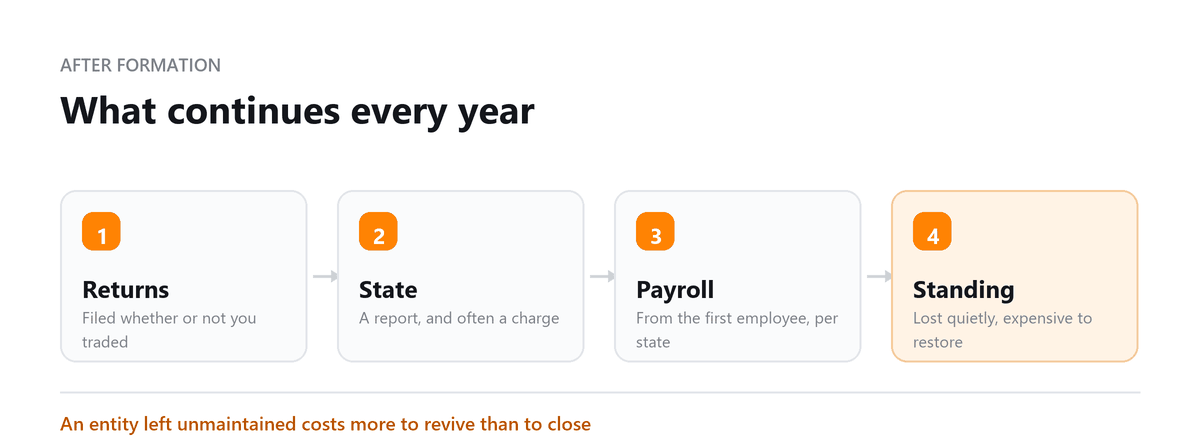
Franchise tax, registered agent fees and annual filings run from year one whether or not you have revenue. A dormant US entity still costs money and still incurs penalties if filings lapse.
Indian founders have obligations at home
An Indian resident investing in a foreign entity falls within the RBI's overseas investment framework, with reporting requirements and timelines attached. This is the single most commonly missed item for founders incorporating from India, and the penalties are not trivial.
Registering in the formation state isn't the end of it
If you later have employees, an office or meaningful activity in another US state, you'll register there as a foreign corporation and pay its fees too. California's $800 minimum franchise tax is the one most founders meet.
Incorporating early can be premature
If you have no US customers, no US hire and no active fundraise, the entity is a cost with no corresponding benefit yet. There's a reasonable case for waiting until one of those three is actually in front of you.
Getting the compliance handled
A US entity generates recurring obligations from day one: federal and state filings, franchise tax, payroll reporting once you hire, registered agent renewals, and multi-state filings as you expand.
Most international founders hand this to a US-based accounting firm at incorporation rather than after the first missed deadline. The reason is practical, the penalties, back taxes and loss of good standing from a compliance gap consistently cost more than the support would have, and the worst time to discover a lapse is during investor diligence.
In its first-year reviews, Profitjets found that approximately 1 in 3 international-founded US entities have at least one unresolved state filing, franchise-tax, or registered-agent compliance issue.
Profitjets works with founders incorporating into the US from India and elsewhere with entity setup through EIN, bank account, ongoing federal and state filings, and books that survive diligence.
Book a free consultation and we will map every filing you will owe.
Frequently Asked Questions
How long does it take to incorporate in the US from India?
The EIN is the variable if an officer has an SSN or ITIN, it's essentially immediate online; without one, you're on a slower application route that can take weeks. The bank account follows the EIN, and payment processors follow the bank account. Plan for a couple of months end to end rather than a few weeks, and start the EIN application as early as possible.
What type of US company should an international founder form?
The choice has real tax consequences on both sides of the border, so take advice on your specific situation rather than picking from a comparison table. Our guide to Delaware LLC vs Wyoming LLC covers the state question.
Do I need to visit the US to incorporate?
No. Formation, EIN, and in many cases bank account opening can all be completed remotely, several neobanks onboard foreign founders without a US visit. Some traditional banks still want an in-person appearance, which is one reason founders default to the newer platforms.
What are my obligations in India if I incorporate in the US?
An Indian resident investing in a foreign entity comes within the RBI's overseas investment framework, which carries reporting requirements and deadlines, and the equity holding also affects your Indian tax filing. This is the most commonly overlooked piece for founders incorporating from India. Speak to a CA who handles cross-border structuring before you form, not after.
Should I incorporate in the US before I have US customers?
Usually no. The entity costs money to maintain from day one and delivers nothing until there's a US customer who needs to contract with you, a US hire, or an investor asking for it. The exception is when a specific opportunity is close enough that the two-month setup timeline would cause you to miss it, in that case, start early, because the EIN won't wait for you.

Written by
Anu Gupta, CA, EA, B.Tech
Anu works with US businesses on tax and entity questions at Profitjets, from choosing a structure to the filings that follow it. She writes about the decisions owners make once and then live with for years. Connect on LinkedIn
Free consultation
Setting Up in the US?
Book a free consultation and we will map every filing you will owe.