
Founders who research a Delaware LLC vs a Wyoming LLC often come with the question already framed between the two states, because the question is always asked in these terms. Delaware has long been the default of the business world, and represents every VC term sheet ever written in the last thirty years. Wyoming presents a case on lower cost, enhanced asset protection and member privacy.
Both are correct but ignore the real question that most people comparing these options have in mind.
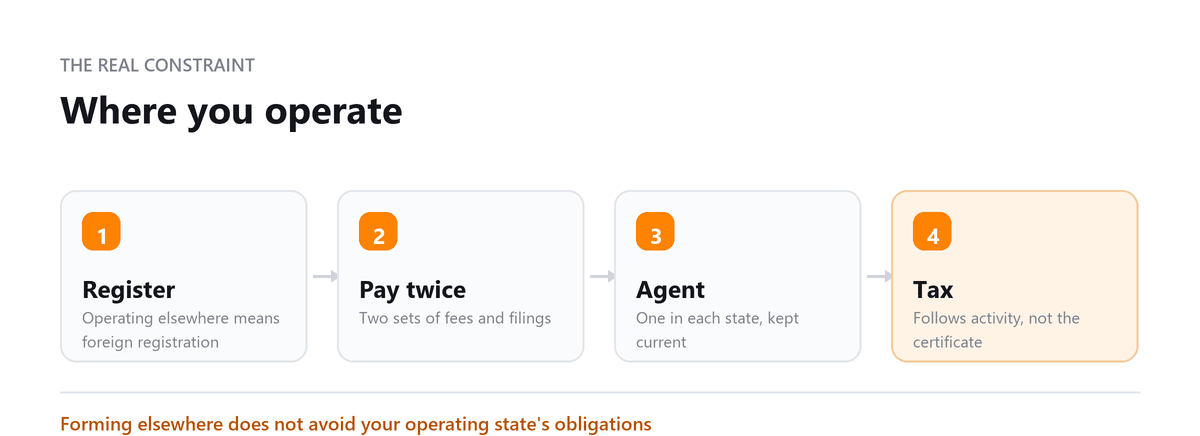
If you are domiciled outside your formation state (and you almost certainly are), that state will require you to register as a foreign LLC, paying its fees and filing its returns. You're maintaining two LLCs now; the one you formed, and the one you're registering as a foreign entity in your home jurisdiction. That $240 a year you saved by forming in Wyoming rather than Delaware is now being spent on something costing more per year than either formation state would have required.
This is not to say that forming in either state is wrong, but that the comparison between them most often ignores the real choice, which is formation state versus home state, and which of those two is cheaper and more strategic.
This guide will cover the features of each state's LLC, the costs of formation in each, when the choice between them makes sense, and when it does not.
Founders pick a formation state and forget that the state they actually work from still wants to hear from them. If you're running the business out of California or Texas, you'll have to register there as a foreign LLC anyway, so you end up with two registered agents, two sets of annual fees and two filings, and the cheaper incorporation turns out to cost more every year than the one you were trying to avoid.
Anu Gupta, CA, EA, B.Tech · LinkedInWhat is a Delaware LLC?
A Delaware LLC is a limited liability company formed under Delaware state law. Delaware's Revised Uniform Limited Liability Company Act (DRULLCA) is one of the most thoroughly tested and flexible LLC statutes in the United States. The state's Court of Chancery, a dedicated business court with no jury trials, resolves corporate disputes quickly using a body of predictable, sophisticated case law that stretches back over 200 years.
- Annual franchise tax: $300 minimum for LLCs (flat fee, not based on shares)
- Annual report: due June 1 each year
- Registered agent required: mandatory if the LLC does not have a Delaware office
- No state income tax on out-of-state income earned by Delaware LLCs
Why Form a Delaware LLC?
Two states dominate the conversation for founders choosing where to form their LLC: Delaware and Wyoming. Delaware has been the default for decades especially for startups raising venture capital.
Investor preference: most venture capital firms and institutional investors require Delaware incorporation. Term sheets and standard SAFE agreements assume Delaware law
- Court of Chancery: business-only court, no jury trials, judges with deep corporate expertise, faster and more predictable outcomes
- Flexible operating agreement: Delaware law allows LLCs to structure governance almost any way they choose, members can waive fiduciary duties, customise profit-sharing, and create complex voting structures
- Privacy: LLC members are not listed in public state records (only the registered agent and organiser appear)
Pros of a Delaware LLC
- Preferred by VCs, angel investors, and accelerators, essential if you plan to raise external capital
- Most complete body of LLC case law, fewer grey areas, more predictable outcomes
- Easy to convert from LLC to C-Corp (common pre-Series A) without reincorporating in a new state
- Strong asset protection and member liability shield
Cons of a Delaware LLC
- Annual franchise tax ($300) plus registered agent costs ($100-$300/year), adds up if the LLC earns little revenue
- If you operate in another state, you must also foreign qualify and pay fees in that state
- Slightly higher formation and ongoing compliance costs than Wyoming
What is a Wyoming LLC?
Wyoming was the first US state to create the LLC structure (1977) and has continued to innovate in business law. It offers some of the strongest asset protection and privacy protections of any US state, with low formation costs and minimal ongoing fees. Wyoming has emerged as a genuine challenger for privacy-conscious founders and small businesses that don't need investor-friendly corporate governance.
- Annual report fee: $60 minimum (or 0.0002 x assets in Wyoming, whichever is greater)
- No state income tax, no franchise tax based on income
- Charging order protection: creditors of an LLC member cannot seize LLC assets, limited to charging orders on distributions
- No requirement to disclose member names in public filings, strong privacy
Pros of a Wyoming LLC
- Lowest annual costs of any major formation state: $60/year vs Delaware's $300+
- Strongest charging order protection in the US, favoured for asset protection planning
- No state income tax, no franchise tax based on revenue or shares
- Privacy: member names not in public records
Cons of a Wyoming LLC
- Not the preferred jurisdiction for venture-backed startups, investors typically require Delaware
- Smaller body of case law compared to Delaware, more legal uncertainty in disputes
- If you operate in another state, you still need to foreign qualify there
Delaware LLC vs Wyoming LLC: Key Differences
| Factor | Delaware LLC | Wyoming LLC |
|---|---|---|
| Annual franchise tax | $300 (flat fee) | $60 minimum |
| State income tax | None on out-of-state income | None |
| Investor acceptance | Preferred by VCs / angels | Not preferred for VC-backed deals |
| Asset protection | Strong | Strongest (charging order) |
| Privacy | Members not in public records | Members not in public records |
| Case law depth | 200+ years, extensive | Growing but thinner |
| Best for | Startups raising capital, tech companies | Small businesses, asset protection, privacy-focused |
Where Should You Incorporate?
- Choose Delaware if: you plan to raise venture capital or angel funding, you will have multiple classes of equity, you anticipate a future exit or IPO, or your lawyers and investors operate in the US startup ecosystem.
- Choose Wyoming if: you are a self-funded small business or sole owner LLC, you want maximum asset protection and privacy, you do not need external investors, and you want to minimise ongoing compliance costs.
Book a free consultation and we will look at where you actually operate.
Frequently Asked Questions
Can I move my LLC from Wyoming to Delaware later?
Yes, through domestication or conversion: both states permit it, so you don't dissolve and re-form. It involves amending the operating agreement and re-registering, and it's worth an attorney rather than a formation service, because the operating agreement is where the cost of getting it wrong shows up years later.
Do I need a physical office in Delaware or Wyoming?
No. Both require only a registered agent with a physical address in the state, which you can hire for a few hundred dollars a year. You can form and run either entity from anywhere in the world. What you can't do is use the registered agent's address to avoid registering where you actually operate.
Is a Delaware LLC better for taxes?
For most LLCs, formation state has very little direct tax effect. You pay income tax where you earn the money and where you live. Delaware's exemption on out-of-state income benefits C-Corps far more than LLCs, and an LLC's treatment flows from its federal classification, sole proprietorship, partnership, S-Corp or C-Corp election, not from where it was formed. Anyone selling you a formation state on tax savings alone is selling you something else.
If I form in Wyoming, do I still pay tax in my home state?
Yes. Doing business in your home state means that state taxes the income and generally requires foreign qualification. Formation state doesn't change where income is earned, and structuring around that is a much more involved exercise than choosing a state on a formation website.
Should I form an LLC or a C-Corp?
If you're raising institutional capital, a Delaware C-Corp is what investors will require and forming as an LLC usually means converting first. If you're self-funded and profitable, an LLC is simpler and avoids double taxation, with S-Corp election available once your profit level makes the payroll tax saving worth the added compliance. The entity question and the state question are separate, decide entity type first, because it changes which state advice applies.

Written by
Anu Gupta, CA, EA, B.Tech
Anu works with US businesses on tax and entity questions at Profitjets, from choosing a structure to the filings that follow it. She writes about the decisions owners make once and then live with for years. Connect on LinkedIn
Free consultation
Deciding Where to Form?
Book a free consultation and we will look at where you actually operate.