
Many healthcare finance executives come from other industries, which means they are accustomed to the finance function being focused on budgets, forecasts, capital investment plans, and reports to the board.
What these executives discover when they join the healthcare sector is that revenue in healthcare is significantly more complicated than in other industries. Prices are not set by the provider but negotiated, the reimbursement for the same procedure may vary drastically depending on the third-party payer, and human error made during coding can result in a claim being denied, even if it was paid months ago.
This is why the finance function of a healthcare entity, and particularly the Chief Financial Officer, is significantly more complex than the same level executive position in other industries. This is the case regardless of the organization of the entity, be it a hospital, a health system, a physician group practice, or a healthcare services firm.
The healthcare CFO has to understand how Medicare and Medicaid reimbursements work, be knowledgeable in revenue cycle management, which is a multi-departmental process, and have knowledge of tax and accounting rules specific to non-profit organizations, which for-profit companies do not have to contend with.
This guide covers what a healthcare CFO does, why the role matters so much, the authority it carries, and the typical path into the job.
What is a CFO in Healthcare?
A Chief Financial Officer in a healthcare organization is a senior financial executive whose responsibilities differ significantly from those of a general corporate CFO. Whether the organization is a hospital, health system, insurance company, or healthcare services company, the CFO must manage the full complexity of CMS reimbursement structures, revenue cycle operations, Medicare and Medicaid cost reporting, and, for non-profit healthcare entities, specialized tax and GAAP considerations that do not apply in other industries.
Healthcare CFOs operate at the intersection of clinical operations and financial management. Their decisions directly affect patient care capacity, staffing, and the organization's ability to invest in technology and facilities. This combination of financial sophistication and healthcare domain expertise makes the role both demanding and critically important.
In most industries, you set your price and the market decides whether to pay it. In healthcare, your biggest payer, the federal government through Medicare, tells you what it will pay. A healthcare CFO's job is to run a financially healthy organization inside rates they can't negotiate. That calls for a very different playbook from a manufacturing or SaaS CFO.
Abhinav Gupta, CPA, CA, MBA · LinkedInImportance of a CFO in Healthcare Organizations
Healthcare is one of the most financially complex industries in the world. The CFO navigates a landscape where payer mix management, CMS cost reports, 340B drug pricing compliance, non-profit GAAP requirements, and physician compensation structures all intersect. Unlike a CFO in manufacturing or technology, where revenue recognition is relatively straightforward, a healthcare CFO must manage revenue from dozens of payer contracts simultaneously, each with different reimbursement rates, billing rules, and contractual adjustments.
A hospital or health system that lacks strong CFO leadership risks revenue leakage through denial management failures, compliance exposure from improper cost reporting, and cash flow instability from poorly managed receivables. The CFO is the financial anchor that keeps the organization solvent and mission-capable.
Role of a CFO in a Healthcare Organization
Financial Planning and Analysis
Healthcare FP&A centers on payer mix modeling, building detailed projections that account for the revenue difference between commercial insurance (highest reimbursement), Medicare, Medicaid (lowest reimbursement), and self-pay patients. The CFO leads budget-to-actual analysis by service line, tracking whether the emergency department, surgical services, outpatient clinics, or other revenue centers are performing against plan. Capital planning encompasses equipment acquisition cycles, facility expansion, and debt service on bond financing, all of which require multi-year financial modeling that accounts for reimbursement trends.
Revenue Cycle Management
The CFO oversees the revenue cycle function end-to-end: charge capture at the point of service, coding accuracy (ICD-10, CPT), claims submission to payers, denial management and appeals, and patient and insurance collections. Days in accounts receivable (AR) is one of the most important financial metrics the CFO monitors, it directly measures how efficiently the organization is converting services rendered into cash collected. A single percentage point improvement in net collection rate at a large health system can represent millions of dollars in recovered revenue annually.
Cost Management and Operational Efficiency
Labor is the largest expense category in most healthcare organizations, typically 55 to 65 percent of total operating expenses. The CFO monitors labor cost per adjusted patient day or equivalent unit of service, manages purchased services contracts, oversees supply chain cost reduction programs, and allocates overhead by department to give clinical leaders an accurate picture of their financial performance. In an environment of thin or negative operating margins (common in non-profit health systems), cost management is not optional, it is existential.
Risk Management and Compliance
Regulatory compliance in healthcare has direct financial consequences. HIPAA violations carry significant financial penalties. Medicare and Medicaid conditions of participation must be maintained or the organization loses access to its largest revenue source. Stark Law and Anti-Kickback considerations govern physician compensation arrangements, structuring these incorrectly creates both legal and financial exposure. The CFO also manages malpractice reserve adequacy, working with actuaries to ensure reserves reflect expected claim settlements.
Financial Reporting and Investor/Creditor Relations
Non-profit healthcare organizations follow GAAP with specific guidance under ASC 954 (Health Care Entities), which requires presentation of net assets (restricted vs. unrestricted), charity care disclosure, and specific rules for healthcare-unique transactions. For organizations with tax-exempt bonds, the CFO ensures covenant compliance and manages relationships with rating agencies (Moody's, S&P, Fitch) that assess creditworthiness. The CMS cost report, an annual filing that determines Medicare reimbursement calculations, requires significant preparation effort and is subject to government audit.
How to Become a CFO in Healthcare
The educational foundation for a healthcare CFO typically includes a bachelor's degree in accounting or finance, followed by a CPA credential or an MBA, often both. Early career experience can come through hospital finance departments, public accounting audit of healthcare clients, or healthcare management consulting. The career progression generally moves from financial analyst to controller to VP Finance to CFO, spanning 15 to 20 years.
The HFMA (Healthcare Financial Management Association) FHFMA designation is widely recognized in the field and signals healthcare finance specialization, though it is not universally required for CFO positions.
Authorities of a Healthcare CFO
The healthcare CFO holds signing authority on material contracts and financing agreements, including bond issuances and credit facility draws. The CFO exercises approval authority over capital expenditures above defined thresholds and sets accounting policies for the organization. The role carries direct oversight of revenue cycle operations, supply chain finance, and treasury functions. The CFO serves as the primary management representative to the board finance committee and audit committee, presenting financial results, capital plans, and risk assessments.
Conclusion
The CFO in a healthcare organization carries responsibilities that extend far beyond those of a general corporate finance executive. Revenue cycle complexity, CMS reimbursement structures, 340B compliance, and non-profit accounting requirements demand a specialist with both deep financial expertise and healthcare domain knowledge. Organizations that invest in strong CFO leadership are better positioned to protect margins, manage compliance risk, and make the capital allocation decisions that sustain their clinical mission.
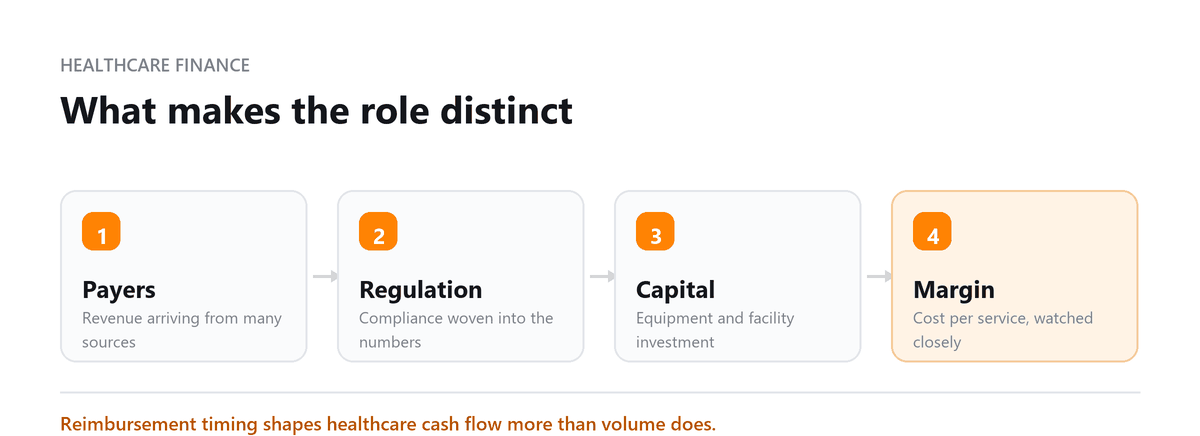
In healthcare finance, I’ve found that revenue alone rarely tells the full story. In one engagement, we worked through reimbursement timing, operating costs, and cash-flow requirements to give the leadership team a clearer view of where money was being tied up. Once those numbers were brought into regular forecasting and reporting, the team could make operating and investment decisions with much better visibility.
Book a free consultation and we will bring the finance function up to speed.
Frequently Asked Questions
What is revenue cycle management, and why does it matter so much to a healthcare CFO?
Revenue cycle management is the process of tracking a patient's care from registration all the way to final payment. It covers charge capture, coding, claims submission, payer follow-up, and collections. For the CFO, it's the main driver of cash flow, and meaningful improvements in collection rates or days in AR can recover millions in revenue.
What accounting standards apply to non-profit healthcare organizations?
They follow GAAP along with healthcare-specific guidance under ASC 954. The main differences from for-profit accounting include presenting net assets as restricted or unrestricted, disclosing charity care, accounting tied to the CMS cost report, and particular rules for healthcare transactions.
Does a healthcare CFO need an HFMA certification?
It helps but isn't required. HFMA designations like the FHFMA and CHFP are well respected and can support career growth, since they show a commitment to healthcare finance. Plenty of healthcare CFOs hold a CPA, an MBA, or both without any HFMA credential.
What is the 340B program, and why should a healthcare CFO care about it?
The 340B program lets eligible organizations, including disproportionate share hospitals and federally qualified health centers, buy outpatient drugs at steep discounts. The CFO oversees compliance with the program's requirements, protects the organization's eligibility, and manages the financial benefit, which can be significant for those who qualify.
How does a healthcare CFO manage payer mix?
Payer mix is how revenue splits across commercial insurance, Medicare, Medicaid, and self-pay patients. The CFO tracks how that mix shifts over time and models the financial effect. A move toward more Medicaid patients, for example, can pull net patient revenue down noticeably even if the number of patients stays the same.

Written by
Abhinav Gupta, CPA, CA, MBA
Abhinav works with business owners across the US on industry-specific bookkeeping, from dental practices and restaurants to construction and e-commerce. He writes about what each trade's books actually need. Connect on LinkedIn
Free consultation
Leading a Healthcare Organisation?
Book a free consultation and we will bring the finance function up to speed.