
The E-commerce landscape is one of the most fast moving businesses and the environment is gaining traction over time. Maintaining an E-commerce business requires understanding the tax obligations across multiple states and franchises. With fees on the marketplace, raw material procuring expenses and operating recurrent warehouse expenses, the financial picture becomes challenging.
Contrary to conventional businesses, Ecommerce businesses must navigate tax rules across muti states and muti jurisdictions at the same time. Recurring expenses often go unnoticed which later impacts the working capital for the business. Maintaining accurate records on financial transactions is significant for the Ecommerce owners to anchor growth and expansion.
What begins as the online sales soon transition into tracking payment, replacement, shipping fee across different geographical regions. Bookkeeping services comprise the financial data as actionable business insights to march toward sustainability.
Most of the successful businesses outsource their bookkeeping practices early to save time and avail the eligible deductions in the tax hassle. Modern workflows need modern financial framework to support scalability with increasing transactional volume.
This guide details the bookkeeping practices that E-commerce businesses must follow to have a clear financial audit-ready framework for investors.
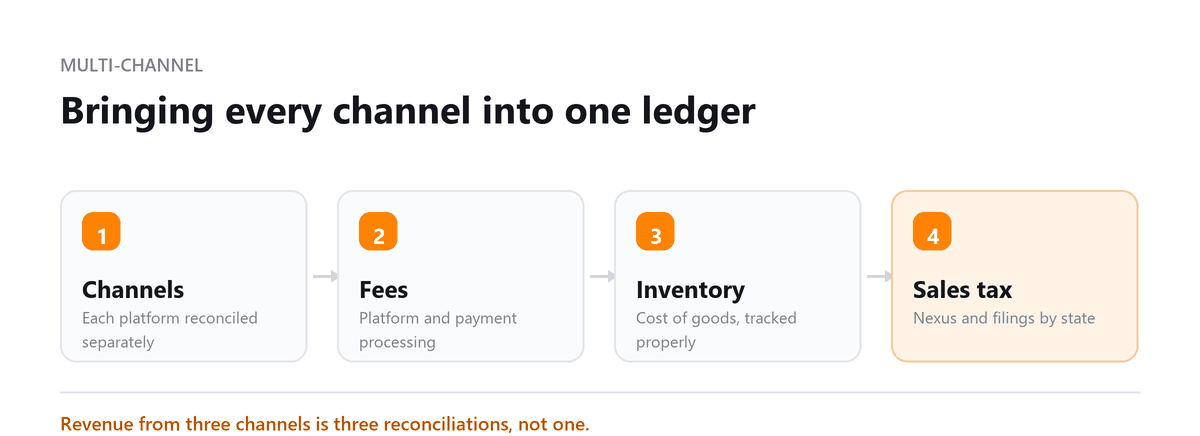
E-commerce bookkeeping has become more complex in the last five years, not less. Multi-channel selling, multi-state sales tax, marketplace fee reconciliation, and inventory valuation across warehouses all require systems that a basic bookkeeper or a simple spreadsheet cannot handle.
Abhinav Gupta, CPA, CA, MBA · LinkedInWhat is E-commerce Bookkeeping?
E-commerce bookkeeping is the systematic recording of all financial transactions in an online selling business. It covers:
- Sales: Revenue from every channel, Shopify, Amazon, Etsy, eBay, direct website
- Purchases: Inventory procurement, supplier invoices, and cost of goods sold (COGS)
- Expenses: Platform fees, shipping costs, advertising, software subscriptions, fulfilment costs, returns and refunds
- Taxes: Sales tax collected and remitted by state, VAT for international sales
Unlike traditional retail, e-commerce bookkeeping must handle marketplace fee reconciliation, split payouts from platforms, and high-volume digital transaction processing.
The reality is that the bookkeeping infrastructure that supports a $100,000-per-year online store is rarely sufficient for a business processing millions in annual sales. The transition to more sophisticated systems must happen before operational complexity creates reporting errors, tax issues, or cash flow surprises. Businesses that invest in scalable bookkeeping processes early are typically better positioned to grow efficiently and maintain control as transaction volumes increase.
Ultimately, e-commerce bookkeeping is about turning large volumes of financial data into meaningful business insights. When sales channels, inventory systems, payment platforms, and accounting records work together seamlessly, business owners gain a clear understanding of their financial performance and a stronger foundation for sustainable growth.
Why Bookkeeping Matters for E-commerce
- Accuracy and compliance: Correct records keep you compliant with sales tax laws in every state where you have nexus
- Profitability insights: Know your true margin after platform fees, shipping, and returns
- Informed growth: Data-driven decisions about which products, channels, and markets to invest in
- Easier tax preparation: Clean records make year-end filing straightforward rather than stressful
At Profitjets, we work with e-commerce brands at every stage of growth from Shopify stores generating their first six figures in annual revenue to multi-channel sellers processing thousands of transactions each day across Amazon, Walmart, Etsy, and direct-to-consumer channels. One of the most common challenges we see is businesses relying on bookkeeping systems that worked during their early growth phase but are no longer capable of handling increasing transaction volumes and operational complexity.
Many e-commerce entrepreneurs are surprised to discover that strong sales numbers alone do not provide an accurate picture of business performance. Marketplace fees, fulfillment expenses, advertising costs, returns, chargebacks, and inventory adjustments can significantly impact profitability. We regularly help clients uncover margin leaks and reporting inaccuracies that were hidden beneath growing revenue figures. Once proper bookkeeping processes and integrations are in place, owners gain the visibility needed to make confident decisions about inventory, pricing, marketing spend, and expansion.
Advantages of E-commerce Bookkeeping Done Right
- Automation: Integrate your selling platforms directly with accounting software to eliminate manual data entry
- Scalability: A well-structured bookkeeping system grows with your sales volume without breaking
- Real-time insights: Live dashboards show cash position, inventory value, and profit margins at any moment
- Reduced stress: Clear records eliminate the anxiety of tax season and investor due diligence
Basic Principles of E-commerce Bookkeeping
- Separate your business and personal finances from the start, open a dedicated business account
- Choose accounting software with native e-commerce integrations (QuickBooks, Xero, A2X)
- Categorise every transaction accurately, sales, refunds, fees, and shipping are not the same
- Reconcile accounts monthly, match platform payouts to bank deposits to accounting records
- Back up all financial data, use cloud software and download regular exports
How to Do E-commerce Bookkeeping: 8-Step Process
Step 1: Organise Your Documents
Gather all platform statements, bank records, credit card statements, supplier invoices, and shipping manifests. Establish a consistent digital filing system.
Step 2: Choose Your Accounting Software
Select a platform that integrates with your selling channels. QuickBooks Online and Xero with A2X middleware are the most common combination for multi-channel sellers.
Step 3: Create Your Chart of Accounts
Build accounts that reflect e-commerce reality: separate income accounts per channel, COGS, shipping expense, marketplace fees, returns, and advertising.
Step 4: Record All Transactions
Import transactions from all sales channels and bank accounts. Use automation wherever possible to reduce manual entry.
Step 5: Classify Transactions Accurately
Match every line item to the correct category. Misclassifying marketplace fees as revenue, or shipping costs as COGS, distorts your profit figures.
Step 6: Reconcile Monthly
Compare your books to bank statements and platform payout reports. Every discrepancy must be investigated and resolved.
Step 7: Generate Financial Reports
Produce a monthly income statement, balance sheet, and cash flow statement. Review gross margin, net margin, and COGS as a percentage of sales.
Step 8: Consult Professionals for Complex Tasks
Sales tax nexus analysis, inventory valuation methods (FIFO vs LIFO), and international VAT compliance require specialist knowledge. Do not handle these alone.
Advanced Tips for E-commerce Bookkeeping
Mastering Inventory Management
Track inventory levels in real time to prevent overselling. Calculate COGS accurately using your chosen inventory costing method. FIFO (First In, First Out) is the most common and is generally preferred for perishable goods or fast-moving SKUs; LIFO (Last In, First Out) may reduce taxable income in inflationary environments but is not permitted under IFRS.
Managing Sales Tax
Post-Wayfair, every US state can require sales tax collection from online sellers who exceed economic nexus thresholds, even without a physical presence. Work with a qualified accountant to identify your nexus states, register where required, and file on time. International sellers must also account for VAT obligations in the EU, UK, and other markets.
Streamlining the Workflow
Automate data entry using platform-native integrations or middleware tools. Use cloud-based software so your bookkeeper and accountant can access records without file transfers. Implement strong data security, e-commerce accounts are a target for fraud.
Optimising for Growth
Track key KPIs: conversion rates, customer acquisition costs, average order value, and return rate. Create monthly budgets and quarterly forecasts. Use your financial data to decide which channels, products, and marketing spend deliver the best return.
Book a free consultation and we will reconcile them into one clean ledger.
Frequently Asked Questions
How do I handle sales tax for my online store?
Start by determining where you have economic nexus, most states set a threshold of $100,000 in sales or 200 transactions per year. Register in each nexus state, collect the correct rate, and remit on time. Platforms like TaxJar or Avalara can automate the calculation and filing process.
What is the best bookkeeping software for e-commerce?
QuickBooks Online or Xero paired with A2X for marketplace reconciliation is the most popular combination for growing e-commerce businesses. A2X automatically maps Amazon, Shopify, and eBay payouts into clean journal entries, saving hours of manual reconciliation.
How should I account for Amazon or Shopify fees?
Platform fees should be recorded as a separate expense category, not netted against revenue. This gives you a clear picture of your gross revenue and your true cost of selling on each channel.
What is COGS and how do I calculate it for e-commerce?
Cost of Goods Sold (COGS) = Opening Inventory + Purchases during the period - Closing Inventory. COGS represents the direct cost of the products you sold. Accurate COGS calculation is essential for knowing your true gross margin.
Do I need an accountant for my e-commerce business?
For very small operations, bookkeeping software alone may suffice. However, once you are selling across multiple states or countries, holding significant inventory, or planning for investment, a qualified e-commerce accountant is a worthwhile expense.
Conclusion
E-commerce success is built on more than great products and smart marketing, it requires financial infrastructure that can handle complexity, scale with growth, and keep you compliant. Building the right bookkeeping system from the start, or upgrading it as you grow, is one of the highest-leverage investments an online seller can make.

Written by
Abhinav Gupta, CPA, CA, MBA
Abhinav works with business owners across the US on industry-specific bookkeeping, from dental practices and restaurants to construction and e-commerce. He writes about what each trade's books actually need. Connect on LinkedIn
Free consultation
Selling on More Than One Channel?
Book a free consultation and we will reconcile them into one clean ledger.