
Real estate bookkeeping extends beyond tracking records and maintaining accuracy. The process involves evaluating the factors in a volatile market such as depreciation, cost flexibility, cash flow tracking and managing expenses on marketing events. Maintaining all these while still calculating the true profit from the property becomes a struggle. Furthermore availing loan, insurance formalities while passing through the seasonal demand imposes the financial decisions.
Every property comprises beyond the equity of building and rent collection as the recurring expenses on maintenance often go unnoticed. Property tax obligations and compliance regulations must be followed by the real estate investors to pass through the tax season without any financial stress.
Without a structured bookkeeping practice, it becomes difficult to understand the true standing of the property. To detect if the property is producing profits or slowly consuming the returns over time with add on expenses. Real estate bookkeeping is the financial framework that creates strategic business decisions. Successful investors know that remarkable returns are a part of healthy financial discipline. When the records are accurate, the tax season can be passed through efficiently with confidence.
This blog serves as the comprehensive guide on how to get the real estate bookkeeping right for investors by overcoming financial challenges.
Real estate bookkeeping that only tracks cash flow is missing half the picture. Depreciation, cost basis adjustments, capital improvement tracking, and refinance accounting all affect your true return on each property, and they are all invisible unless your books are set up correctly.
Abhinav Gupta, CPA, CA, MBA · LinkedInWhat is Real Estate Bookkeeping?
Real estate bookkeeping is the systematic recording and management of all financial transactions across a property portfolio. Core functions include:
- Recording rental income when rent is received
- Tracking all operating expenses: maintenance, insurance, property management fees, utilities, and property taxes
- Performing bank reconciliations monthly
- Maintaining rent rolls, a current record of all tenants, lease terms, and rent amounts
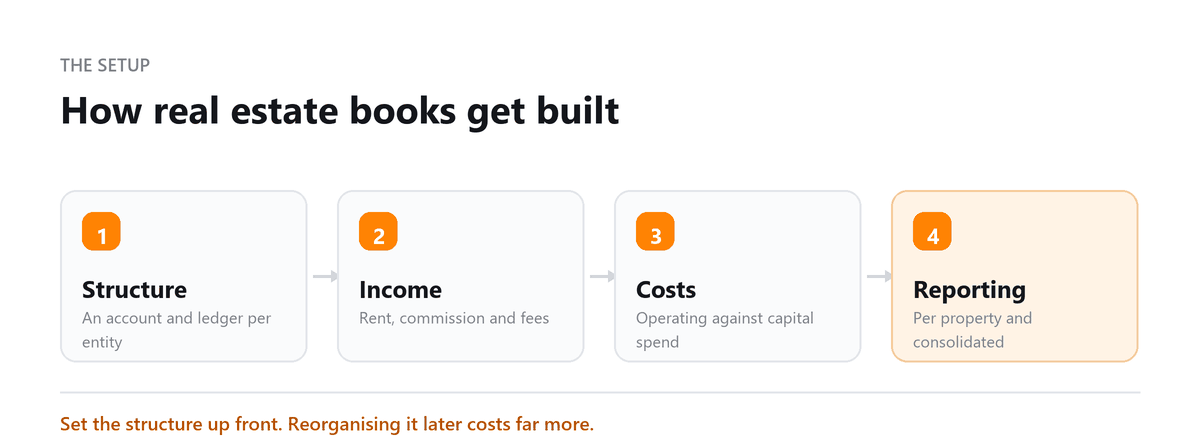
- Producing monthly financial reports per property and for the portfolio as a whole
Robust bookkeeping is crucial for maximising rental revenue, tax efficiency, and long-term investment returns.
Why Bookkeeping Matters for Real Estate Investors
- Track rental income and expenses accurately across every property
- Simplify tax filing, Schedule E, depreciation, cost segregation, and 1031 exchanges all require clean records
- Build creditworthiness, lenders require organised financials for refinancing and portfolio expansion
- Identify new opportunities, financial analysis reveals which properties to keep, improve, or sell
- Stay compliant, accurate records protect you in the event of an IRS audit
Advantages of Strong Real Estate Bookkeeping
- Enhanced decision-making: Know the true net return on each property before deciding to sell, refinance, or reinvest
- Precise tax liability: Maximise depreciation deductions and correctly track cost basis
- Clear profitability insights: Understand which property types and markets deliver the best risk-adjusted returns
- Fund access: Clean financials make it significantly easier to secure financing for the next acquisition
- Reduced compliance risk: Organised records reduce audit exposure and simplify regulatory filings
Basic Principles of Real Estate Bookkeeping
- Record rental income in the period it is received; do not mix with personal income
- Reconcile bank accounts and property management statements routinely, monthly at minimum
- Track income and expenses separately for each property in its own set of accounts
- Maintain current rent rolls with lease expiry dates, deposit amounts, and payment history
- Establish clear processes for cash in (rent, security deposits) and cash out (repairs, management fees, mortgage payments)
- Keep detailed, organised records of all invoices, receipts, and bank statements
How to Do Real Estate Bookkeeping
For each property in your portfolio, the following process should be in place:
Custom Onboarding
Set up a dedicated account structure for the property: income accounts (rent, late fees, laundry income), expense accounts (by category), and asset accounts (purchase price, capital improvements).
Daily Transaction Entry
Record rent receipts, maintenance invoices, and disbursements as they occur, not in a monthly batch. Real-time entry prevents errors and backlogs.
Expense Tracking
Categorise every expense correctly. A capital improvement (new roof) is treated differently from a repair (patching a leak). Misclassification affects both your tax return and your reported profitability.
Budgeting Tools
Set an annual budget for each property covering expected maintenance, capex reserves, insurance renewals, and vacancy allowances. Compare actuals to budget monthly.
Monthly Reports
Produce a property-level income statement, cash flow summary, and rent roll reconciliation every month. Review trends over rolling 12-month periods.
Annual Tax Preparation
Provide your CPA with organised records covering all income, all expenses, depreciation schedules, and any capital improvements, well before the filing deadline.
Challenges of DIY Real Estate Bookkeeping
- Data entry errors: Manual entry across multiple properties and bank accounts leads to mistakes that compound over time
- Inconsistent reconciliation: Skipping monthly reconciliation allows discrepancies to accumulate until tax season
- Confusing income and expense classification: Repairs vs capital improvements, security deposits vs income, the distinctions matter significantly for tax purposes
- Complex depreciation calculations: Residential properties depreciate over 27.5 years; commercial over 39 years. Cost segregation can accelerate deductions but requires specialist analysis
- Ever-changing compliance rules: 1031 exchange rules, opportunity zone regulations, and state-level landlord tax requirements change regularly
At Profitjets, we work with real estate investors ranging from first-time landlords to experienced portfolio owners managing multiple residential and commercial properties. One of the most common issues we encounter is incomplete financial tracking. Investors often focus heavily on purchasing the right property but underestimate the importance of maintaining accurate records afterward. Years later, when preparing for a refinance, sale, partnership reporting requirement, or tax filing, reconstructing those records become expensive and time-consuming.
We have helped investors organize property-level reporting, track capital improvements correctly, and establish bookkeeping systems that provide real-time visibility into profitability and cash flow. In many cases, clients discover that properties they believed were performing well looked very different once maintenance costs, depreciation, vacancy periods, and financing expenses were properly accounted for. Reliable bookkeeping transforms assumptions into measurable financial insights.
Advisory Services for Better Real Estate Performance
Beyond bookkeeping, a specialist real estate accounting firm can help you:
- Lower your tax liability through depreciation strategies, cost segregation, and timing of capital improvements
- Secure better financing rates by presenting clean, well-organised financials to lenders
- Identify the highest-ROI properties in your portfolio using standardised performance metrics
- Reduce operating expenses through benchmarking against comparable properties and vendor negotiation support
Book a free consultation and we will design the ledger before it grows.
Frequently Asked Questions
What is the best way to organise rental property records?
Use a cloud-based accounting platform (QuickBooks Online or Xero) with a separate class or sub-account for each property. Store all supporting documents (invoices, lease agreements, bank statements) in a linked document management system such as Google Drive or Dropbox.
Can I use QuickBooks for real estate bookkeeping?
Yes. QuickBooks Online is widely used for real estate bookkeeping. Set up each property as a class, configure income and expense accounts for rental operations, and use the reconcile function monthly. For larger portfolios, Buildium, AppFolio, or Stessa may offer more property-specific features.
How do I handle security deposits in my books?
Security deposits are a liability, not income. Record them in a separate liability account when received. When returned to the tenant, debit the liability account. When retained for damages, move the amount to income and document the reason.
What is depreciation and how does it affect my real estate taxes?
Depreciation allows you to deduct the cost of a rental property over its useful life (27.5 years for residential, 39 years for commercial). This non-cash deduction reduces taxable income each year. When you sell, depreciation recapture tax applies, your accountant should model this before you decide to sell.
When should a real estate investor outsource bookkeeping?
As soon as you own more than one rental property or are spending more than a few hours per month on your books, outsourcing typically pays for itself. Specialist real estate bookkeepers reduce errors, improve tax efficiency, and free you to focus on acquiring and managing properties.
Conclusion
Real estate bookkeeping done right is an investment strategy in its own right. Clean records improve tax efficiency, enable better financing, and give you the visibility to manage and grow your portfolio with confidence. Whether you use a property management platform, a general accounting system, or a specialist outsourced team, the discipline of consistent, accurate bookkeeping is what separates the investors who scale from those who stagnate.

Written by
Abhinav Gupta, CPA, CA, MBA
Abhinav works with business owners across the US on industry-specific bookkeeping, from dental practices and restaurants to construction and e-commerce. He writes about what each trade's books actually need. Connect on LinkedIn
Free consultation
Want It Structured Properly?
Book a free consultation and we will design the ledger before it grows.