
Maintaining books seems feasible in the beginning and it slowly becomes a handful. Your pending reconciliations for every month become a quarter in a blink. Misclassified transactions slowly compounds to more than hundreds from multiple sources. Your financial statements are no longer indicating your current picture of your business. Poor visibility leads to a working capital crisis which influences decisions without the financial accuracy.
Catch up bookkeeping is when your pending backlogs, errors are resolved and financial records are documented at present. It is a process structured to maintain efficiency and consistency. In 2026, lagging behind in books is an issue that most of the business owners face. Seasonal changes pile up bookkeeping when it comes to changes in staffing, peak workloads, increase in transactional volume, software transition and structural changes. The problem is insufficient time and resources to fulfill the requirements.
The more you delay in resolving the bookkeeping challenges the more you’re burning your cash. As the saying goes, prevention is always better than the cure the applies when it comes to bookkeeping as well. This article explains bookkeeping process, how it works in 2026 for business owners to make strategic decisions.
The longer you wait to address a bookkeeping backlog, the more it costs, in time, in accountant fees at year-end, and in the quality of decisions made without accurate financial data. Acting quickly is always the right move.
Ankit Sarawagi, CPA, CA, MBA · LinkedInWhat is Catch-Up Bookkeeping?
Catch-up bookkeeping involves updating accounting records and backdating entries to ensure all historical transactions are accurately recorded in your accounting software. The goal is to produce financial statements that reflect the business's true financial position for all outstanding periods, not just the current month.
When Does a Business Need Catch-Up Bookkeeping?
- Records have been neglected for weeks, months, or years
- There are missing financial documents, receipts, invoices, or bank statements not recorded
- Bank and credit card statements do not reconcile with accounting records
- Financial reports are distorted, incomplete, or simply missing for past periods
- Tax filing is approaching and historical records are not in an acceptable state
- The business has grown and transaction complexity has outpaced record-keeping capacity
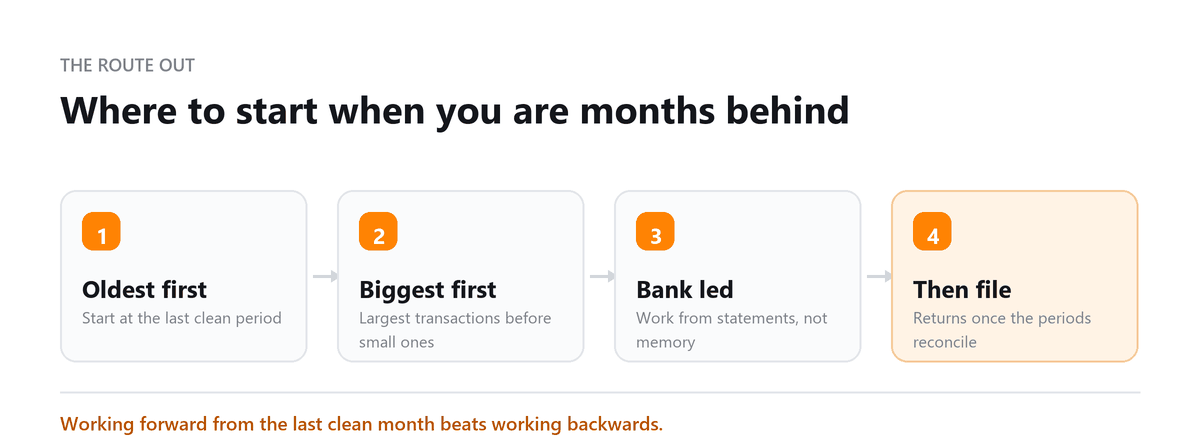
How Catch-Up Bookkeeping Works: Step by Step
Step 1: Initial Assessment
A bookkeeper evaluates the backlog, how far back it goes, what transaction types are involved, what software is in use, and what documentation is available. This determines the scope and timeline of the catch-up engagement.
Step 2: Data Gathering and Organisation
All financial documents are collected and organised: bank statements, credit card statements, bills, invoices, receipts, and payroll records. Gaps in documentation are identified at this stage so missing records can be requested from banks or vendors.
Step 3: Data Entry and Categorisation
Transactions are entered into the bookkeeping software and classified accurately, income, expenses, assets, liabilities, for every period in the backlog. Correct categorisation is critical because financial reports, tax filings, and business analysis all depend on it.
Step 4: Account Reconciliation
Bank and credit card statements are reconciled with the entries in the bookkeeping software. Every discrepancy is identified and resolved, whether caused by a missing transaction, a duplicate, a bank error, or a timing difference.
Step 5: Generating Financial Reports
With all records accurate and reconciled, financial reports are produced: balance sheet, income statement, and cash flow statement. These provide a complete, accurate view of the business's financial position for every period covered.
Step 6: Ongoing Bookkeeping Support
The final step is establishing a plan to prevent the backlog from recurring. Options include engaging ongoing professional bookkeeping, implementing cloud accounting software with automated bank feeds, or a hybrid model with professional periodic review.
What Does Catch-Up Bookkeeping Cost?
| Factor | Description | Impact on Cost |
|---|---|---|
| Complexity | Extent of backlog, volume of missing documents | Higher complexity = higher cost |
| Business size | Number of transactions per period | More transactions = higher cost |
| Provider | Experience, reputation, turnaround speed | Varies by provider |
Most professional services quote catch-up bookkeeping as a fixed project fee based on scope assessment. Always request a clear quote before work begins, and confirm what is included in the price.
Our professionals handle catch-up bookkeeping services for almost 500+ clients throughout the year comprising volumes across industries. First we tell clients that longer the backlogs remain, longer it takes to resolve the challenges. For instance, one of our clients was afraid that their backlogs could be resolved. When we took over we assessed their situation and implemented a structured approach. Recovered business owners from pending reconciliations,reporting inconsistencies and inaccurate records.
The result when the existing numbers were updated with clear records, he was able to see their financial standing which regained faith and enabled strategic decisions based on the data.
Book a free consultation and we will catch the books up and keep them there.
Frequently Asked Questions
How long does it take to catch up on bookkeeping?
Duration depends on transaction volume and how far back the backlog goes. Professional services can typically complete several months of catch-up within a week or two. Years of backlog take longer, but a clear timeline should be provided upfront.
Can I do my own catch-up bookkeeping?
Yes, but for significant backlogs it is often not the best use of your time. Professional bookkeepers work through backlogs faster, make fewer errors, and know how to handle missing documentation more efficiently than most business owners.
What software is recommended for bookkeeping in 2026?
QuickBooks Online, Xero, and FreshBooks remain the leading options for small businesses. The right choice depends on your transaction volume, industry, and integration requirements. A professional bookkeeper can advise on the best fit for your situation.
How much does catch-up bookkeeping cost?
Costs vary by provider, volume, and complexity. Most professional firms quote catch-up as a fixed project fee after an initial scope assessment. This is preferable to open-ended hourly billing for a project with an unclear timeline.
Why is regular bookkeeping important after catching up?
Because catch-up bookkeeping solves the past, but only good habits prevent a future backlog. Regular, current records ensure compliance, provide accurate insights for decision-making, and keep you audit-ready and investor-ready at all times.
Conclusion
Catch-up bookkeeping is a finite, solvable problem, but it requires a systematic approach to do it correctly. Working through the six steps outlined in this guide, whether self-managed or with professional support, will produce accurate financial records that can be relied upon for tax filing, business decisions, and future planning. Once the backlog is cleared, the priority shifts to ensuring it never builds up again.

Written by
Ankit Sarawagi, CPA, CA, MBA
Ankit leads the finance team at Profitjets, where he has worked with 500+ businesses across the US on bookkeeping, tax and CFO-level strategy. He writes about the habits that keep small business books accurate all year. Connect on LinkedIn
Free consultation
Want Help Getting Current?
Book a free consultation and we will catch the books up and keep them there.