
Choosing the bookkeeper aligning with their requirements is the main deciding factor for every small business owner. While experience and industry insights are required,ensuring if your bookkeeper is professionally certified gives additional guarantee that your finances are handled well. When your bookkeeper has finished his/her training with certification it portrays the standards they offer with quality of their service. Ensuring professional qualifications are vital for business owners in handling their key operations.
This article walks you through the qualifications and responsibilities of the best bookkeeper to affirm financial clarity in your business.
At Profitjets, we ensure that every bookkeeper is professionally trained, qualified and certified. This builds authority in our clients and the expertise it provides to them. Certified bookkeepers in our team help ensure financial clarity when explaining the complex decisions to the clients.
The CB certification exists for a reason, it means the bookkeeper has been tested on real-world accounting scenarios, not just basic data entry. When accuracy matters, certification is the baseline, not a bonus.
Ankit Sarawagi, CPA, CA, MBA · LinkedInWho is a Certified Bookkeeper?
A certified bookkeeper is a financial professional who has completed formal training and passed a recognised examination to earn the CB (Certified Bookkeeper) credential. Unlike a basic bookkeeper who simply records transactions, a certified bookkeeper has demonstrated expertise in accurate record-keeping, regulatory compliance, and financial analysis. The CB designation is awarded by professional bodies such as the American Institute of Professional Bookkeepers (AIPB).
What Certifications Should a Bookkeeper Have?
Two certifications are most widely recognised in bookkeeping and accounting:
- Certified Bookkeeper (CB): Demonstrates competency in core bookkeeping principles, day-to-day financial recording, and accounts management. The right credential for a dedicated bookkeeping professional.
- Certified Public Accountant (CPA): A broader credential covering auditing, tax preparation, and advanced financial analysis. CPAs are trained accountants, not bookkeepers, their services typically cost more and are suited to more complex financial needs.
Roles and Responsibilities of a Certified Bookkeeper
A certified bookkeeper’s responsibilities extend well beyond basic transaction recording:
- Balancing the books to ensure all income and expenses are correctly recorded
- Reconciling accounts to identify and eliminate errors and discrepancies
- Managing payroll processing and tax compliance
- Generating clear, accurate financial reports
- Creating budgets and cash flow forecasts
Benefits of Hiring a Certified Bookkeeper
Accuracy and Security
Certification means your bookkeeper has been tested on the standards that prevent errors and fraud. Accurate records from the start are far cheaper than correcting messy books later.
Compliance and Peace of Mind
Certified bookkeepers understand tax regulations and reporting requirements. They will keep your records in a state that satisfies auditors and tax authorities, reducing your risk of penalties.
Business Insights and Growth Strategy
Beyond compliance, a strong bookkeeper analyses trends in your financial data, flags anomalies, and highlights optimisation opportunities that a basic record-keeper would miss.
Freed-Up Time
Delegating bookkeeping to a certified professional lets you focus on the parts of the business only you can run, rather than spending hours in spreadsheets.
How to Choose the Best Certified Bookkeeper
Use this process to narrow down your options:
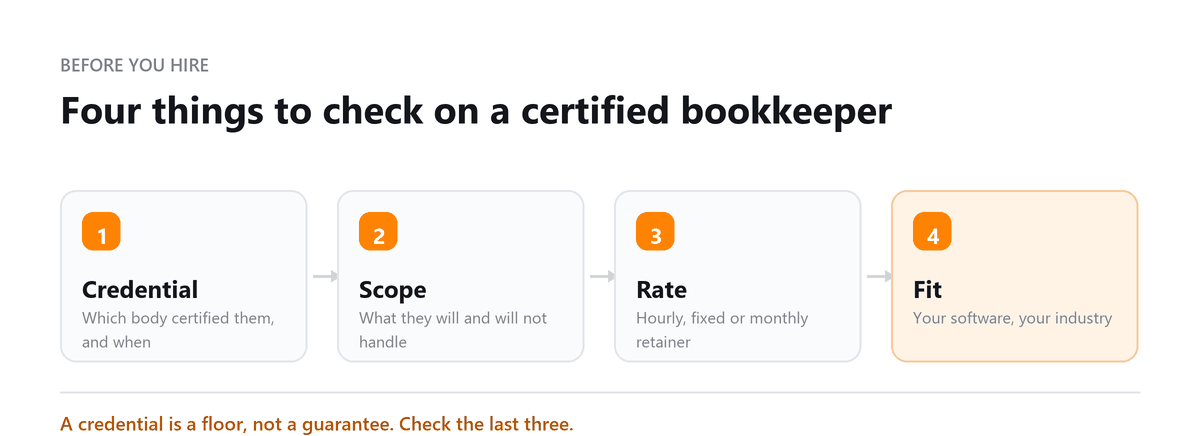
- Define your specific financial needs and business structure before you start searching
- Request referrals from colleagues, your accountant, or professional organisations
- Verify credentials, ask to see the CB certificate and check it is current
- Review online profiles and client testimonials for evidence of consistent quality
- Schedule a consultation to assess their communication style and whether they understand your industry
- Check references from at least two previous clients
- Agree a contract that specifies scope, fees, turnaround times, and confidentiality obligations
Hourly Rates for a Certified Bookkeeper
Rates vary depending on experience, location, and the complexity of the work:
| Region | Typical Range | Average |
|---|---|---|
| United States | $30 to $50 per hour | ~$40 per hour |
| Canada | $25 to $40 per hour | ~$35 per hour |
| United Kingdom | £50, £70 per hour | ~£60 per hour |
Key factors affecting cost: level of experience and specialised knowledge, geographic location (metropolitan vs. regional), complexity of the work (basic transaction recording vs. full payroll management), and project volume.
Certified Bookkeeper vs. CPA: Which Do You Need?
| Feature | Certified Bookkeeper (CB) | Certified Public Accountant (CPA) |
|---|---|---|
| Focus | Day-to-day bookkeeping | Broader financial services |
| Services | Bookkeeping, A/P, A/R, payroll, reports | Auditing, tax planning, consulting |
| Education | Associate’s degree + CB certification | Bachelor’s degree + CPA exam |
| Ideal For | Small businesses, solopreneurs | Complex finances, tax expertise needed |
| Hourly Rate | ~$30 to $50 | ~$50 to $100 |
| Best For | Accurate, efficient day-to-day records | Tax optimisation, audits, planning |
Book a free consultation and we will match you with the right person.
Frequently Asked Questions
What is a Certified Bookkeeper (CB)?
A Certified Bookkeeper is a professional who has passed a formal examination administered by a recognised body, typically the American Institute of Professional Bookkeepers (AIPB) in the US. The CB credential confirms competency in bookkeeping principles, account reconciliation, payroll, and financial reporting.
How much does a certified bookkeeper cost per hour?
In the US, expect to pay $30 to $50 per hour for a certified bookkeeper, with an average around $40. Rates in Canada are slightly lower ($25 to $40), while UK rates tend to be higher (£50, £70). Monthly retainer packages from bookkeeping firms often work out cheaper than hourly billing.
Do I need a certified bookkeeper or a CPA?
Most small businesses need a bookkeeper for day-to-day records and a CPA for annual tax filing and strategic financial advice. These are complementary roles, not interchangeable ones. Start with a certified bookkeeper and bring in a CPA for tax season or major financial decisions.
How do I verify a bookkeeper’s certification?
Ask to see their certificate and check it is current. For the CB credential, you can contact the AIPB directly to verify membership. Reputable bookkeepers will have no hesitation providing proof of their credentials.
What is the difference between a bookkeeper and a CPA?
A bookkeeper records and organises your financial transactions. A CPA (Certified Public Accountant) uses that organised data for tax planning, auditing, and strategic financial advice. Both roles are important, but they serve different purposes, and CPAs typically charge significantly more.
Conclusion
Choosing a certified bookkeeper is one of the highest-leverage decisions a small business owner can make. Certification is not just a credential, it is evidence that the person managing your books has the knowledge to do it right. Take the time to verify credentials, check references, and find someone whose communication style fits your business. The right certified bookkeeper pays for themselves many times over.

Written by
Ankit Sarawagi, CPA, CA, MBA
Ankit leads the finance team at Profitjets, where he has worked with 500+ businesses across the US on bookkeeping, tax and CFO-level strategy. He writes about the habits that keep small business books accurate all year. Connect on LinkedIn
Free consultation
Want a Certified Team on Your Books?
Book a free consultation and we will match you with the right person.