
Businesses managing bookkeeping services have transitioned from conventional approach to modern, cloud based interface. From being an additional service, outsourced bookkeeping has become a main strategic decision for businesses. Outsourcing bookkeeping services including secured, cloud technology with affordable, seamless access to trusted expertise of professionals had made in-house bookkeeping expensive.
The in-house practice has increasingly become difficult to trust for the emerging organizations. The accounting platforms enable businesses to comparatively analyze the cost factor and access real-time financial data. Outsourced bookkeeping is widely adopted by businesses of different volumes and sizes irrespective of their location.
Parallely, outsourced bookkeeping enables full time access to experienced teams without recurring investments in terms of retaining the employees full-time. This blog explains the outsourced bookkeeping practices including benefits,how the process functions with the available types of bookkeeping services and solutions for businesses in 2026.
Outsourced bookkeeping works best when both sides treat it as a partnership, not a transaction. The businesses that get the most value are the ones who engage with their financial reports, ask questions, and act on the insights.
Ankit Sarawagi, CPA, CA, MBA · LinkedInWhat is Outsourced Bookkeeping?
Outsourced bookkeeping means contracting external accounting specialists to handle your business's day-to-day financial data entry, organisation, and management. Rather than employing an in-house bookkeeper, you work with a professional service that manages your accounts remotely using cloud-based platforms. Typical outsourced tasks include:
- Entering bills, expenses, invoices, and other transactions
- Reconciling accounts against bank and credit card statements
- Producing financial statements, income statement, balance sheet, cash flow
- Processing payroll accurately and on time
- Preparing records for annual tax filing and audits
Who Outsources Their Bookkeeping?
- Startups: Need professional financial systems from day one without the overhead of a full-time hire
- Small businesses: Want to control costs while focusing on customer relationships and growth
- Mid-market companies: Expanding with regulatory complexity that justifies specialist support
- Enterprises: Embedding specialist teams across business units for deeper financial visibility
How Does Outsourced Bookkeeping Work?
The process from onboarding to ongoing management:
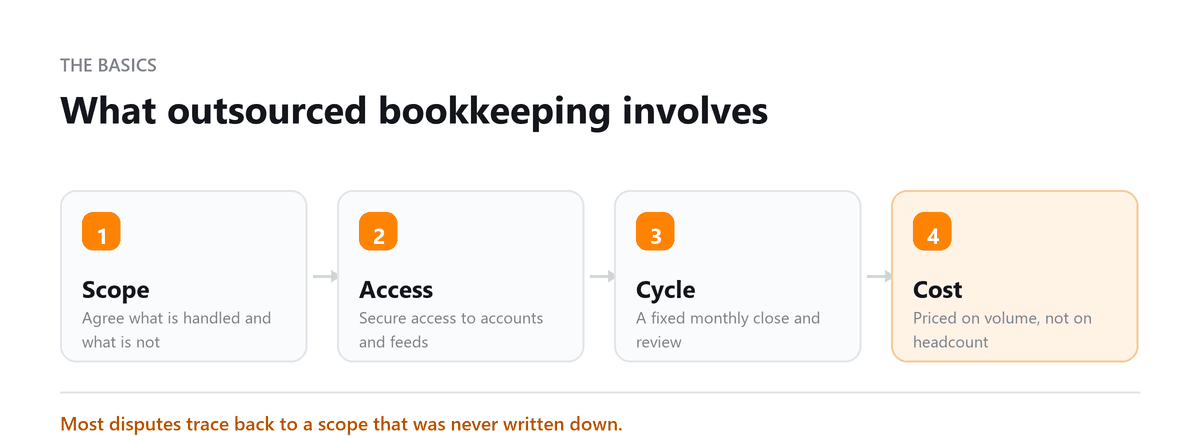
- Assess Needs: Identify what bookkeeping tasks need to be covered and what oversight you want to retain
- Find a Provider: Evaluate based on services, industry expertise, software compatibility, security practices, and pricing
- Onboard and Transition: Introduce the provider to your systems, share required documents, and migrate historical data
- Manage Collaboration: Establish communication cadence, share access, and review work streams
- Optimise Over Time: Continuously align on reporting needs, adjust scope, and refine as the business evolves
When Should a Business Consider Outsourcing?
Common triggers include:
- Critical financial reports are consistently delayed
- Existing staff are juggling too many responsibilities
- Concerns about accuracy, compliance, or audit risk
- Lack of capability for complex filings or reporting
- Leadership is spending meaningful time on routine financial tasks instead of strategic work
What Are the Benefits of Outsourced Bookkeeping?
- Improved accuracy: External bookkeepers implement controls that reduce errors and produce reliable reports
- Better reporting: Deep data analysis tied to your business goals, not just compliance outputs
- Built-in scalability: No staffing decisions as transaction volume increases
- Proactive guidance: Professionals who flag cash flow trends and compliance issues before they become problems
- Time savings: Hours per week returned to the work that actually grows your business
Types of Outsourced Bookkeeping Services
Virtual Bookkeeping and Accounting Firms
Dedicated teams providing defined service scopes with predictable capacity and pricing. Best for businesses that want ongoing, reliable financial management from a single accountable provider.
Freelance Bookkeepers
Independent professionals providing flexibility for specific projects or shorter engagements. Less expensive but with narrower skills, less backup cover, and higher dependency on a single individual.
What Does Outsourced Bookkeeping Cost?
Rates vary by experience, workload complexity, turnaround times, and location:
| Bookkeeper Type | Typical Hourly Rate |
|---|---|
| Offshore/international staff | $5 to $25 per hour |
| US-based staff | $20 to $35 per hour |
| Certified / experienced staff | $25 to $45 per hour |
Most businesses prefer monthly fixed-rate packages over hourly billing for cost predictability. Typical monthly costs range from $200 for basic bookkeeping to $2,500+ for full-service packages including payroll, tax support, and advisory.
5 Things to Look for in an Outsourced Bookkeeping Provider
- Clarity of scope: Ensure their services match your specific bookkeeping goals from day one
- Accuracy standards: Ask how they handle errors and what quality controls are in place
- Affordability and sustainability: Ensure the pricing model works long-term, frequent provider changes create data exposure risk
- Relevant experience: Bookkeeping improves with practice and industry knowledge, look for providers with a track record in your sector
- Trained, certified professionals: Verify the team's qualifications before committing
Book a free consultation and we will put the scope and the price in writing.
Frequently Asked Questions
What is the difference between outsourced and in-house bookkeeping?
In-house bookkeeping gives you direct oversight and a dedicated employee who knows your business. Outsourced bookkeeping provides expert service, scalability, and lower cost, without the employment overhead. For most small businesses, the economics strongly favour outsourcing.
Is outsourced bookkeeping secure?
Yes, with reputable providers. Professional firms use bank-level encryption, secure client portals, and role-based access controls. Ask any prospective provider for specifics on their data security practices, certifications, and compliance standards.
What are the most commonly outsourced bookkeeping tasks?
Bank reconciliation, accounts payable and receivable, payroll processing, expense categorisation, and monthly financial reporting are the most commonly outsourced tasks. Many providers also handle tax preparation, budgeting support, and catch-up bookkeeping.
How do I switch from in-house to outsourced bookkeeping?
Start with a provider consultation to assess your current state. The provider will handle data migration, software setup, and a transition period to ensure continuity. Most professional services make the switch straightforward, it typically takes two to four weeks.
Can I outsource only part of my bookkeeping?
Yes. Many businesses outsource specific functions, payroll only, or reconciliation only, while handling other tasks in-house. Most professional providers offer modular services so you can build a package that fits your exact needs.
Conclusion
Outsourced bookkeeping is not just a cost-cutting measure, it is a strategic upgrade to your financial infrastructure. The right provider brings expertise, systems, and accountability that most in-house setups simply cannot match at the same price. Take the time to vet providers carefully, define your scope clearly, and build a relationship based on transparency. The payoff is accurate books, reliable reports, and the financial clarity your business decisions depend on.

Written by
Ankit Sarawagi, CPA, CA, MBA
Ankit leads the finance team at Profitjets, where he has worked with 500+ businesses across the US on bookkeeping, tax and CFO-level strategy. He writes about the habits that keep small business books accurate all year. Connect on LinkedIn
Free consultation
Want the Scope Written Down Properly?
Book a free consultation and we will put the scope and the price in writing.