
NetSuite accounting is a cloud-based Enterprise Resource Planning (ERP) platform that automates and centralizes financial processes with real-time insights.
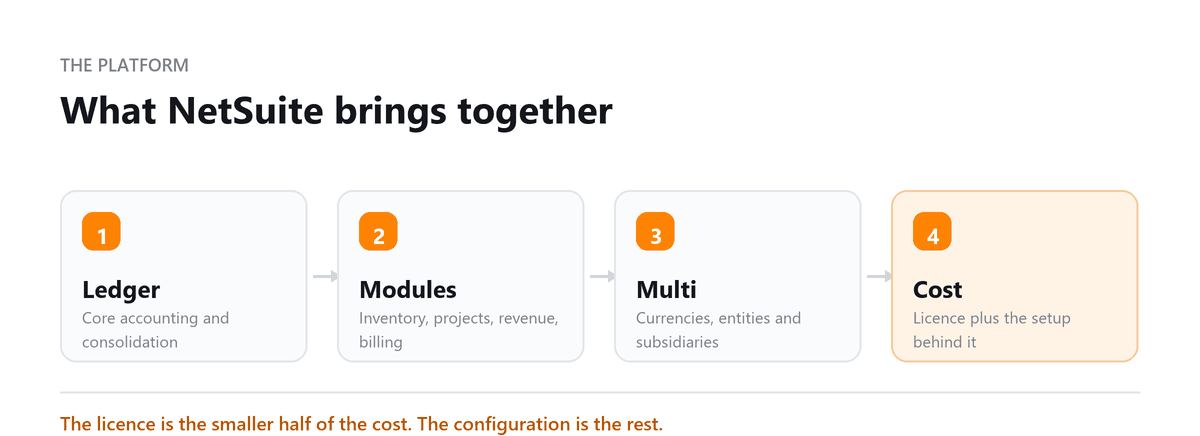
It consolidates the general ledger, accounts receivable, accounts payable, invoicing, order management, inventory, and financial reporting into a single unified platform eliminating the patchwork of disconnected systems that most growing businesses rely on.
NetSuite accounting has been owned by Oracle since 2016 and serves more than 40,000 customers across more than 200 countries. It is the dominant cloud ERP choice for mid-market businesses that have outgrown QuickBooks but are not yet at enterprise scale.
Expert Perspective
NetSuite is the right tool for the right stage. If you're a $2M business, it's overkill. If you're a $20M multi-entity business trying to consolidate financials in QuickBooks, you're already paying the price of the wrong tool. The question isn't whether NetSuite is worth it, it's whether you've outgrown what you have.
Ankit Sagatani, MBA, B.Com · LinkedInHow to Use NetSuite for Accounting?
A NetSuite implementation follows a structured sequence: configure your chart of accounts and reporting rules (reflecting your entity structure, business units, and reporting hierarchy); import opening balances from your prior system; begin processing invoices, bills, and payments through NetSuite workflows; reconcile bank statements using NetSuite's bank feeds and matching tools; and generate financial reports through role-based dashboards that deliver the right data to the right person.
The key advantage over standalone accounting software is that all of these functions and the operational data behind them live in one system, updated in real time.
Benefits of Using NetSuite Accounting
- Real-time financial visibility across all entities, subsidiaries, and currencies, no end-of-month consolidation required.
- A unified platform eliminates the time and errors involved in reconciling data between disconnected systems.
- Proven scale: NetSuite handles organizations with 5,000+ employees and billion-dollar transaction volumes.
- Customizable workflows and multi-level approval hierarchies for procurement, payments, and period close.
- Robust security: role-based access controls, 256-bit encryption, and a complete audit trail for every transaction.
NetSuite Accounting Features
| Feature | Description |
|---|---|
| General Ledger | Multi-entity, multi-currency, automated period close |
| Accounts Receivable | Invoice management, collections, revenue recognition |
| Accounts Payable | Purchase orders, vendor management, bill payment |
| Order Management | Quote-to-cash automation across the order lifecycle |
| Fixed Assets | Asset tracking, depreciation schedules, disposal |
| Financial Reporting | Real-time dashboards, custom reports, GAAP/IFRS compliant |
| Audit Trail | Complete transaction history, SOX compliance support |
NetSuite Accounting Pricing and Usage
NetSuite uses a tiered, custom pricing model. The base license cost depends on the number of users, transaction volume, modules required, and optional industry-specific add-ons. Published estimates for a base implementation typically start at $999 or more per month, but actual costs for a mid-market implementation with multiple modules, users, and customizations are substantially higher. Contact NetSuite (or an authorized NetSuite partner) directly for current 2026 pricing based on your specific requirements published list prices are rarely what companies actually pay.
Types of Businesses That Use NetSuite
NetSuite is primarily used by mid-market and enterprise organizations across manufacturing, professional services, nonprofits, SaaS companies, retail, e-commerce, and financial services. The common thread is complexity that QuickBooks or Xero cannot handle: multiple legal entities, multi-currency operations, complex revenue recognition, or high transaction volumes. NetSuite is rarely the right fit for businesses under $5-10M in revenue, the cost and implementation complexity outweigh the benefits at that scale.
NetSuite vs QuickBooks
| Factor | NetSuite | QuickBooks Online |
|---|---|---|
| Best for | Mid-market to enterprise | Small to mid-size businesses |
| Multi-entity | Yes, native | Limited (separate subscriptions) |
| ERP capabilities | Full ERP (inventory, CRM, HR) | Accounting + basic inventory |
| Customization | Highly customizable | Limited customization |
| Pricing | $999+/month (custom) | $35-$235/month |
| Implementation | 3-6 months typical | Days to weeks |
NetSuite Accounting Services with Profitjets
NetSuite accounting offers unmatched scale for growing businesses, but setting up multi-subsidiary consolidations, inventory GL mappings, and automated revenue recognition often turns into an operational nightmare. At Profitjets, we take the friction out of enterprise resource planning by pairing your team with certified NetSuite specialists who streamline your chart of accounts, fix broken workflows, and turn complex ERP data into clear, actionable financial reports.
We help companies configure their chart of accounts, migrate historical data, establish reporting hierarchies, and run ongoing financial operations on NetSuite giving you the platform's capabilities without the internal headcount to manage it.
Profitjets has helped growing brands shorten their monthly close cycle from 21 days down to just 4 business days post-NetSuite optimization, maintaining a 99.4% reporting accuracy rate across multi-currency operations.
We took on a direct-to-consumer brand that had spent six months trying to self-implement NetSuite, only to find their inventory valuation completely out of sync with their actual warehouse counts.
Their previous setup was misrouting COGS line items every time a bundled SKU was sold. Our team stepped in, restructured their item fulfillment rules, and rebuilt their general ledger mappings line by line straightening out six months of backlogged inventory variance in less than two weeks so their leadership team could finally rely on their margins again.
Conclusion
NetSuite is the leading cloud ERP for mid-market businesses that have outgrown entry-level accounting software. Its strength is consolidation: one platform for financials, operations, reporting, and compliance updated in real time across all entities. The investment in implementation and licensing is significant, but for businesses at the right scale, the alternative cost of managing disconnected systems is higher.
Book a free consultation and we will run the books inside it for you.
Frequently Asked Questions
When should a business switch from QuickBooks to NetSuite?
Common triggers include: managing multiple legal entities, needing real-time consolidated reporting across subsidiaries, handling complex revenue recognition (ASC 606), requiring inventory management across multiple locations, or exceeding $10-20M in revenue where QuickBooks limitations create operational bottlenecks.
How long does NetSuite implementation take?
A typical NetSuite implementation takes 3-6 months for a mid-market company, depending on data migration complexity, number of customizations, integrations, and user training requirements. Rushing implementation increases the risk of errors in the chart of accounts setup and opening balances.
Is NetSuite suitable for small businesses?
Generally no. NetSuite's complexity and cost (typically starting at $999+/month) make it inappropriate for businesses under $5-10M in revenue. Small businesses get better value from QuickBooks Online, Xero, or Zoho Books. NetSuite is designed for mid-market and enterprise complexity.
Does NetSuite handle multi-currency accounting?
Yes. NetSuite has robust multi-currency capabilities including real-time exchange rate feeds, currency revaluation, and consolidated reporting across currencies. This is one of the key reasons international businesses choose NetSuite over QuickBooks.
Can I integrate NetSuite with my existing tools?
Yes. NetSuite's SuiteCloud platform supports integrations with CRM, e-commerce, payroll, and hundreds of third-party systems. Common integrations include Salesforce, Shopify, ADP, and custom APIs. Integration complexity is a key factor in implementation timelines and costs.

Free consultation
Running NetSuite, or About To?
Book a free consultation and we will run the books inside it for you.