
A customer pays $2,400 for a year of service in January, and the money lands in the business bank account the same day. It's tempting to count it as January's revenue. Plenty of small businesses do exactly that, and for one month their P&L looks fantastic. Then February through December show almost nothing from that customer, even though the team is still doing the work every month.
That distortion is what deferred revenue accounting exists to prevent. Under accrual accounting, getting paid doesn't create revenue.
Delivering what the customer paid for does. Until you deliver, the cash you've received is an obligation: you owe the customer the product or service, or in many cases their money back.
Recording it correctly keeps your monthly results honest. Revenue lines up with the work actually performed, profit isn't overstated in the month cash arrives, and your balance sheet shows how much you still owe customers. For any business that takes deposits, retainers, or annual subscriptions, it's one of the most important accounting habits to get right.
Expert Perspective
The most common deferred revenue mistake I see is booking annual or upfront payments straight to revenue. The month the payment comes in looks hugely profitable, the rest of the year looks weak, and the balance sheet hides a liability the business actually owes. It usually gets caught at the worst possible time, during a lender review, investor due diligence, or an audit, and restating a year of revenue then is far more painful than recording it properly from day one.
Abhinav Gupta, CPA, CA, MBA · LinkedInThis guide covers what deferred revenue is, how it works step by step, why it's a liability, how to calculate and record it, and how it differs from accrued revenue.
What is Deferred Revenue?
Deferred revenue is created whenever a customer pays before the service is rendered or product is delivered. Common examples: annual software subscriptions (payment on January 1; service delivered monthly throughout the year); magazine subscriptions; gift cards; advance deposits on construction or consulting projects; retainer fees for professional services.
| Business Type | Deferred Revenue Example |
|---|---|
| SaaS / software | Annual subscription: $1,200 received January 1; $100 recognised per month |
| Consulting / professional services | $5,000 retainer received; recognised as hourly work is completed |
| Construction / project-based | 25% advance deposit; recognised as project milestones are completed |
| Gym / membership | Annual membership fee; recognised monthly over the year |
| Gift cards | Full face value deferred at sale; recognised when redeemed (breakage estimated separately) |
How Does Deferred Revenue Work?
- Step 1: Cash received, record as deferred revenue (liability), not as revenue. Journal entry: Debit Cash / Credit Deferred Revenue.
- Step 2: Service delivered, recognise the portion delivered. Journal entry: Debit Deferred Revenue / Credit Revenue.
- Example: a 12-month SaaS subscription at $1,200/year ($100/month). On January 1: Debit Cash $1,200 / Credit Deferred Revenue $1,200. Each month: Debit Deferred Revenue $100 / Credit Revenue $100.
Why is Deferred Revenue a Liability?
Deferred revenue is a liability because it represents an obligation, the business owes the customer delivery of the paid-for goods or services. If the business fails to deliver, it must refund the unearned portion. Until delivery occurs, the cash belongs (economically) to the customer, not the business. Incorrectly recognising deferred revenue as earned revenue overstates profit and equity, which misleads investors, lenders, and tax authorities.
How to Calculate Deferred Revenue
Deferred Revenue = Total Cash Received - Revenue Recognised to Date
Example: $2,400 annual subscription, 4 months delivered. Revenue recognised: 4 x $200 = $800. Deferred revenue: $2,400 - $800 = $1,600 (still owed to the customer as future service delivery).
How to Record Deferred Revenue in Your Accounting System
- Create a 'Deferred Revenue' liability account in your chart of accounts (under Current Liabilities)
- At subscription/advance receipt: credit the Deferred Revenue account
- At each delivery milestone (monthly, on completion, on shipment): journal entry from Deferred Revenue to Revenue
- At period-end: review the Deferred Revenue balance and confirm it matches outstanding customer obligations
- Most accounting platforms (QuickBooks, Xero, NetSuite) support deferred revenue schedules natively for subscription businesses
Deferred Revenue vs Accrued Revenue
Deferred revenue and accrued revenue are opposites. One is cash before delivery, the other is delivery before cash.
| Deferred Revenue | Accrued Revenue | |
|---|---|---|
| Definition | Cash received; service not yet delivered | Service delivered; cash not yet received |
| Balance sheet | Current liability | Current asset |
| Cash flow | Cash already received | Cash not yet received |
| Recognition timing | When delivery occurs | When service is performed (before billing) |
| Example | $1,200 annual subscription received Jan 1 | December consulting work billed in January |
Both exist for the same reason: to match revenue to the period in which it was actually earned, regardless of when cash changes hands.
Why It Is Genuinely an Obligation
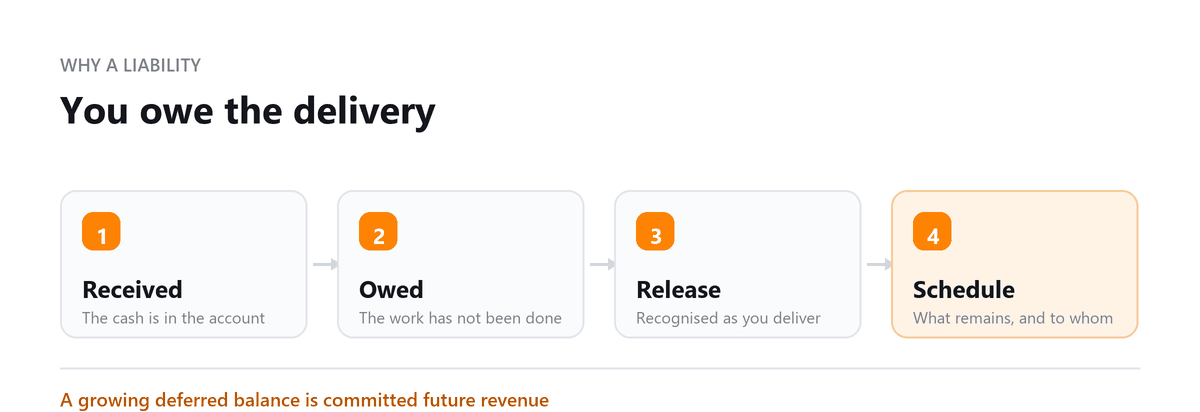
Calling money you have received a liability feels wrong until you look at what it represents. You have been paid and you have not yet delivered, so what you owe is the delivery.
If the arrangement ended today, the customer would generally be entitled to the part they have paid for and not received. That is the definition of an obligation, and it belongs on the balance sheet until the work is done.
- Recognise the revenue as you deliver, not when the money arrives
- Where delivery is over time, release it over that time rather than in one step
- Keep the balance supported by a schedule showing what is still owed and to whom
- Watch the cash effect: the money is in the account and is not yet yours
It Changes How the Business Reads
For a business with any meaningful deferred balance, revenue and cash diverge, and reading either alone gives a misleading picture.
A month with strong collections can show modest revenue because most of what was received relates to future delivery. The reverse also happens: a quiet month for cash can show good revenue as earlier receipts are recognised.
This is why subscription and service businesses look confusing on cash figures alone, and why the deferred balance is worth watching as a measure in its own right. A growing balance means committed future revenue, which is a genuinely positive signal. A shrinking one means the opposite, regardless of what this month's revenue figure says.
Keeping the Schedule Straight
The balance is only as reliable as the schedule behind it, and in most small businesses that schedule lives outside the accounting system.
It needs to record each arrangement, what was received, what period or deliverable it relates to, how much has been recognised and how much remains. Reconciled to the ledger balance monthly, it stays reliable. Reconstructed at year end, it rarely does.
Refunds and cancellations are where it most often breaks, because they reduce the obligation and frequently get recorded only as a cash movement. So do changes in scope, where the delivery changes but the schedule does not. Both are worth a rule agreed in advance rather than a decision taken case by case.
Book a free consultation and we will set the schedule up.
Frequently Asked Questions
Is deferred revenue the same as unearned revenue?
Yes. Deferred revenue and unearned revenue are two names for the same thing: cash received in advance for goods or services not yet delivered. They're recorded identically. Current US accounting standards also use the term contract liability for the same concept.
How does deferred revenue affect cash flow?
It's good for cash flow in the period the payment is received, because the cash arrives before you've spent money delivering the service. The revenue and profit are recognized later, but the cash benefit is immediate. That's one of the main financial advantages of subscription and prepayment models.
Is deferred revenue a current or long-term liability?
Most deferred revenue is a current liability because it's usually earned within 12 months. If a customer prepays for a multi-year contract, the portion to be delivered more than a year from the balance sheet date is classified as a long-term liability.
Do cash-basis businesses record deferred revenue?
Generally not in their own books. Cash-basis accounting records income when it's received, so advance payments are usually treated as revenue right away. Deferred revenue is an accrual accounting concept, and businesses that need GAAP financial statements for lenders or investors will typically need to track it.
What happens to deferred revenue if a customer cancels?
It depends on the contract. If the customer receives a refund, the refunded amount reduces the deferred revenue balance. If the payment is non-refundable, the remaining balance may be recognized as revenue, but the timing depends on the terms, so it's worth reviewing with your accountant.

Written by
Abhinav Gupta, CPA, CA, MBA
Abhinav works with business owners across the US on industry-specific bookkeeping, from dental practices and restaurants to construction and e-commerce. He writes about what each trade's books actually need. Connect on LinkedIn
Free consultation
Billing in Advance?
Book a free consultation and we will set the schedule up.