
Maintaining the Airbnb property provides a sustainable income stream. Beyond collecting income, the operational infrastructure should support seamless tenant experience. With raising demand in personalizing needs and expenses, often tracking the revenue has become a constraint. The practice does not follow a structured timezone for income as check in and check out are based on tenants requirements.
The Airbnb hosts in general begin with the second income stream and document with simple spreadsheets. Over time, the process becomes increasingly complex, when the hosts need to spend time evaluating multiple sources of revenue, what are the recurring expenses and tracking platform fee for the minor spend, reporting utilities, supplies are often missed and assumed due to workload.
The main error that bookkeeping owners make is not classifying the expense properly in personal and business. As they are the owners, they often neglect to maintain a structured infrastructure to Airbnbs. Hosts wearing multiple hats often end up in creating books with inaccurate records.
All the minor losses left unresolved and documented amount to expensive errors in future. Short term rentals with huge volume of transactions, It becomes critical for hosts to track and navigate their spend
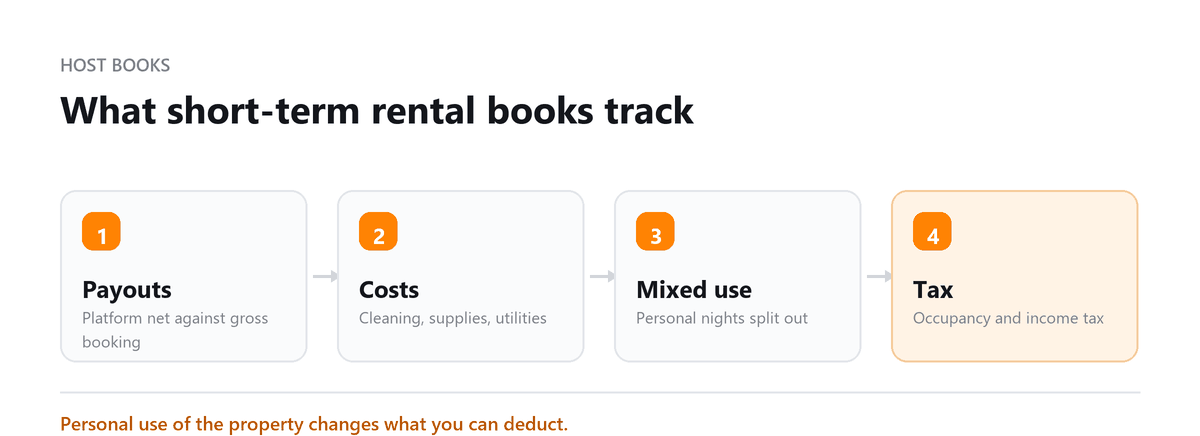
Short-term rental income gets complex quickly when you factor in cleaning fees, host service fees, platform deductions, occupancy taxes, and the mixed-use rules that apply when you rent a property you also use personally. The IRS pays attention to this category.
Abhinav Gupta, CPA, CA, MBA · LinkedInWhat is Bookkeeping for Airbnb Hosts?
Bookkeeping for Airbnb hosts is the systematic recording of all financial transactions related to your short-term rental business. It covers three primary areas:
Income Tracking
- Booking revenue from each reservation
- Cleaning fees charged to guests
- Amenity fees and extra-service charges
Expense Tracking
- Cleaning supplies and professional cleaning services
- Utilities (electricity, water, internet) allocated to rental use
- Repairs and maintenance costs
- Property taxes and insurance
- Mortgage interest (for rental-use portion)
Receipt and Documentation Management
Every expense must be supported by a receipt or invoice. For Airbnb hosts who also personally use the property, meticulous documentation is critical for establishing the business-use percentage that underpins your deductions.
What is Accounting for Airbnb Hosts?
Where bookkeeping records transactions, accounting interprets them. Accounting for Airbnb hosts includes:
- Preparing financial statements (income statement, balance sheet, cash flow statement)
- Tax planning, estimating quarterly payments, identifying deductions, structuring ownership
- Performance analysis, occupancy rate, revenue per available night, net profit margin
Together, bookkeeping and accounting give hosts the data they need to price smarter, invest further, and stay compliant.
Why Bookkeeping and Accounting Matter for Airbnb Hosts
- Missed deductions: Without records, legitimate deductions for cleaning, maintenance, depreciation, and home-office use are lost
- Cash flow issues: Seasonal rental income needs careful tracking to cover year-round expenses
- Tax penalties: Airbnb reports income to the IRS on Form 1099-K, undisclosed income triggers penalties
- Poor decisions: Without accurate financials, pricing, reinvestment, and expansion decisions are guesswork
- Lost growth: Hosts who cannot show clean financials struggle to secure financing for additional properties
Tips for Effective Airbnb Bookkeeping
- Choose your accounting method: Cash accounting suits most individual hosts; accrual is better for multiple properties
- Track everything from day one: Every booking, every fee, every cost, even small ones compound
- Automate where possible: Use software that pulls directly from Airbnb and your bank
- Open a dedicated business bank account and credit card for all rental-related transactions
- Use cloud-based accounting software for real-time visibility and easy collaboration with a bookkeeper
- Reconcile accounts monthly: Match your bank statements to your records every month without fail
- Review financial statements quarterly: Know your net income, occupancy rate, and expense ratios
- Seek professional help for tax filing, especially for mixed-use properties and multi-state income
- Stay current on short-term rental tax regulations, occupancy taxes vary by city and state
- Track mileage for property-related driving (inspections, supply runs, maintenance)
- Maintain guest communication records as supporting documentation for business-use claims
- Document all property improvements for depreciation calculations, keep invoices and photos
Bookkeeping Software for Airbnb Hosts
| Software | Pricing | Airbnb Integration | Scalability |
|---|---|---|---|
| QuickBooks Online | $38/month | Yes | High |
| Xero | $25/month | Yes | High |
| FreshBooks | $23/month | Limited | Medium |
| Wave | Free | No | Low |
Common Airbnb Bookkeeping Mistakes
- Mixing personal and rental finances in a single account
- Not using dedicated accounting software, spreadsheets break down at scale
- Neglecting to store receipts for every rental-related expense
- Ignoring the tax implications of mixed personal/rental property use
- Not backing up financial data, cloud software solves this automatically
- Procrastinating on bookkeeping until tax season, creating a costly backlog
At Profitjets, we regularly work with Airbnb hosts who started with a single listing and quickly found themselves managing multiple properties, several bank accounts, and hundreds of transactions each month. What initially seemed straightforward often becomes surprisingly complex once hosts begin tracking platform payouts, guest fees, maintenance costs, and tax obligations across different properties. Establishing the right bookkeeping structure early helps prevent confusion, saves significant time during tax season, and provides greater visibility into the performance of each listing.
We have also seen hosts underestimate how much money is lost through missed deductions, incomplete expense tracking, or poor recordkeeping. Once a proper bookkeeping system is implemented, many hosts gain a much clearer understanding of their cash flow, operating margins, and return on investment. More importantly, they are able to make informed decisions about pricing, expansion, property improvements, and future acquisitions.
Book a free consultation and we will get each listing reporting separately.
Frequently Asked Questions
Do I need to report Airbnb income on my tax return?
Yes. Airbnb reports host earnings to the IRS via Form 1099-K when income exceeds $600 in a calendar year. All rental income must be reported regardless of whether you receive a 1099-K.
What expenses can Airbnb hosts deduct?
Deductible expenses include cleaning costs, supplies, repairs, utilities (proportional to rental use), property taxes, mortgage interest, insurance, depreciation, and Airbnb service fees. Mixed-use properties require calculating the rental-use percentage first.
What is the 14-day rule for Airbnb taxes?
If you rent your primary residence for 14 days or fewer per year, the rental income is generally tax-free and need not be reported. Beyond 14 days, all income is taxable and standard rental expense deductions apply.
Should I set up an LLC for my Airbnb business?
An LLC can provide liability protection and may offer tax advantages depending on your situation, but it also introduces additional reporting requirements. Consult a tax professional to evaluate whether an LLC makes sense for your rental portfolio.
How do I handle occupancy taxes collected by Airbnb?
In many jurisdictions Airbnb collects and remits occupancy taxes on your behalf. You still need to document these amounts in your books. In jurisdictions where Airbnb does not collect, you are responsible for collecting and remitting directly.
Conclusion
Airbnb hosting can be highly profitable, but only if the underlying finances are managed with the same care as the guest experience. Accurate bookkeeping protects your deductions, keeps you compliant, and gives you the clear numbers you need to grow. Whether you manage one listing or ten, the right system, and the right professional support, makes all the difference.

Written by
Abhinav Gupta, CPA, CA, MBA
Abhinav works with business owners across the US on industry-specific bookkeeping, from dental practices and restaurants to construction and e-commerce. He writes about what each trade's books actually need. Connect on LinkedIn
Free consultation
Hosting More Than One Place?
Book a free consultation and we will get each listing reporting separately.