
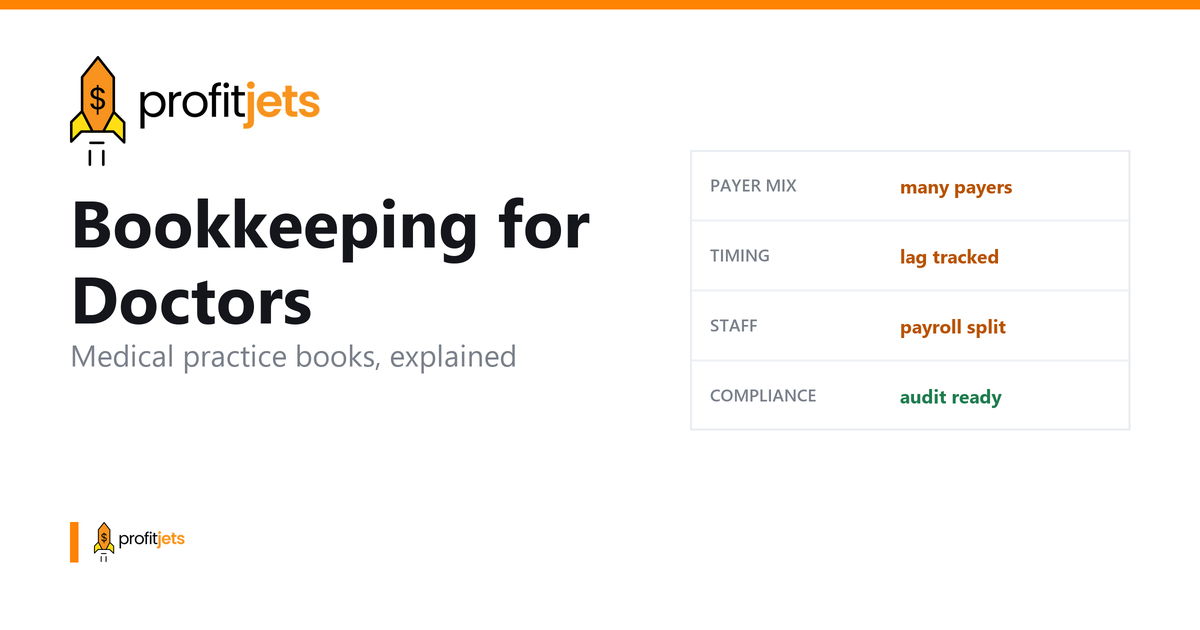
Medical practice extends beyond patient care and maintenance. Managing medical operations are more complex than it sounds. Legers hold the information of patient transactions, pre op and post op protocol with difficulty in availing insurance, reimbursements, billing mismatch affect margins. The above factors directly impact the cash flow even when there are no open slots for appointments and booking followup schedules.
Tracking revenue is again a hassle with different sources of income across different times. It has increasingly become complex to attain visibility. This disrupts clarity in ensuring whether financial hygiene is maintained. When reviewing expenses on medical instruments, insurance, medicare schemes, ngo measures and medicare expenses, integrating good bookkeeping practice helps scale better. When anchoring profitability to different services and departments it gets a handful in managing the financial activity.
Good bookkeeping helps doctors and medical practices track and audit where their profits are directed and clear records enable them to ideate well to produce sustainable growth. This guide explains the latest bookkeeping tips for doctors and medical practices in 2026 to streamline efficiency in their financial operations
Medical practice bookkeeping is not just about compliance, it is about understanding whether the practice is actually profitable after all the costs that come with delivering care. Many practice owners are surprised when they see the real numbers.
Abhinav Gupta, CPA, CA, MBA · LinkedInWhat is Bookkeeping for Doctors?
Bookkeeping for doctors involves the systematic recording and management of all financial transactions in a medical practice. Because medical practices deal with multiple revenue streams, direct patient payments, insurance reimbursements, Medicare/Medicaid payments, and sometimes research or teaching income, accrual basis accounting is typically preferred. It records income when earned and expenses when incurred, giving a more accurate financial picture than cash basis.
On the expense side, bookkeeping tracks staff salaries, medical supplies, malpractice insurance, facility rent, equipment leases, and continuing medical education costs, each requiring its own category for meaningful reporting.
Why It Matters
- Missed deductions: Without proper records, legitimate business deductions go unclaimed at tax time
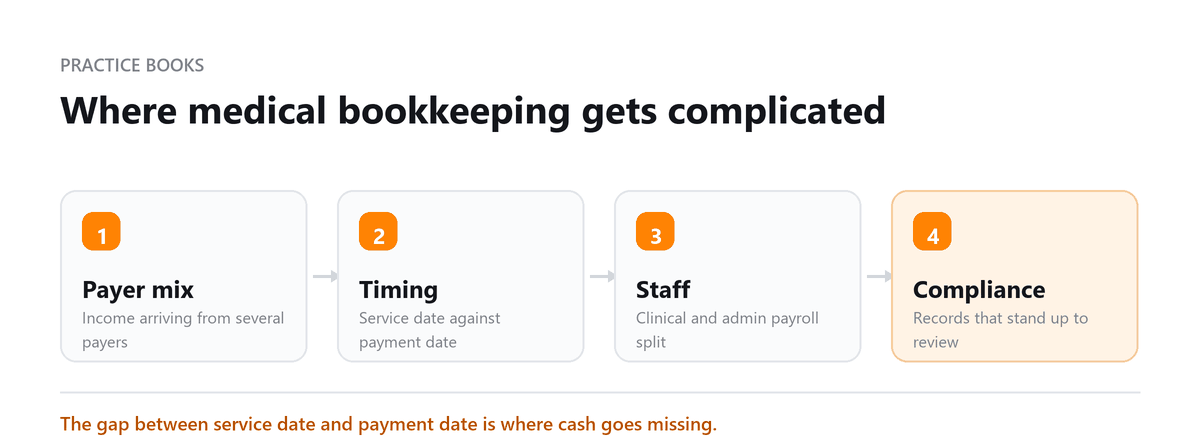
- Cash flow blind spots: The lag between service delivery and insurance payment can mask serious cash flow problems
- Inaccurate financial statements: Errors in bookkeeping produce misleading reports that lead to poor decisions
- Tax errors: Incorrect categorisation of income or expenses can trigger penalties and interest
- Loan difficulties: Lenders require accurate, up-to-date financial statements, messy books can cost you financing
Bookkeeping Tips for Medical Practices
- Choose the right accounting method: Accrual basis is recommended for practices billing insurance
- Set up a detailed chart of accounts: Separate patient revenue, insurance revenue, and each major expense category
- Track everything: Every transaction, including small cash purchases, must be recorded
- Automate bank feeds and recurring entries: Reduce manual data entry and the errors it introduces
- Reconcile monthly: Bank, credit card, and insurance receivable reconciliation must happen every month
- Review financial statements monthly: P&L and balance sheet review should be a standing monthly appointment
- Consider outsourcing: A specialist medical bookkeeping service understands coding, billing, and compliance requirements
- Seek professional help proactively: Do not wait for problems, work with an accountant experienced in medical practices
- Maintain patient billing accuracy: Coding errors in billing affect not just revenue but bookkeeping accuracy
- Stay current on regulations: Healthcare billing regulations affect how revenue is recognised and categorised
- Implement internal controls: Separate duties between the person who handles cash and the person who reconciles accounts
- Prioritise data security: Patient and financial data must be protected to HIPAA standards
- Communicate with staff: Your front desk and billing team are the first line of bookkeeping accuracy
- Invest in technology: Modern practice management software integrated with cloud accounting dramatically reduces errors
- Commit to continuous improvement: Review your bookkeeping processes annually and update as the practice grows
Best Bookkeeping Software for Medical Practices
| Software | Pricing | Ease of Use | Integrations | Scalability |
|---|---|---|---|---|
| QuickBooks Online | $38/month | Easy | Wide | High |
| Xero | $25/month | Easy | Wide | High |
| FreshBooks | $23/month | Easy | Wide | Medium |
| Wave | Free (basic) | Very Easy | Limited | Low |
Common Bookkeeping Mistakes in Medical Practices
- Mixing personal and business finances, a dedicated practice account is essential
- Not using accounting software, spreadsheets are not adequate for a medical practice
- Neglecting receipts and documentation, every expense needs a paper trail for tax purposes
- Ignoring medical coding and billing regulations, errors affect both revenue and bookkeeping accuracy
- Not backing up data, cloud-based software solves this automatically
- Procrastinating on reconciliation, monthly catch-up is far easier than year-end panic
Medical practice bookkeeping is not just about compliance or preparing for tax season. It is about understanding whether the practice is truly profitable after accounting for the full cost of delivering care. When financial records are accurate and up to date, practice owners can identify opportunities for growth, address inefficiencies early, and build a stronger foundation for long-term success.
Book a free consultation and we will take one of those off your list.
Frequently Asked Questions
Should a medical practice use cash or accrual accounting?
Accrual accounting is strongly preferred for medical practices. Because insurance payments arrive weeks after services are delivered, cash basis accounting creates a distorted view of financial performance. Accrual basis records income when earned, giving you a more accurate monthly picture.
What is the difference between medical billing and medical bookkeeping?
Medical billing is the process of submitting and following up on insurance claims to receive payment. Medical bookkeeping records those payments (and all other transactions) in the financial accounts of the practice. Both functions must be accurate for the practice to run well.
Do doctors need a separate bank account for their practice?
Yes. A dedicated business bank account for the practice is essential. Mixing practice and personal finances complicates tax filing, makes financial statements unreliable, and in the event of a legal dispute, can create personal liability that a properly structured practice would avoid.
How often should a medical practice reconcile its accounts?
At a minimum, monthly. Many practices reconcile more frequently, weekly reconciliation of insurance payments is particularly useful given the volume and complexity of insurance remittances.
When should a medical practice outsource its bookkeeping?
When the practice is spending more than a few hours per week on bookkeeping, when errors are recurring, or when the practice manager is handling finances without formal accounting training, those are the clearest signals to engage a specialist service.
Conclusion
Bookkeeping is the financial backbone of a medical practice. Done well, it provides the clarity you need to manage costs, optimise revenue, and plan for sustainable growth. Done poorly, it creates tax risk, cash flow problems, and strategic blind spots that no clinical skill can compensate for.
Profitjets delivers specialist bookkeeping for medical practices, built around the specific revenue structures, expense categories, and compliance requirements of healthcare providers.

Written by
Abhinav Gupta, CPA, CA, MBA
Abhinav works with business owners across the US on industry-specific bookkeeping, from dental practices and restaurants to construction and e-commerce. He writes about what each trade's books actually need. Connect on LinkedIn
Free consultation
Running a Practice and the Books?
Book a free consultation and we will take one of those off your list.