
What is the Role of the CFO in the SaaS Business?
A CFO who has spent their career in retail or manufacturing will be genuinely confused in a SaaS business, which is unfair to them, but true nonetheless. Subscription revenue violates many ingrained financial principles; revenue is recognized ratably over the life of the contract, not when cash is received.
This has cascading effects on the balance sheet, marginal profitability, and the narrative a board wants to hear about the business. It is different work, requiring different skills, with a different lingo, albeit under the same job title.
Your core metrics, MRR, ARR, net revenue retention, etc., simply do not exist in a traditional COA and so a generalist CFO has to learn something fundamentally new, not merely extrapolate from related fields.
A SaaS CFO is a specialist because the nature of the business requires it. The accounting is different, the growth levers are different, the metrics are different, the investor story is different. Picking up a CFO with a general financial background is a learning experience for them, as they learn the ropes of a new type of business.
The metrics that matter for a SaaS CFO aren't revenue, it's the cohort behavior underneath. Are customers expanding or contracting over time? What does the LTV curve look like at month 12 vs month 24? A SaaS CFO who can tell that story with data is worth more to investors than any pitch deck.
Abhinav Gupta, CPA, CA, MBA · LinkedInResponsibilities of a SaaS CFO
Revenue Management
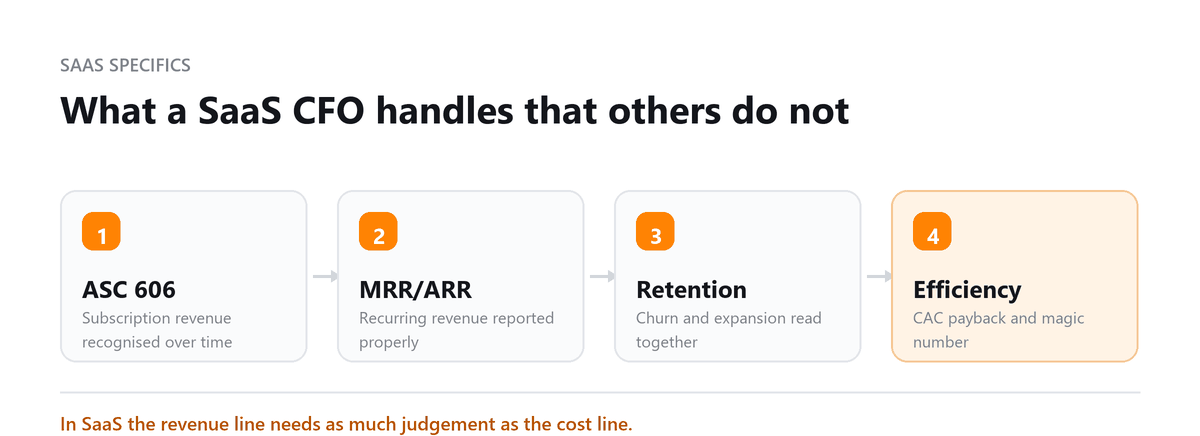
Applies ASC 606, recognizing subscription revenue ratably over the service period rather than when cash is collected.
Manages the deferred revenue balance on the balance sheet.
Tracks MRR and ARR movements across all four categories: new business, expansion (upsell/cross-sell), contraction (downgrades), and churn.
Ensures revenue reporting accurately reflects the subscription base at any point in time.
Cost Management
Models gross margin by customer segment, isolating the true cost of serving each cohort.
Tracks cost of goods sold (COGS) including hosting infrastructure, customer support labor, and implementation costs.
Manages the R&D capitalization vs. expensing decision under GAAP- a judgment-intensive area that directly affects reported gross margin and profitability metrics.
Financial Operations
Oversees accounts payable, accounts receivable, and billing operations, including the invoice-to-cash cycle for subscription billing (annual prepay, monthly, and usage-based models).
Maintains an accurate chart of accounts structured for SaaS, ensuring clear separation between cost categories that investors and analysts scrutinize.
Financial Reporting and Compliance
Produces monthly board reporting packages covering all key SaaS metrics. Maintains the investor data room with current financials and model updates.
Ensures ASC 606 and GAAP compliance across all financial statements. Coordinates audit preparation and manages the external auditor relationship.
Key SaaS Metrics for the CFO to Track
| Metric | Definition | Healthy Benchmark |
|---|---|---|
| MRR (Monthly Recurring Revenue) | Total normalized monthly subscription revenue | Benchmark varies by stage; growth rate matters more than absolute number |
| ARR (Annual Recurring Revenue) | MRR x 12, annualized subscription base | $1M ARR = common Series A benchmark |
| CAC (Customer Acquisition Cost) | Total sales + marketing spend / new customers | Varies by segment; B2B SaaS: $1,000 to $50,000+ |
| CLV / LTV (Customer Lifetime Value) | Average revenue per customer x average customer lifespan | LTV:CAC ratio of 3:1 or better is the standard target |
| Churn Rate | % of customers or revenue lost in a period | Best-in-class B2B SaaS: <5% annual revenue churn |
| Burn Rate | Monthly cash expenditure net of revenue | Runway = cash / burn rate; 18+ months post-funding is standard |
| Rule of 40 | Revenue growth rate + EBITDA margin >= 40% | A key SaaS health metric for investors |
Advantages of Having a CFO in a SaaS Business
A CFO in a SaaS business provides specific advantages that go beyond general financial oversight. ASC 606 compliance is handled correctly from the start, avoiding costly restatements later.
Board reporting is produced in the format investors actually expect MRR bridges, cohort retention charts, and unit economics waterfall analyses. Fundraising is supported by a CFO who has built investor models before and knows what questions will come in due diligence. Pricing decisions benefit from rigorous unit economics modelling. And burn rate discipline is maintained by someone who tracks cash runway daily, not quarterly.
How Profitjets Helps SaaS Businesses with CFO Services
Profitjets provides CFO services specifically designed for SaaS and subscription businesses. We build ASC 606-compliant financial models, produce MRR/ARR board reporting packages, support fundraising with investor-ready financial data rooms, and provide ongoing fractional CFO oversight calibrated to your growth stage.
Profitjets supports SaaS businesses across different stages of growth, from early-stage companies building their first recurring-revenue model to established businesses managing in ARR.
Its SaaS clients typically use financial reporting to track recurring revenue, gross margin, customer acquisition costs, churn, and cash runway as the business scales.
Working with SaaS companies, we’ve seen how revenue growth can look strong while the underlying unit economics tell a different story. In one engagement, we worked through CAC, LTV, churn, and gross margin to understand why customer growth wasn't translating into stronger profitability, then used those numbers to improve the company's financial model and spending decisions.
Book a free consultation and we will get the recurring revenue reported right.
Frequently Asked Questions
How is a SaaS CFO actually different from a traditional CFO?
Fluency in subscription-specific mechanics: ASC 606 revenue recognition, deferred revenue accounting, MRR/ARR reporting, cohort analysis, unit economics. A traditional CFO trained on product or services businesses can be excellent at their job and still lack the specific vocabulary and models that SaaS investors expect to see.
What's the Rule of 40, and why does it get so much attention?
Revenue growth rate plus EBITDA margin should equal or exceed 40, a 50%-growth company at -10% margin scores 40 and passes. It's a quick way for investors to check whether a company is balancing growth against profitability, not a strict pass/fail threshold; plenty of well-regarded SaaS companies sit below it depending on stage and strategy.
When should a SaaS company actually hire a CFO?
Common triggers: approaching Series A (roughly $1M to $2M ARR), revenue recognition complexity that needs real ASC 606 compliance, preparing for a raise or acquisition, or investor reporting demands that outpace what the founding team can produce internally.
What accounting method do SaaS companies use, and why does it matter?
Accrual accounting, following ASC 606 for revenue recognition, not cash basis. Multi-year subscriptions paid upfront get recorded as deferred revenue and recognized monthly as the service is actually delivered, which creates a real gap between cash collected and revenue recognized that needs active CFO oversight, not a set-and-forget process.
What does a SaaS CFO actually do for investor relations specifically?
Builds the monthly board package (MRR, ARR, churn, CAC, LTV, burn, runway), maintains the financial model behind investor presentations, manages the data room through due diligence, fields investor questions directly, and models scenarios for whatever the next raise looks like.

Written by
Abhinav Gupta, CPA, CA, MBA
Abhinav works with business owners across the US on industry-specific bookkeeping, from dental practices and restaurants to construction and e-commerce. He writes about what each trade's books actually need. Connect on LinkedIn
Free consultation
Running a SaaS Business?
Book a free consultation and we will get the recurring revenue reported right.