
Early-stage founders often confuse accounting with financial strategy. While a bookkeeper may help you close the books, your startup needs a CFO to drive runway, unit economics, and investor confidence. As your company grows from a seed round to Series A, you need a financial strategist to help you plan for cash needs, model financing alternatives, and prepare capitalization tables and data rooms for investors.
A full-time CFO at this stage is an unnecessary dilution of your equity, while a part-time executive provides limited strategic value. A startup CFO offers the domain-specific financial expertise and executive support needed to negotiate, model, and execute crucial financing deals to raise cash and execute your growth trajectory.
What Does a Startup CFO Do for Your Small Business?
A startup CFO is a fundamentally different role from a corporate CFO. Where a corporate CFO focuses on compliance, shareholder value management, and running an established finance function, a startup CFO is building the financial foundation from the ground up. The priorities are cash runway and burn rate management, fundraising narrative and investor reporting, unit economics analysis, and early-stage financial modelling.
A startup CFO needs to be comfortable with ambiguity, capable of building systems from scratch rather than managing existing ones, and fluent in the language that growth-stage investors use to evaluate startups.
Signs Your Startup Needs a CFO
If any of the following apply to your startup, it's time to bring in CFO-level expertise:
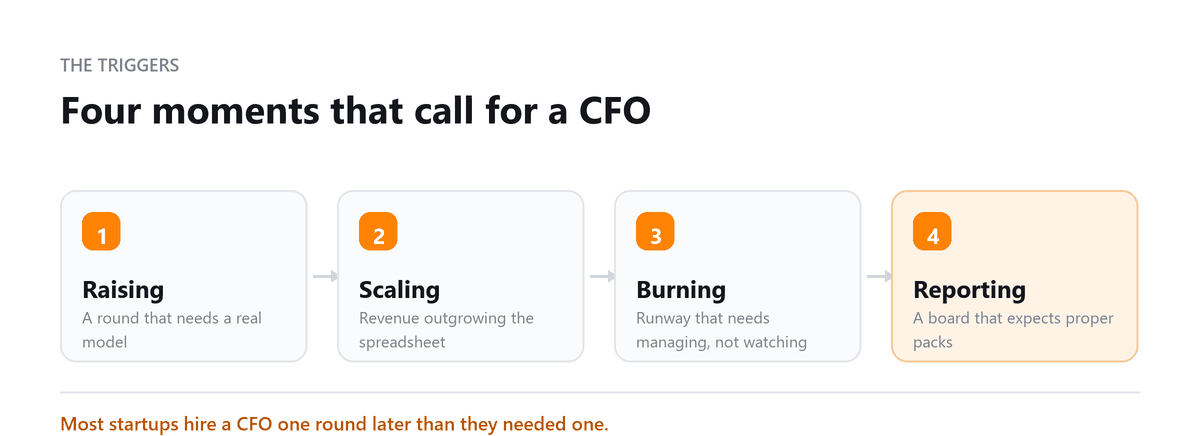
- You are preparing for a seed, Series A, or Series B round
- You have more than 6 months of financial data that no one is reading
- Burn rate is unknown or manually calculated in a spreadsheet
- Your cap table is managed in Excel without a formal data room
- Investors are asking for financial models you can't produce
- You are approaching $1M to $2M ARR and need growth forecasting
- You are considering a major hire, acquisition, or market expansion
Why Consider an Interim CFO for Your Startup?
An interim CFO fills the gap between outgrowing your bookkeeper and being ready to hire a permanent, full-time CFO. The interim model is particularly valuable in transition periods: after a CFO departure, during a major fundraise, or when the startup is scaling faster than its financial infrastructure. Interim CFOs bring institutional knowledge from prior companies, often having been through the exact funding rounds or growth challenges the startup is now facing. And because there's no long-term employment commitment, the startup can right-size the engagement as the situation evolves.
The Ideal Startup CFO
The right startup CFO has direct experience at your current funding stage and sector. They understand startup-specific metrics, MRR, CAC, LTV, burn, and runway, not just traditional accounting measures. Critically, they can build financial systems from scratch rather than maintain existing ones: a startup CFO who has only ever managed established finance functions at large companies will struggle in a startup environment where nothing exists yet.
They also speak investor language, they've been in data rooms, answered investor due diligence questions, and built the financial models that investors actually use to make decisions.
Interim CFO vs Full-Time CFO: A Cost-Benefit Analysis
| Factor | Interim/Fractional CFO | Full-Time CFO |
|---|---|---|
| Annual cost | $24,000 to $120,000 | $200,000 to $400,000+ (incl. benefits/equity) |
| Commitment | Flexible (month-to-month) | Permanent hire |
| Ramp time | Days (experienced immediately) | Weeks to months |
| Best for | Pre-Series B startups | Post-Series B, complex operations |
| Equity | None or minimal | Typically 0.1% to 1% + options |
How to Find the Right Startup CFO Partner
When evaluating startup CFO candidates or firms, check for: direct experience at your funding stage (not just general finance experience), references from portfolio companies that have successfully raised or exited, the ability to build financial models from scratch rather than from templates, and familiarity with your sector's investor expectations. A startup CFO who has never been through a Series A process at a SaaS company is not the right partner for your Series A SaaS fundraise, regardless of how impressive their corporate finance background is.
Expert Quote
The worst time to start looking for a CFO is two weeks before your investor due diligence. The best time is six months before you plan to raise, so whoever you bring in has time to build the financial foundation that investors actually check.
Abhinav Gupta, CPA, CA, MBA · LinkedInWhy Go for Profitjets Startup CFO Services
Profitjets delivers startup CFO services built specifically for early-stage and growth-stage companies. We provide the financial modelling, investor reporting, burn rate management, and fundraising support that startups need at critical inflection points without the overhead of a full-time executive hire.
Profitjets has supported over 60+ venture-backed startups through successful Seed and Series A raises, extending client cash runways by an average of 5.2 months through strategic working capital adjustments.
We recently stepped in to support a founder who was preparing for their Series A raise with a home-grown spreadsheet model showing 80% gross margins. Within two days of auditing their underlying unit economics, we realized they hadn't factored in customer success bandwidth or cloud hosting scaling costs, pulling their true gross margin down to 52%. We spent three weeks rebuilding their 3-statement model to reflect true unit economics before opening their data room ultimately saving the round from falling apart during institutional due diligence.
Book a free consultation and we will tell you what level of help fits now.
Frequently Asked Questions
Does a startup need a CFO before Series A?
Not always a full-time one. But you do need CFO-level work before Series A financial projections, a three-statement model, clean cap table documentation, and data room preparation. A fractional or interim CFO can provide this for $3,000 to $8,000/month, which is the right investment at pre-Series A scale.
What is the difference between an interim CFO and a fractional CFO for a startup?
An interim CFO is typically a full-time, temporary hire filling a vacant CFO seat during a transition (e.g., after a CFO departure, before a new permanent hire). A fractional CFO works part-time across multiple clients simultaneously. Both are cost-effective alternatives to a permanent hire, but the right choice depends on your hours-needed and urgency.
What metrics does a startup CFO track?
Key metrics include: monthly and annual recurring revenue (MRR/ARR), gross margin, customer acquisition cost (CAC), customer lifetime value (LTV), LTV:CAC ratio, monthly burn rate, cash runway (months), and churn rate. A startup CFO translates these metrics into investor narratives and operational decisions.
When should a startup hire a permanent CFO?
Most startups hire a permanent, full-time CFO when they raise a Series B or C round, when revenue exceeds $10 to 20M ARR, when preparing for an IPO, or when financial complexity (multi-entity, international operations, public reporting) requires full-time leadership. Before that, fractional is usually the more efficient model.
Can a startup CFO help with fundraising?
Yes. this is often the primary reason startups engage a CFO. Responsibilities include building the financial model and projections for the investor deck, structuring the data room, responding to term sheet negotiations, and managing the due diligence process. A CFO with experience at your target investor's portfolio companies is particularly valuable.

Written by
Abhinav Gupta, CPA, CA, MBA
Abhinav works with business owners across the US on industry-specific bookkeeping, from dental practices and restaurants to construction and e-commerce. He writes about what each trade's books actually need. Connect on LinkedIn
Free consultation
Raising or Scaling?
Book a free consultation and we will tell you what level of help fits now.