

Selling on Amazon looks simple and online at the beginning. But in real, the process amounts to much more than selling. From listing products, fulfilling orders and getting payments, every item sold navigates the Amazon platform fee, recurring ad expenses and inventory costs. The process soon becomes financially complex as it handles refunds, delivery expense and reimbursement costs. Structuring a clear P&L statement financially is vital for sellers on the Amazon platform
With revenue split across multiple states and geographical location, maintaining tax obligation for every state becomes more difficult. For every Amazon seller, it has become essential to understand the clear picture of their business to assess their profitability from the revenue. Regulating the organized bookkeeping practice saves the sellers from unnecessary tax surprises that could have been easily avoided in the initial place.
Platform also deducts expenses on storage and processing fee along with inventory expense. Sellers aren’t completely aware of their performance as they rely on bank deposits. The payment landscape creates bookkeeping challenges that require early structuring to minimize the impact later.
This blog serves as the expert bookkeeping guide along with insights for the Amazon Sellers to understand the financial clarity for their businesses.
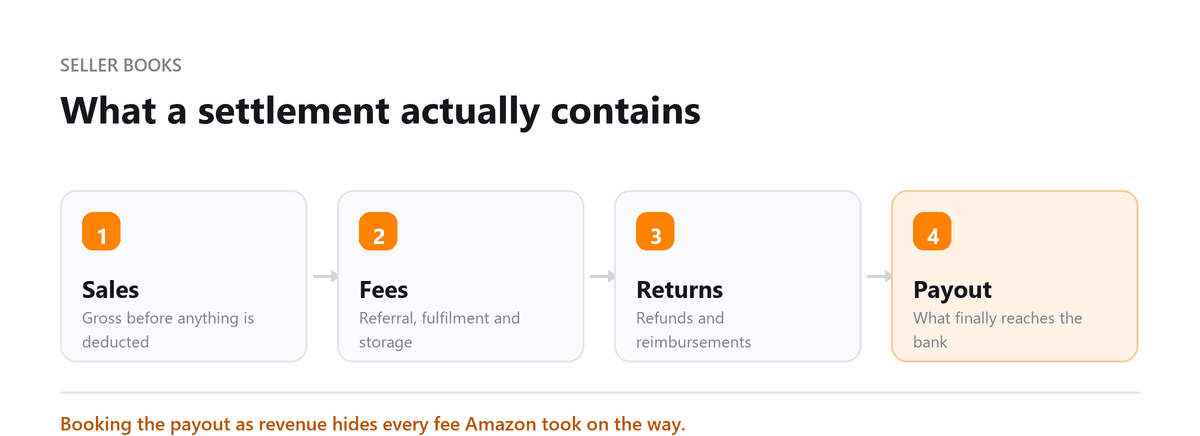
Amazon sellers face a bookkeeping challenge that does not exist in traditional retail: the marketplace takes fees, holds reserves, and disburses money on its own schedule. Your sales numbers and your bank deposits are almost never the same figure, and reconciling the difference is where most sellers make mistakes.
Abhinav Gupta, CPA, CA, MBA · LinkedInWhy Bookkeeping Matters for Amazon FBA Sellers
Amazon sellers who neglect bookkeeping run into three recurring problems:
- Missing tax deductions: FBA fees, storage fees, advertising costs, and return-related expenses are all deductible, but only if they are recorded correctly.
- Inaccurate financial reports: Amazon disbursements combine sales, refunds, fees, and adjustments. Without reconciliation, your reported revenue and actual profit can be wildly different.
- IRS audit risk: High-volume sellers without clear financial records are more likely to face scrutiny, and less able to defend their returns when they do.
4 Key Financial Management Areas for Amazon Sellers
1. Inventory Management
Track the cost of every product you source, including the unit cost, inbound shipping, and prep fees. This is the foundation for calculating cost of goods sold (COGS), which determines your true product profitability rather than just your gross revenue. For FBA sellers, also track storage fees that accumulate on slow-moving inventory.
2. Sales Tracking
Record every transaction: product selling price, shipping income (where applicable), promotional discounts applied, and sales tax collected on behalf of customers. Amazon's settlement reports are the source of truth here, your accounting system needs to reconcile against them, not against bank deposits alone.
3. Expense Tracking
Categorise all business expenses systematically: Amazon selling fees and FBA fees, advertising costs (Sponsored Products, Sponsored Brands), software subscriptions, shipping supplies, and professional services. Each of these is potentially deductible and needs a clear record to support a tax filing.
4. Reconciliation
Reconcile your accounting records against both your Amazon seller account statements and your bank account regularly. The difference between Amazon gross sales and the deposit in your bank account represents fees, refunds, and reserve holdbacks, all of which need to be accounted for separately.
Tools for Amazon Sellers
Several tools are designed specifically to address the bookkeeping complexity Amazon creates:
- SellerManager: Automates Amazon bookkeeping by recording sales, tracking inventory costs, and generating financial reports directly from seller account data.
- TaxJar: Calculates and files sales tax across multiple states, essential for sellers with nexus in multiple states due to economic nexus thresholds.
- QuickBooks Online / Xero: General accounting platforms with Amazon integrations (via A2X or similar connectors), best when used alongside a dedicated Amazon reconciliation tool or bookkeeper.
Beyond the Basics: Growing Your Amazon Business with Better Financials
Once basic bookkeeping is in place, financial data becomes a strategic tool:
- Analyse product-level profitability: Compare net margin per ASIN after fees, COGS, and advertising to identify which products to scale and which to discontinue.
- Forecast cash flow: Amazon's 14-day disbursement cycle and inventory replenishment lead times create cash flow timing challenges. Financial forecasting helps you plan reorders without running out of stock or cash.
- Benchmark against industry data: Understanding industry-standard margins for your product category helps you set realistic performance targets and spot underperformance early.
At Profitjets, we regularly work with Amazon sellers who believed their products were highly profitable based on sales volume alone. Once we reconciled marketplace fees, inventory costs, advertising expenses, and fulfillment charges, the reality was often very different. In several cases, products generating strong revenue were delivering far lower margins than expected, while overlooked expenses were quietly eroding profitability month after month.
We have also seen growing sellers struggle with sales tax compliance, inventory valuation, and multi-channel reporting as they expand beyond Amazon into platforms such as Shopify, Walmart, and eBay. Without accurate bookkeeping, it becomes difficult to understand cash flow, track inventory correctly, or make informed decisions about pricing, sourcing, and advertising investments.
The most successful Amazon businesses treat bookkeeping as a strategic tool rather than a compliance requirement. Proper financial reporting allows sellers to understand true product-level profitability, monitor advertising return on investment, forecast inventory needs, and identify operational inefficiencies before they become costly problems. As sales volume grows, that visibility becomes increasingly important.
Common Amazon Seller Bookkeeping Mistakes
- Not reconciling Amazon disbursements against seller account statements, leading to unaccounted fees and returns
- Missing inventory COGS, recording revenue but not the associated product costs, overstating profit
- Ignoring sales tax nexus, many sellers are now required to collect and remit sales tax in multiple states due to economic nexus rules post-South Dakota v. Wayfair
- Mixing Amazon business income with personal finances, creates tax and liability complications
Book a free consultation and we will unpick the payouts properly.
Frequently Asked Questions
Do Amazon sellers need an accountant?
Larger Amazon sellers (typically over $100,000 annual revenue) benefit significantly from a CPA or bookkeeper with e-commerce and Amazon experience. Sales tax complexity, inventory accounting, and quarterly estimated taxes are difficult to manage accurately without professional help.
How do I handle Amazon FBA fees in bookkeeping?
Amazon FBA fees, fulfilment fees, storage fees, referral fees, should be recorded as cost of goods sold or operating expenses depending on the nature of the fee. Tools like A2X can automatically import and categorise these from your Amazon settlement reports into QuickBooks or Xero.
What is sales tax nexus and why does it matter for Amazon sellers?
Nexus is the legal connection between a seller and a state that creates an obligation to collect and remit sales tax. Amazon FBA creates physical nexus in states where Amazon warehouses hold your inventory. Additionally, most states have economic nexus thresholds (typically $100,000 in sales or 200 transactions). Exceeding these in multiple states creates multi-state tax obligations.
What accounting method should Amazon sellers use?
Most small Amazon sellers use cash basis accounting. Sellers with significant inventory are generally required by the IRS to use accrual accounting. Consult a CPA to determine which method applies to your situation and which gives the most useful financial picture.
How do I account for Amazon returns and refunds?
Returns and refunds should be recorded as a reduction in revenue (not as an expense). The associated inventory that is returned to sellable condition should be added back to inventory at cost. FBA disposal fees for unsellable returns are a separate operating expense.
Conclusion
Amazon selling is a legitimate business, and like any legitimate business, it requires proper financial management to stay profitable, compliant, and scalable. The bookkeeping complexity that Amazon creates is manageable with the right tools, processes, and professional support.
Profitjets works with Amazon FBA and FBM sellers to build bookkeeping systems that provide accurate profit visibility, simplify tax compliance, and support growth decisions. Get in touch to find out how clean books can improve your Amazon business.

Written by
Abhinav Gupta, CPA, CA, MBA
Abhinav works with business owners across the US on industry-specific bookkeeping, from dental practices and restaurants to construction and e-commerce. He writes about what each trade's books actually need. Connect on LinkedIn
Free consultation
Settlements Not Reconciling?
Book a free consultation and we will unpick the payouts properly.