
Landscaping involves managing narrow margins with seasonal demand along with varying opportunities. Landscaping businesses often navigate the financial constraints with unstable income, maintenance costs and customization expenses. Every project arrives with different requirements from the clients. So managing the expenses for the procuring materials from different places often becomes a struggle.
Contrary to service businesses, landscaping businesses include the combination of movable and additional expense along with the regular workflow. This makes the process increasingly difficult with recurring costs in maintenance. The project looks profitable on records but often the landscaping owners operate based on assumptions without accessing precise records.
Good bookkeeping practice enables the clear financial standing of the business to help make informed decisions. With the right bookkeeping, they can access which projects are driving profits, seasonal demand and make changes with workload with material and equipment investment.
This article serves as the expert bookkeeping guide for landscaping businesses to navigate the financial challenges and stay audit ready before the tax season.
Landscaping is a volume business with thin margins. The companies that scale are almost always the ones that track job costs accurately, not because they like spreadsheets, but because they know exactly where they are making money and exactly where they are not.
Abhinav Gupta, CPA, CA, MBA · LinkedInWhat is Bookkeeping for Landscaping Businesses?
Bookkeeping for landscaping businesses means recording every financial transaction related to your operations. Key areas include:
Income
- Service revenue: lawn maintenance, design, installation, seasonal clean-ups
- Plant and material sales
- Equipment rentals charged to clients
Expenses
- Employee salaries and subcontractor payments
- Landscaping supplies, plants, mulch, and materials
- Vehicle maintenance and fuel
- Equipment purchase, lease, and repair costs
- Insurance, licences, and permits
Payroll
Landscaping businesses often employ seasonal staff, making payroll management, including accurate overtime tracking and correct classification of workers, a critical bookkeeping function.
What is Accounting for Landscaping Businesses?
Accounting takes the recorded data and turns it into insight:
- Financial statements: income statement, balance sheet, cash flow statement
- Financial analysis: profitability by service line, job type, crew, or season
- Budgets and forecasts: planning for slow seasons, equipment upgrades, and expansion
Why It Matters
- Missed deductions: Without records, deductions for vehicle use, equipment depreciation, and supply costs are left on the table
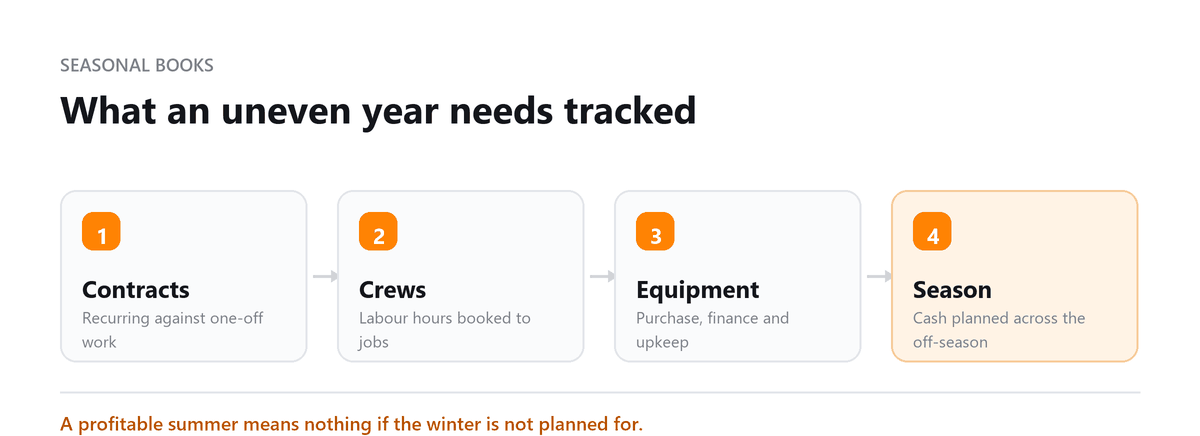
- Cash flow difficulties: Seasonal revenue patterns require careful management to cover year-round payroll and overhead
- Inaccurate financial statements: Decisions about pricing, staffing, and equipment investment become unreliable without accurate data
- Tax errors: Misclassified workers, unreported income, and missed deadlines create expensive problems
- Loan obstacles: Lenders require clean, organised financials, a business without them struggles to secure equipment financing or a growth line of credit
Tips for Effective Landscaping Bookkeeping
- Choose your accounting method: Most landscaping businesses use cash accounting; accrual is better as you scale
- Build a chart of accounts with landscaping-specific categories (job types, equipment types, crew costs)
- Track every expense and receipt, even small ones add up across a busy season
- Automate invoicing and payment collection to reduce accounts receivable delays
- Reconcile bank and credit card accounts monthly
- Review your income statement monthly, know which service lines are profitable
- Consider outsourcing bookkeeping so you can focus on operations and sales
- Seek professional help for payroll tax filings and year-end tax planning
- Maintain organised job costing records: labour hours, materials, and equipment time per job
- Utilise mobile apps to capture receipts and mileage in the field in real time
- Track mileage for all business-related driving
- Open separate business bank accounts and credit cards for all company transactions
- Document equipment purchases and improvements for accurate depreciation
- Stay current on state and local regulations for contractor licensing and payroll
- Educate field staff on expense documentation procedures
At Profitjets, we have worked with landscaping companies generating more than $1 million in annual revenue that were still relying on spreadsheets and basic recordkeeping systems. One of the first improvements we typically make is implementing job costing. Many owners know their overall revenue but have limited visibility into which services, contracts, or project types are generating the strongest margins. Until that information is available, growth decisions are often based on assumptions rather than data.
We have also seen landscaping businesses struggle with seasonal cash flow planning. During peak months, strong revenue can create the illusion of financial security, only for businesses to face cash shortages during slower periods because profitability, equipment costs, and tax liabilities were not being tracked properly. Once structured bookkeeping and reporting systems are in place, owners gain a much clearer understanding of their financial position and can plan proactively rather than reactively.
Bookkeeping Software for Landscaping Businesses
| Software | Pricing | Job Costing | Scalability |
|---|---|---|---|
| QuickBooks Online | $38/month | Add-on | High |
| Xero | $25/month | Add-on | High |
| FreshBooks | $23/month | Add-on | Medium |
| Wave | Free | No | Low |
Common Landscaping Bookkeeping Mistakes
- Mixing personal and business finances, a dedicated business account is non-negotiable
- Not using accounting software, manual systems cannot scale with a growing crew
- Neglecting to keep receipts for materials, equipment, and fuel purchases
- Ignoring job costing, the single most expensive mistake in a margin-thin business
- Procrastinating on data entry until tax season, backlogs cost time and money
- Not backing up financial data, cloud accounting software solves this automatically
- Not seeking professional help for payroll taxes, quarterly filings, and depreciation
Book a free consultation and we will map the cash across the full year.
Frequently Asked Questions
How do landscaping companies track job costs?
Job costing in landscaping means recording all labour hours, materials, equipment time, and subcontractor costs against a specific job or contract. Software like QuickBooks with a job costing add-on or industry-specific tools like Aspire or LMN make this manageable.
What can landscaping businesses deduct on their taxes?
Deductible expenses include payroll costs, vehicle expenses (mileage or actual costs), equipment depreciation, tools and supplies, insurance, advertising, professional services, and the home-office deduction if applicable. Keep receipts for everything.
Should I use cash or accrual accounting for my landscaping business?
Most small landscaping companies start with cash accounting for its simplicity. As you grow past $1M in revenue or begin taking on long-term contracts, accrual accounting gives a more accurate picture of financial health.
How do I manage cash flow in the off-season?
Build a cash reserve during peak months to cover fixed costs in slow months. Analyse your monthly cash flow needs from the previous year and set a target reserve balance before summer or winter slow periods begin.
Do landscaping businesses need a dedicated bookkeeper?
Once you have a crew, multiple service lines, and regular billing cycles, a dedicated bookkeeper, in-house or outsourced, pays for itself quickly through cleaner records, fewer tax errors, and more accurate job costing.
Conclusion
Landscaping businesses that invest in proper bookkeeping know their numbers, and businesses that know their numbers make better decisions, avoid costly mistakes, and grow with confidence. Whether you handle it in-house or partner with a specialist, building a solid financial foundation is one of the best investments you can make in your business.

Written by
Abhinav Gupta, CPA, CA, MBA
Abhinav works with business owners across the US on industry-specific bookkeeping, from dental practices and restaurants to construction and e-commerce. He writes about what each trade's books actually need. Connect on LinkedIn
Free consultation
Want the Off-Season Planned For?
Book a free consultation and we will map the cash across the full year.