
Therapists spend intensive learning on the subject to resolve the mental and physical health of their patients. As they are professionally trained and licensed they ensure quality in the service. However, the majority of them still operate without a proper financial framework that becomes difficult when the set up is reaching an expansion stage. Good bookkeeping practice is essential for therapists to understand the financial health of their businesses.
The therapy initially begins simple, but the process becomes complex with virtual and physical consultation across different geographical locations and time zones. Income is received by multiple sources which becomes difficult to track. From maintaining payrolls, software purchases, client transaction details, insurance, reimbursements and handling funds from the sponsors the process has various aspects to take account for. The financial aspect should not become an after thought to help neglect ¿in the early phase.
With the right bookkeeping practice, Therapists gain financial visibility of their business which help them make strategic decisions on scalablity. With the right bookkeeper, the entire process becomes seamless to navigate the tax season audit ready.
Therapists are particularly vulnerable to bookkeeping errors around insurance reimbursements, the lag between service delivery and payment can distort your sense of how well the practice is performing. Accrual accounting gives you a much cleaner picture.
Abhinav Gupta, CPA, CA, MBA · LinkedInWhat is Bookkeeping for Therapists?
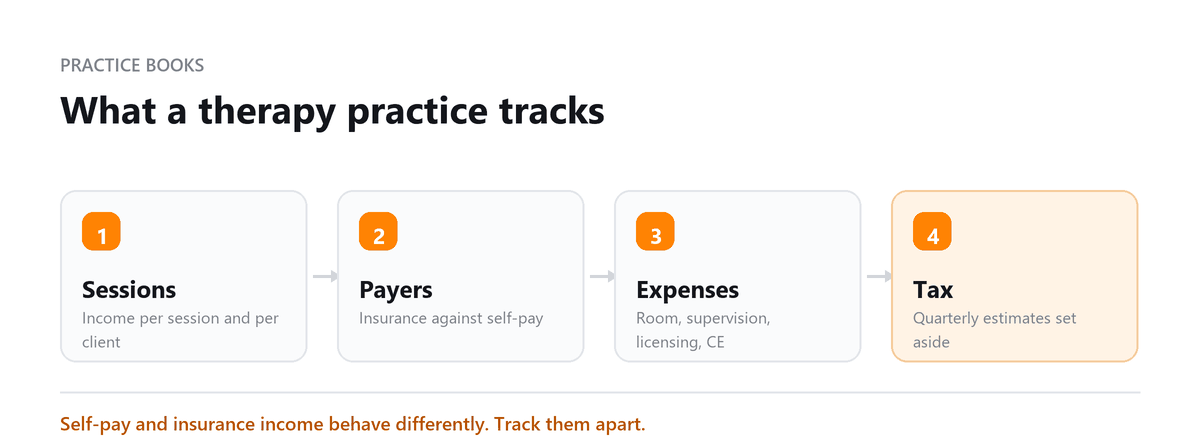
Bookkeeping for therapists involves recording and organising all financial transactions of a therapy practice or private practice. This includes income from client session fees, insurance reimbursements, employee assistance programme (EAP) payments, and group programme fees. On the expense side, it covers office rent, software subscriptions, professional development, malpractice insurance, and administrative costs. For therapists in private practice, accurate bookkeeping is the foundation of both tax compliance and business growth.
Why Bookkeeping Matters for Therapists
- Informed decision-making: Accurate financial data tells you whether your practice rate is sufficient, whether your overhead is sustainable, and when you can afford to hire
- Tax preparation: Clean records make filing straightforward and ensure all deductions, from home office to CPD, are captured
- Budgeting: Understanding your monthly fixed and variable costs helps you plan for slower periods
- Loan applications: If you ever seek a practice loan or lease, lenders will require accurate financial statements
- Business insights: Bookkeeping data reveals which service types or client groups are most profitable
Bookkeeping Tips for Therapists
- Separate business and personal accounts: A dedicated practice bank account and business credit card are essential
- Categorise transactions consistently: Create income categories for client fees, insurance reimbursements, and EAP payments separately
- Use therapy-specific or HIPAA-compatible software: Not all accounting tools meet healthcare data standards, verify compliance before selecting
- Automate payments and invoicing: Practice management software that handles billing reduces errors and time spent chasing payments
- Review your books regularly: A monthly financial review takes less than an hour and prevents surprises
- Seek professional help when growing: As your practice expands, adding clinicians, moving to a larger space, bookkeeping complexity grows with it
At Profitjets, we work with therapists, counselors, psychologists, and mental health practices that want greater clarity and control over their finances. Many therapist clients come to us after managing their books through spreadsheets or basic recordkeeping systems that worked when they first started but became increasingly difficult to maintain as their practices grew. Once proper bookkeeping processes are established, they are often surprised by how much administrative time they recover and how much clearer their financial picture becomes.
We have also seen therapists gain valuable insights into appointment profitability, insurance reimbursement trends, and operating costs simply by having accurate, up-to-date financial reports. Rather than scrambling to prepare for tax season or wondering whether they can afford to hire additional clinicians, they can make decisions based on reliable financial data throughout the year.
Common Bookkeeping Mistakes and How to Avoid Them
- Underestimating the importance of bookkeeping: Many solo therapists treat it as optional until tax time, by then, months of reconstruction work is needed
- DIY errors: Without accounting training, categorisation mistakes are common; consider professional support from the start
- Manual data entry errors: Cloud software with bank feeds eliminates most manual entry mistakes
- Skipping monthly reviews: Monthly P&L review takes under an hour and catches issues before they compound
- Ignoring tax implications: Quarterly estimated tax payments, self-employment tax, and home office deductions all require ongoing attention
Best Bookkeeping Software for Therapists
| Software | Key Features | Pricing | Best For |
|---|---|---|---|
| TherapyNotes | HIPAA-compliant, practice management + bookkeeping | Higher pricing | Established practices |
| SimplePractice | User-friendly, affordable, insurance billing | Mid-range | Solo/small practices |
| HoneyBook | Insurance integration, client-facing workflows | Mid-range | Client-facing workflows |
| Wave | Free basic plan, simple accounting | Free/paid | Budget-conscious practitioners |
| Zoho Books | Affordable, mobile access, good reporting | Low | Growing practices |
Book a free consultation and we will keep the practice books current.
Frequently Asked Questions
Do I need HIPAA-compliant accounting software as a therapist?
Your accounting software does not itself need to be HIPAA-compliant if it does not store protected health information (PHI). However, your practice management software, which handles billing, insurance claims, and client records, must be. Many therapists use a HIPAA-compliant EHR/practice management tool alongside standard accounting software like QuickBooks or Wave.
Can a therapist deduct their home office?
Yes, if you use a dedicated space in your home exclusively and regularly for your practice, you may be eligible for the home office deduction. This can include a proportional share of rent, utilities, and internet. The space must be used solely for business, a guest room that doubles as an office does not qualify. Consult a tax professional for your specific situation.
How do I handle insurance reimbursements in my bookkeeping?
Record the full session fee as income when the session occurs. When insurance pays, record the payment as received. Any write-offs (the difference between your billed rate and the insurance contracted rate) should be recorded separately so you can track your effective income per session.
Should a therapist in private practice use cash or accrual accounting?
Many solo therapists use cash basis accounting because it is simpler and aligns with how they experience money, paid when the client pays. If you bill insurance regularly and have significant receivables, accrual accounting gives a more accurate picture. Discuss with your accountant which method suits your practice structure.
How often should I review my practice finances?
Monthly, at a minimum. A monthly P&L review helps you spot whether income is keeping up with expenses, whether your rate is appropriate, and whether any unusual costs have appeared. Quarterly, review your estimated tax position to avoid underpayment penalties.
Conclusion
A therapy practice is a business, and good bookkeeping is what keeps that business sustainable. With the right software, consistent habits, and professional support when you need it, your practice finances become a source of confidence rather than anxiety.
Profitjets provides bookkeeping services designed for healthcare and wellness professionals. We understand the revenue structures, compliance requirements, and tax considerations unique to therapy practices, and we handle the numbers so you can focus on your clients.

Written by
Abhinav Gupta, CPA, CA, MBA
Abhinav works with business owners across the US on industry-specific bookkeeping, from dental practices and restaurants to construction and e-commerce. He writes about what each trade's books actually need. Connect on LinkedIn
Free consultation
Rather Focus on Clients?
Book a free consultation and we will keep the practice books current.