
Virtual bookkeeping is maintaining all your financial records digitally instead of manually updating them into spreadsheets and ledgers. This accounting software enables businesses to virtually maintain the financial records providing accuracy replacing redundant practices. Managing bookkeeping digitally streamlines your business operational workflow with efficiency.
At Profitjets digital bookkeeping services, every customer we onboard works on cloud based bookkeeping. The shift is not as complex as people think of. The transition is not because of advancing technology but instead visibility shifts as the process is interconnected and easily accessible in a single place. There’s no information distinguished in fragments in multiple places that requires access.
The feedback we often hear from 80% of our customers is that the process is easy to keep track of and they didn't want to go back to how it was initially.
Moving to digital bookkeeping was the single biggest efficiency gain we've seen our clients make. What used to take days of manual reconciliation now happens automatically overnight. The question isn't whether to go digital, it's why you haven't already.
Ankit Sarawagi, CPA, CA, MBA · LinkedInWhat is Digital Bookkeeping
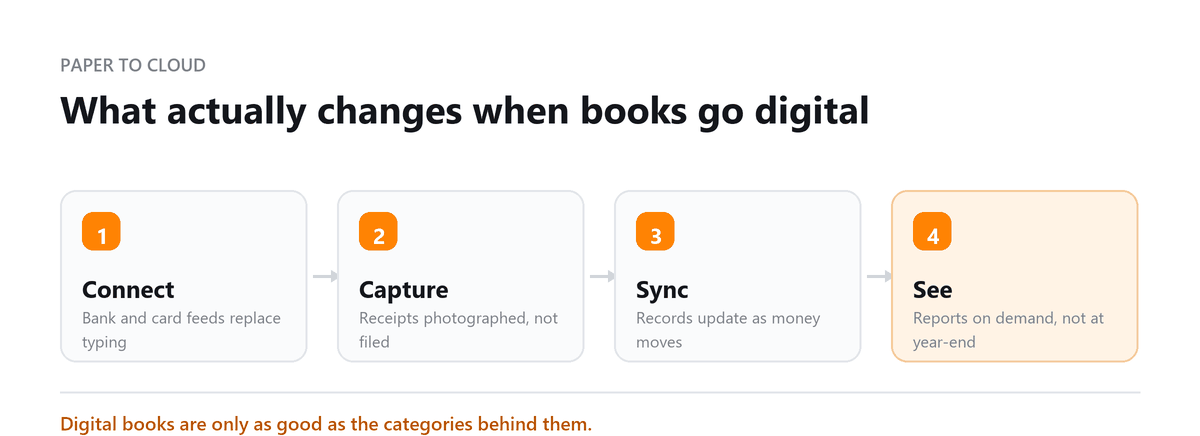
Digital bookkeeping leverages technology to revolutionize financial record-keeping for businesses. Gone are the days of manual data entry and paper-based ledgers. Instead, digital bookkeeping utilizes software to electronically capture receipts, connect to bank accounts, and streamline financial data management.
Cloud-based accounting software provides a central hub for all your financial records, offering real-time access, automated tasks like reconciliations, and secure data storage. This enhanced efficiency empowers business owners to make data-driven decisions, improve collaboration with accountants, and free up valuable time to focus on core business activities. In short, digital bookkeeping is the wave of the future for businesses seeking a more efficient, secure, and insightful approach to managing their finances.
We have seen the pattern at Profitjets that our clients opting digital bookkeeping consume 85% less time on reconciliations every month. When compared to conventional bookkeeping, this approach facilitates the entire process seamlessly without manual entries and the remaining time could be used to strategize the business further.
Traditional Bookkeeping vs Digital Bookkeeping, Differences
| Feature | Traditional Bookkeeping | Digital Bookkeeping |
|---|---|---|
| Location | On-site, paper-based | Cloud-based, accessible anywhere |
| Technology | Limited software use | Relies heavily on robust bookkeeping software |
| Automation | Minimal | Extensive use of AI for repetitive tasks |
| Data Access | Periodic reports | Real-time dashboard and reports |
| Scalability | Limited, requires hiring additional staff | Highly scalable, adapts to business growth |
| Cost | Higher overhead due to office space and supplies | Cost-effective, pay only for services used |
Benefits of Digital Bookkeeping for Small Businesses
Buckle up because the benefits of Digital Bookkeeping are a sight to behold:
- Accuracy and Efficiency: Say goodbye to human error and hello to AI-powered precision. Transactions reconcile themselves, and data flows seamlessly, saving you time and money.
- Real-time Insights: Ditch the quarterly scramble for financial reports. With digital bookkeeping, you have 24/7 access to real-time financial data, empowering you to make informed decisions faster.
- Scalability and Flexibility: Whether you're a solopreneur or a multinational corporation, digital bookkeeping adapts to your needs. Scale your services up or down effortlessly as your business grows.
- Collaboration Made Easy: Share financial data securely with your team, accountant, or investors with a few clicks. Collaboration becomes effortless, fostering transparency and improved decision-making.
- Peace of Mind: Knowing your finances are in the hands of qualified professionals, backed by secure cloud storage, brings invaluable peace of mind. You can focus on what you do best, running your business.
Before You Make the Switch: Key Considerations
Before you embark on your digital bookkeeping journey, consider these wise words:
- Define Your Needs: Do you require complete bookkeeping service or just specific tasks automated? Assess your needs to choose the right software and service provider.
- Embrace Security: Ensure the selected software has access controls and data encryption among its security features. Your financial data deserves top-notch protection.
- Seek Expert Guidance: Transitioning to digital bookkeeping can be smooth with the help of experienced professionals. Seek guidance from certified bookkeepers or software providers.
Top Digital Bookkeeping Software
- QuickBooks Online: Small to medium businesses often choose this option for its user-friendly features and scalability.
- Xero: Ideal for cloud-based collaboration and automation, with industry-specific features for various businesses.
- Zoho Books: A cost-effective option for startups and freelancers, offering essential accounting tools and integrations.
- Wave Accounting: Free for basic bookkeeping needs, with paid add-ons for advanced features.
Digital bookkeeping is not just a passing trend; it's the future of efficient financial management. Empower your business with digital bookkeeping. Embrace the cloud and soar to new heights.
Advanced Digital Bookkeeping for Entrepreneurs
While the core principles of digital bookkeeping are accessible to all, the truly savvy entrepreneur will delve deeper, exploring advanced features and leveraging them to gain a competitive edge.
Here's a glimpse into the world of advanced digital bookkeeping:
- Embrace Integrations: Modern bookkeeping solutions seamlessly integrate with your CRM, e-commerce platform, bank accounts, and more. This eliminates data silos, streamlines workflows, and provides a holistic view of your financial ecosystem.
- Unleash the Power of Machine Learning: AI-powered tools can analyze financial data, predict cash flow, and detect fraud providing insights that help you stay ahead of the competition.
- Deep Dive into Analytics: Advanced bookkeeping software offers interactive dashboards and customizable reports that allow you to drill down into specific metrics and identify areas for improvement.
- Embrace the Global Stage: Digital bookkeeping solutions offer multi-currency support, automated foreign exchange calculations, and compliance with international tax regulations.
- Security in the Digital Age: Advanced digital bookkeeping platforms employ robust security measures like multi-factor authentication, data encryption, and regular backups.
Remember, digital bookkeeping is not just a tool; it's a mindset. By embracing the power of technology, continuously seeking new avenues for optimization, and turning your financial management into a strategic tool, you can achieve growth and success in today's rapidly changing business environment.
Book a free consultation and we will set the software up and run it for you.
Digital Bookkeeping FAQs
Is digital bookkeeping safe?
Yes, reputable cloud bookkeeping platforms use bank-grade encryption, multi-factor authentication, and automatic backups. Your data is generally safer in a well-maintained cloud system than in a local spreadsheet or paper ledger that could be lost, damaged, or accessed by anyone with physical access to your office.
What is the best digital bookkeeping software for small businesses?
QuickBooks Online is the most widely used and integrates with the most third-party tools. Xero is popular for its clean interface and strong collaboration features. Wave is a solid free option for very small businesses or freelancers. The best choice depends on your transaction volume, team size, and budget.
Can I switch from paper to digital bookkeeping mid-year?
Yes, and you don't need to wait for the new financial year. Most bookkeeping software allows you to import historical data from spreadsheets or manually enter opening balances. A bookkeeper can help you migrate cleanly so your records are continuous and accurate.
How much does digital bookkeeping cost?
Software costs range from free (Wave) to $30 to $80/month (QuickBooks, Xero) for small businesses. If you outsource digital bookkeeping to a service like Profitjets, costs typically range from $200 to $800/month depending on transaction volume, often cheaper than hiring even a part-time bookkeeper.
Do I still need an accountant if I use digital bookkeeping software?
Yes. Software handles data entry and organisation, it doesn't replace professional judgment. You still need an accountant for tax filing, financial strategy, and interpreting what your numbers mean. Think of digital bookkeeping software as the tool, and an accountant as the expert who uses it properly.

Written by
Ankit Sarawagi, CPA, CA, MBA
Ankit leads the finance team at Profitjets, where he has worked with 500+ businesses across the US on bookkeeping, tax and CFO-level strategy. He writes about the habits that keep small business books accurate all year. Connect on LinkedIn
Free consultation
Moving Your Books to the Cloud?
Book a free consultation and we will set the software up and run it for you.