
Majority of the business owners know that they shouldn't be spending a lot of time in organizing their books. They need to work more in strategizing decisions that fuel significant growth. But still most of them hesitate to delegate the tasks accordingly. They feel they are saving money by not hiring services but in reality small delays compound to inconsistencies in their financial records which amounts to costly errors that could have been prevented.
When the business is tending to expand with additional tools and services, it becomes more challenging to maintain clean and accurate financial information. With factors like increase in volumes of transaction, rising payroll duties and additional requirements the process becomes more complex to manage. Outsourcing bookkeeping services helps eliminate the hassle and make the business owners approach the tax season with clarity. Business owners increasingly rely on professionals to streamline the workflow by enhancing their visibility.
Here are the ten most important reasons why you should outsource your bookkeeping services for long-term growth.
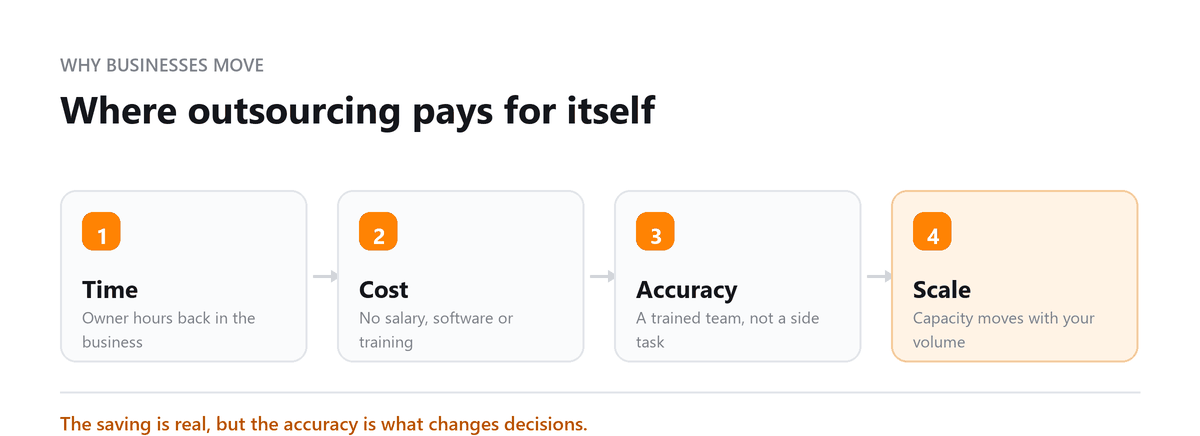
The number one thing outsourcing bookkeeping buys you is not just time or money, it is clarity. When someone else is managing your books professionally, you stop guessing and start knowing.
Ankit Sarawagi, CPA, CA, MBA · LinkedInWhat is Outsourced Bookkeeping?
Outsourced bookkeeping means delegating your financial record-keeping and accounting tasks to a professional third-party service provider. These professionals manage transactions, payroll, reconciliations, and tax preparation, allowing you to concentrate on running and growing your business rather than managing its paperwork.
How Does Outsourced Bookkeeping Work?
- Select a bookkeeping service aligned with your business size, industry, and software
- Provide secure access to your financial data and accounting systems
- Work with a dedicated bookkeeper managing your accounts on an agreed schedule
- Receive regular financial reports and updates, monthly as standard, more frequently if needed
What Services Can You Outsource?
- Daily transaction recording and data entry
- Accounts payable and receivable management
- Payroll processing and tax filing
- Bank reconciliations and financial reporting
- Tax preparation and annual filing support
Top 10 Reasons to Outsource Your Bookkeeping
1. Focus on Your Core Strengths
Your time and energy are best spent on the parts of the business only you can do, product development, customer relationships, strategy. Bookkeeping is important, but it does not need to be done by you. Outsourcing returns those hours to the work that moves the business forward.
2. Access to Expertise You Cannot Afford In-House
Outsourcing gives you access to certified, experienced bookkeepers, and often an entire team, at a cost that bears no comparison to hiring that expertise full-time. You benefit from deep accounting knowledge and current software proficiency without the employment overhead.
3. Scalability and Flexibility
As your business grows, your bookkeeping needs change. An outsourced provider adjusts their service scope without the complexity of hiring, training, or managing additional staff. Scale up for a busy period, scale back in a quieter one.
4. Enhanced Data Security
Professional bookkeeping firms use enterprise-grade security: encrypted data storage, secure portals, two-factor authentication, and role-based access controls. In many cases this exceeds what a small business could implement internally.
5. Improved Internal Controls
An external bookkeeper provides a fresh perspective on your financial processes. They can identify inconsistencies, flag unusual transactions, and implement controls that reduce the risk of errors and fraud that can go unnoticed in a self-managed setup.
6. Streamlined Accounting Processes
Professional bookkeeping services work from established systems and workflows, bringing structure and efficiency to financial management that most owner-managed businesses lack. The result is faster month-end closes and more reliable reports.
7. Greater Tax Accuracy and Savings
Accurate, well-categorised books make tax preparation faster and more accurate. They also ensure that deductible expenses are captured throughout the year, not just at year-end when some may already be lost. Professional bookkeepers know what triggers audits and how to maintain records that withstand scrutiny.
8. Always Up-to-Date Technology
Cloud accounting software is updated continuously. Working with a professional service means you always benefit from the latest features and integrations without carrying the cost or responsibility of maintaining them yourself.
9. More Time for Business Growth
The cumulative time freed by outsourcing bookkeeping, hours per week that are no longer spent on reconciliations, invoicing, and report preparation, compounds into significant capacity for the strategic work that actually grows the business.
10. Reduced Stress and Burnout
Financial management is a significant source of stress for small business owners. Knowing that your books are in the hands of a qualified professional, and that reports are accurate and deadlines are being met, removes a persistent mental load that affects everything else you do.
Types of Outsourced Bookkeeping
- Full-service bookkeeping: Comprehensive financial management from daily transactions through reporting
- Virtual bookkeeping: Remote management by dedicated professionals using cloud platforms
- Part-time bookkeeping: Specific tasks or seasonal support, billed as needed
We have recently partnered with the emerging ecommerce business at Profitjets, whose founder was wearing multiple hats. He spends Friday every week to organize the records and sales transactions. The transaction volume and reconciliations were from multiple channels. His business was performing as he expected but he was doubtful about the numbers reconciled and the backlogs increased when volume increased. He made ad-hoc decisions on cash flow instead of relying on precise financial records.
After we took over, business transitioned to the structured reporting with clear, reconciled accounts. Financial statements were updated to present. After a few months, owner was clearly able to detect the shortfalls as his financial picture was made clear. He improved his decisions on purchasing, analyzed his profit SKUs which overall minimized the spend and gave better ROI.
Most business owners do not outsource because their books are completely broken. They outsource because they reach a point where managing bookkeeping internally is no longer the best use of their time. The value comes from having accurate financial information available when decisions need to be made not weeks or months later.
Book a free consultation and we will tell you what your books actually need.
Frequently Asked Questions
What is outsourced bookkeeping?
Outsourced bookkeeping is the practice of delegating your financial record-keeping to a professional third-party service. The provider manages transactions, reconciliations, payroll, and reporting remotely using cloud-based accounting software.
Is outsourced bookkeeping suitable for very small businesses?
Yes, in fact, small businesses often benefit the most. The economics are compelling: you get professional-quality financial management at a fraction of what a full-time hire would cost, and you free up your own time for revenue-generating activity.
How do I know which bookkeeping tasks to outsource?
Start with the tasks that consume the most time and carry the highest risk of error, typically bank reconciliation, payroll, accounts payable, and tax preparation. Most professional services offer tiered packages so you can outsource exactly what you need.
What does outsourced bookkeeping cost?
Typically $200 to $2,500 per month for small businesses, depending on transaction volume, service scope, and the provider's pricing model. Fixed monthly packages are generally more cost-effective and predictable than hourly billing.
How long does it take to set up outsourced bookkeeping?
Most professional services can complete onboarding within one to two weeks, covering software setup, bank feed connections, historical data migration, and establishing your reporting schedule.
Conclusion
Outsourcing your bookkeeping is not a sign that you cannot manage your finances, it is a sign that you understand where your time is best spent. Every one of the ten reasons above compounds over time. Clean books, expert oversight, and freed-up hours are not small advantages; they are strategic assets. The question is not whether to outsource, but when to start.

Written by
Ankit Sarawagi, CPA, CA, MBA
Ankit leads the finance team at Profitjets, where he has worked with 500+ businesses across the US on bookkeeping, tax and CFO-level strategy. He writes about the habits that keep small business books accurate all year. Connect on LinkedIn
Free consultation
Ready to Hand the Books Over?
Book a free consultation and we will tell you what your books actually need.