
To ensure financial growth while executing the operations, every small business owner needs to appropriately segregate the roles of the CFO vs COO in order to define the reporting requirements and obligations effectively.
As such, the Chief Financial Officer governs the financial policies of the organization, including its capital, whereas, the Chief Operating Officer manages the supply chains and operations of the business.
By understanding the differences between the responsibilities of the CFO vs COO, the company would be able to scale its development and ensure that its operations have the required unit economics while fulfilling its business needs at an optimal rate.
Moreover, the collaboration of the two executives would create a solid structure that allows transforming the goals of the organization into reality while maximizing the profits it can generate.
CFO vs COO: Definition
What is a CFO?
A Chief Financial Officer (CFO) is the executive responsible for managing a company's financial health, strategy, and reporting. The CFO oversees financial planning and analysis, investor relations, capital structure, treasury, risk management, and the finance team.
They translate the company's strategy into financial plans and ensure the business has the capital it needs to execute. The CFO reports to the CEO and has a direct reporting relationship to the board through the audit and finance committees.
What is a COO?
A Chief Operating Officer (COO) is the executive responsible for managing a company's day-to-day operations. The COO oversees the systems, processes, and people that deliver the company's products or services: supply chain, production, customer delivery, quality management, and operational efficiency.
Where the CEO sets the strategic direction, the COO executes it. The COO typically reports to the CEO and often serves as the CEO's closest operational partner and, in many organizations, designated successor.
The best CFO-COO partnerships I've seen work because neither executive tries to own the other's domain. The COO drives operational performance; the CFO translates it into financial language for the board. When they're aligned, the CEO gets coherent messaging from both directions.
Ankit Sagatani, MBA, B.Com · LinkedInCFO vs COO: Similarities
Both the CFO and COO are C-suite executives who report to the CEO. Both carry company-wide influence and are accountable for business performance from their respective domains. Both interact directly with the board, the COO through operational performance reporting, the CFO through financial and audit committee relationships. Both roles require strong analytical capability, leadership skills, and the ability to manage large, complex organizations. Neither role is well-suited to narrow functional specialists, both require executives who understand how the whole business works.
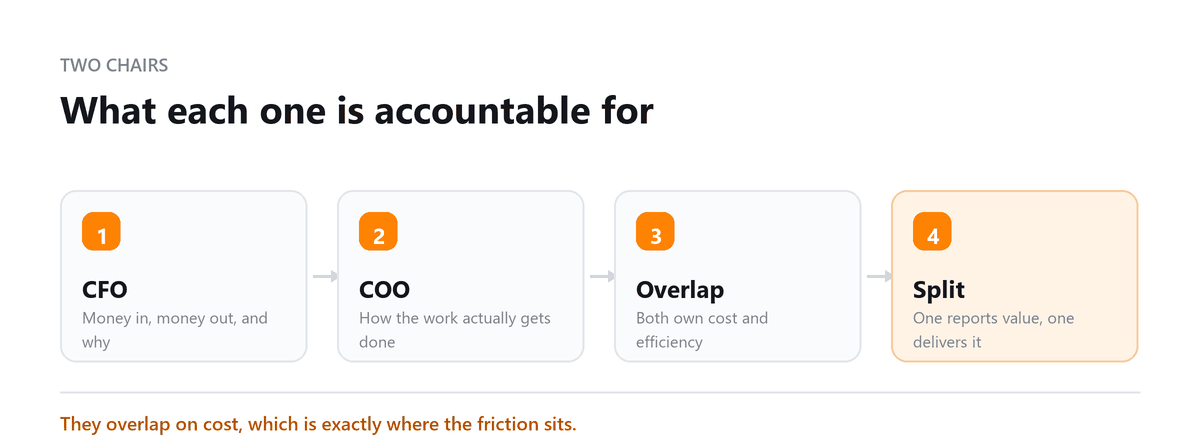
CFO vs COO: Key Differences
| Dimension | CFO | COO |
|---|---|---|
| Primary domain | Finance and capital | Operations and execution |
| Success metric | Financial performance (profit, ROIC) | Operational KPIs (throughput, quality, cost) |
| Budget authority | Sets budget policy | Manages operating budget |
| External focus | Investors, lenders, auditors | Suppliers, partners, customers |
| Background | Finance, accounting, investment banking | Operations, engineering, consulting, supply chain |
| Succession to CEO | Less common | Common, COO often seen as heir apparent |
Benefits of a Strong CFO-COO Partnership
When the CFO and COO work in genuine alignment, the business benefits from financial discipline applied to operational decisions. The COO brings the operational context that makes financial planning meaningful, real cost drivers, actual production constraints, genuine customer demand patterns. The CFO provides the financial framework that ensures operational investments generate acceptable returns and that working capital is managed efficiently.
Shared accountability for EBITDA is the most powerful expression of CFO-COO alignment: when both executives own the margin outcome together, operational and financial decisions are made with a shared lens rather than in departmental silos. Working capital management particularly inventory and receivables benefits enormously from CFO-COO collaboration, where financial metrics and operational realities are simultaneously in view.
Companies supported by Profitjets fractional CFO leadership reduce annual budget variance by an average of 42% and improve inventory cash conversion cycles by 18 days through structured CFO-COO operational alignment.
Cloud-Based Accounting Software for CFOs and COOs
Modern cloud ERP platforms: NetSuite, SAP S/4HANA, Oracle Fusion Cloud, are changing how CFOs and COOs collaborate. Operational data flows automatically into financial reporting: production volumes feed revenue recognition; inventory movements update the balance sheet in real time; purchase order commitments appear in cash flow projections before the invoice arrives.
This integration eliminates the data lag that historically separated operational and financial management, allowing the CFO and COO to work from a shared, real-time view of business performance.
Conclusion
The CFO and COO are complementary executive roles that together cover the financial and operational dimensions of business leadership. Neither substitutes for the other, the domains are distinct and the skill sets are different. Companies that have both roles filled by strong executives, and that have built a genuine working partnership between them, consistently outperform peers on both operational and financial metrics. For growing companies that cannot yet afford both full-time, fractional CFO services are a proven model for accessing financial leadership while the operational function develops.
While advising a mid-market manufacturing client, we observed a classic tension: the COO wanted to double safety stock to prevent stockouts, while the founding team was concerned about cash drain. Stepping in as fractional CFO, we built a dynamic working capital model showing that holding three additional weeks of inventory would cause a $600,000 cash shortfall during their off-season. By establishing a joint inventory-to-cash KPI, we enabled the COO to optimize safety stock while preserving critical liquidity.
Book a free consultation and we will cover the finance seat for now.
Frequently Asked Questions
Does a company need both a CFO and a COO?
Not always. Many companies start without a COO, the CEO manages operations directly. A COO is typically added when the CEO needs to free up time from operational execution to focus on external strategy and fundraising. The CFO is usually hired earlier, once financial complexity requires dedicated leadership. At Series B and beyond, having both is common.
Can a CFO do a COO's job?
In smaller companies, a strong CFO often covers some operational oversight particularly in financial operations (AP, AR, payroll). But a CFO trained in finance typically lacks the operational domain expertise manufacturing, supply chain, customer service that a COO brings. The roles are complementary, not interchangeable.
Who earns more, a CFO or a COO?
Compensation varies by company and industry, but both roles are typically in the same range at most companies. CFOs at large companies sometimes earn more due to the financial complexity and regulatory accountability they carry. COOs at operationally intensive companies (manufacturing, retail, logistics) may earn comparable or higher total comp due to their direct impact on operational profit.
Is the COO always the CEO's successor?
Not always, but the COO role is historically one of the most common paths to CEO. Many companies use the COO position explicitly as CEO succession planning. The CFO can also become CEO particularly in financially complex industries like investment banking, private equity, or financial services.
How do the CFO and COO collaborate on budget planning?
The annual operating budget is the primary collaboration: the COO's team provides operational inputs (headcount plans, capex needs, operational cost assumptions); the CFO's team translates these into financial projections and sets the overall budget envelope. The final budget requires alignment between both executives before board approval.

Free consultation
Building the Leadership Team?
Book a free consultation and we will cover the finance seat for now.