
Incorporating is a series of small, sequential steps where each one generally needs the previous one to be finished first.
Founders usually know the first few and are surprised by what follows: the agent, the identifier, the bank account, the internal documents, and the obligations that begin the moment the entity exists and repeat every year afterwards.
This covers what incorporation actually gives you, the steps in the order they have to happen, what each one requires, roughly what the process costs, and how long it realistically takes.
What Does Incorporation Actually Mean?
Incorporating a company in the USA means filing formation documents with a state government to create a legally recognized business entity separate from its owners. The entity can sign contracts, own assets, hire employees, and be taxed independently.
The part founders skip is what happens every year afterwards. Each state wants a periodic report and its own fee, the registered agent has to stay appointed, and the entity files whether or not it traded. Put all of those dates in the calendar the day the company is formed.
Abhinav Gupta, CPA, CA, MBA · LinkedInStep 1: Choose Your Entity Type
| Entity | Best For |
|---|---|
| C-Corporation | VC-backed startups, stock options, international investors |
| S-Corporation | Small profitable businesses, payroll tax savings |
| LLC | Flexible ownership, pass-through taxes, simple operations |
| Sole Proprietorship | Solo freelancers (no incorporation required) |
| Partnership | Two+ owners, no liability protection desired |
For most startups planning to raise capital: Delaware C-Corporation. For most small businesses staying private: LLC in your home state.
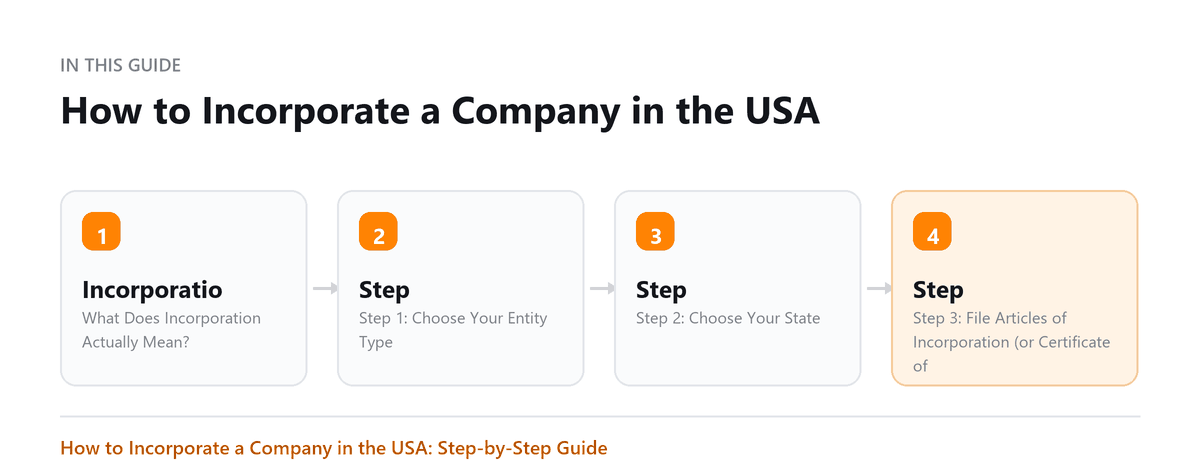
Step 2: Choose Your State
You can incorporate in any US state regardless of where you operate. Most businesses choose between:
- Delaware: Preferred by VCs, Court of Chancery, predictable corporate law. Annual franchise tax minimum $175.
- Wyoming: Low fees ($100 formation, $60/year), strong privacy, no state income tax. Good for private companies.
- Your home state: Simplest if you operate locally, avoids foreign qualification filings.
- Nevada: Used to be popular for asset protection, largely superseded by Wyoming.
Step 3: File Articles of Incorporation (or Certificate of Formation)
For a C-corp, this is called Articles of Incorporation (or Certificate of Incorporation in Delaware). For an LLC, it is Articles of Organization (or Certificate of Formation). The document includes:
- Company name (must be unique in the state)
- Registered agent name and address
- Number of authorized shares (for corps) or member names (for LLCs, where required)
- Incorporator name and signature
- Principal office address
Filing fees: $89-$300 depending on state. Most states offer online filing with same-day or next-business-day approval.
Step 4: Appoint a Registered Agent
Every US business entity must have a registered agent: a person or company with a physical address in the state of incorporation, available during business hours to receive legal documents. You can be your own agent (if you are physically in the state) or hire a service.
| Provider | Annual Cost |
|---|---|
| Northwest Registered Agent | $125/year |
| CT Corporation | $150-$300/year |
| Registered Agents Inc. | $200/year |
| Harvard Business Services (Delaware) | $50/year |
| Your formation attorney | Often bundled |
Step 5: Get an EIN (Employer Identification Number)
An EIN is your company's federal tax ID, the business equivalent of a Social Security Number. Required for:
- Opening a business bank account
- Hiring employees
- Filing business tax returns
- Setting up payroll
- Applying for business licenses
How to get one:
- Online: IRS website (https://www.irs.gov), instant, free, available to US residents with SSN/ITIN
- Form SS-4 by fax: 4 business days. Required if you do not have an SSN (international founders).
- Form SS-4 by mail: 4-6 weeks
Step 6: Open a Business Bank Account
You need: EIN, formation documents (Articles of Incorporation/Organization), and sometimes an operating agreement or bylaws. Options:
- Traditional banks (Chase, Bank of America): Requires in-person visit, higher minimums
- Mercury: Online, free, great for startups. Works for non-US residents with a US entity.
- Relay: Online, no fees, good for multi-user teams
- Brex: Corporate card + banking, good for funded startups
- Wise Business: Good if you receive international payments
Step 7: Draft Bylaws (Corp) or Operating Agreement (LLC)
Bylaws govern how your corporation operates: board structure, officer roles, voting procedures, share issuance. Operating agreements govern LLCs: profit/loss allocation, member voting rights, decision-making procedures. Not filed with the state but essential for:
- Bank account opening (some banks require it)
- Investor diligence
- Resolving disputes among founders
- Establishing authority to sign contracts
Step 8: Issue Founder Shares and File 83(b) Election
For corporations: issue stock to founders immediately. If shares are subject to vesting (which they should be), file an 83(b) election with the IRS within 30 days of the grant date. This election starts your capital gains holding period and QSBS clock immediately, potentially saving hundreds of thousands in taxes.
Step 9: Foreign Qualify if Operating in Another State
If you incorporate in Delaware but operate in California (have employees, offices, or significant business activity there), you must register as a foreign corporation in California. This involves:
- Filing a Statement and Designation by Foreign Corporation in California
- Appointing a registered agent in California
- Paying California franchise tax (minimum $800/year)
- Filing California corporate tax returns
Cost Summary
| Item | Typical Cost |
|---|---|
| State filing fee (Delaware C-corp) | $89-$109 |
| Registered agent (first year) | $50-$300 |
| Attorney formation package (optional) | $1,500-$5,000 |
| Formation platform (Stripe Atlas/Clerky) | $500-$2,000 |
| EIN | Free |
| Business bank account | Free (Mercury/Relay) |
| Annual Delaware franchise tax | $175 minimum |
Timeline
| Step | Time Required |
|---|---|
| Delaware online filing | Same day to 24 hours |
| EIN (online, US residents) | Instant |
| EIN (Form SS-4 by fax, international) | 4 business days |
| Bank account (Mercury) | 1-3 business days |
| Total (online, US resident) | 2-5 business days |
Book a free consultation and we will get the numbers straight.
Frequently Asked Questions
Do I need an attorney to incorporate?
No, but you should consider one if you have multiple founders, complex IP, or are raising capital soon. Formation platforms like Stripe Atlas, Clerky, or Firstbase offer legal document templates that work for simple situations.
Can I incorporate in Delaware if I live in another state?
Yes. You can incorporate in any state. If you have a physical presence in your home state, you will need to foreign qualify there as well.
How long does it take?
Delaware online filing: same day. Rush filing available for $50-$100 extra for 24-hour processing. EIN by fax: 4 business days. Bank account: 1-5 business days.
What is an authorized shares method vs assumed par value method for Delaware franchise tax?
Delaware C-corps with many authorized shares (common for startups) can face large franchise tax bills under the Authorized Shares Method. The Assumed Par Value Capital Method almost always results in a lower bill. Always use the Assumed Par Value Method when filing.
What has to happen every year once the company exists?
More than most founders expect, and missing it is how companies quietly lose good standing. Each state wants a periodic report and its own fee, the registered agent has to stay appointed and reachable, and the entity files a federal return whether or not it traded. Where you have qualified to do business in a second state, that state wants the same again. Put every one of these dates in the same calendar the day the company is formed.

Written by
Abhinav Gupta, CPA, CA, MBA
Abhinav works with business owners across the US on industry-specific bookkeeping, from dental practices and restaurants to construction and e-commerce. He writes about what each trade's books actually need. Connect on LinkedIn
Free consultation
Want Books You Can Rely On?
Book a free consultation and we will get the numbers straight.