
When businesses focus on expanding, managing their financial operations becomes more important. Few of them require ongoing support in bookkeeping while most of the others intend to go for a bookkeeping professional to handle the process end-to-end. Reliable and accountable expertise in managing complex systems enables a time-saving approach to focus more on strategy than reviewing records. By colliding core technical expertise with strategic alignment, consultants in bookkeeping streamline workflows enabling precise financial strategy to focus long-term scalability.
At Profitjets, our bookkeeping consultants analyze the existing financial health of the business and help curate a playbook for business owners to navigate without any hurdles. After serving 500+ clients, the pattern we saw had processing challenges in terms of inconsistent categories, lack of precise information and disconnected interfaces which often made recurring bookkeeping gaps. Our consultant’s work was not just to contribute in maintaining records, but instead helped build the strategy and interface to prevent the recurring issues and focus more on expansion.
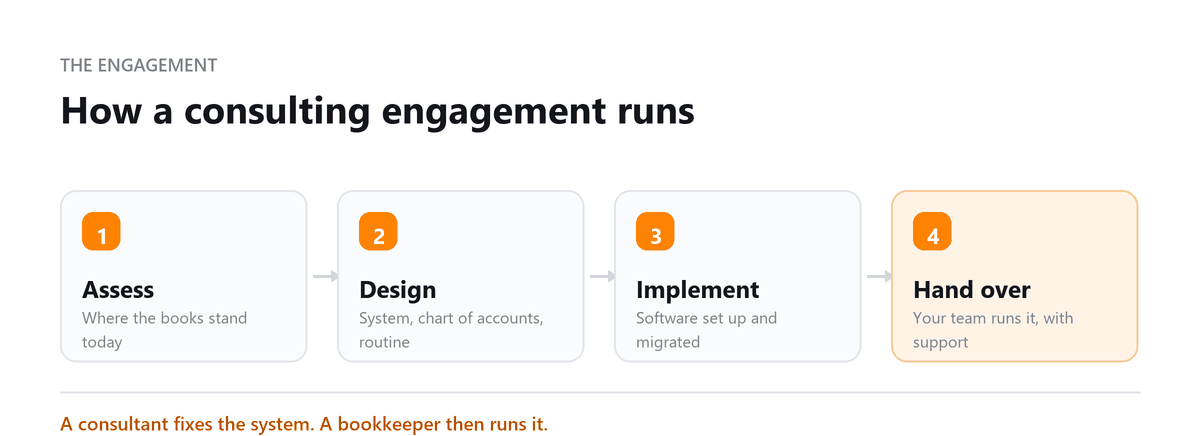
A good bookkeeping consultant does not just clean up your records, they redesign the system so errors stop happening in the first place. The goal is to make your books run themselves.
Ankit Sarawagi, CPA, CA, MBA · LinkedInWho is a Bookkeeping Consultant?
A bookkeeping consultant is a financial specialist who offers comprehensive bookkeeping and advisory services to businesses, particularly smaller enterprises that need expert input without the cost of a full-time hire. These professionals bring extensive knowledge of financial regulations, tax statutes, and accounting platforms, and deliver customised approaches to improve financial workflows and guarantee precision. Think of them as an outsourced CFO for your day-to-day financial operations, without the full-time salary.
What Does a Bookkeeping Consultant Do?
- Bookkeeping and Data Entry: Managing daily transactions, reconciling bank statements, and ensuring all records are accurate and up to date
- Financial Reporting: Creating income statements, balance sheets, and cash flow statements on a regular schedule
- Tax Preparation and Planning: Assisting with accurate tax filing and identifying legitimate cost-saving opportunities
- Accounting Software Setup and Training: Recommending the right platform, implementing it, and training your team to use it correctly
- Financial Analysis and Budgeting: Examining patterns in your financial data, forecasting performance, and establishing realistic budgets
Benefits of Hiring a Bookkeeping Consultant
- Enhanced Accuracy and Efficiency: Professional expertise reduces errors and eliminates the guesswork that leads to costly mistakes
- Improved Financial Visibility: Regular, structured reporting gives you a clear, current picture of where your business stands
- Reduced Stress and Workload: Delegating financial responsibilities frees you to focus on growth, not admin
- Cost-Effectiveness: More economical than a full-time hire for businesses that do not need daily financial support
- Compliance Assurance: A qualified consultant ensures you meet tax deadlines and regulatory requirements without needing to track them yourself
How to Find the Best Bookkeeping Consultant
Use these criteria to evaluate candidates:
- Experience and expertise: Look for a track record in your industry or with businesses at your stage of growth
- Services offered: Confirm they cover everything you need, basic bookkeeping, tax support, analysis, or all three
- Technology proficiency: They should be fluent in cloud-based solutions and capable of integrating with your existing systems
- Communication and accessibility: Choose someone available when you need them and able to explain financial data clearly
- Fees and pricing structure: Get a clear breakdown upfront, hourly, monthly retainer, or project-based
Understanding Your Bookkeeping Needs First
Identifying Your Skill Gaps
Before hiring, be honest about what you can handle yourself and where the gaps are. If you are comfortable with basic data entry but struggle with reconciliation, tax prep, or financial reporting, those are the areas to brief a consultant on.
Matching Needs to Services
Different consultants offer different service packages. Define exactly what you need, is it a one-time clean-up, ongoing monthly support, or a full financial systems overhaul? The clearer your brief, the more accurately you can compare providers.
Industry-Specific Regulations
Some industries have specific compliance requirements, healthcare, nonprofits, construction, and e-commerce all have unique bookkeeping considerations. Where relevant, prioritise consultants with direct experience in your sector.
Choosing the Right Bookkeeping Software
Cloud-Based vs. Desktop Software
Cloud-based platforms (QuickBooks Online, Xero, FreshBooks) offer real-time access, automatic bank feeds, and remote collaboration. Desktop software has lower ongoing costs but limits accessibility. For most businesses working with an external consultant, cloud-based is the right choice.
Integration and Scalability
Your bookkeeping software should integrate with your other business tools, CRM, point-of-sale, payroll, and e-commerce platforms. It should also be capable of scaling with your business so you are not switching systems again in two years.
Building a Strong Relationship with Your Consultant
- Clear expectations: Define scope, turnaround times, reporting format, and communication frequency from day one
- Regular communication: Schedule monthly reviews so you are never out of the loop on your own finances
- Transparency: Share all relevant financial information openly, a consultant can only advise on what they can see
The Impact of Technology on Bookkeeping Consulting
Automation and AI are handling more routine bookkeeping tasks, data entry, categorisation, bank reconciliation, which changes what a consultant’s time is spent on. The best consultants today use technology to work more efficiently and focus their expertise on analysis, advice, and exception handling rather than repetitive data work.
Profitjets has supported more than 100 businesses through accounting and financial consulting engagements, helping clean up books, improve reporting, and establish more consistent financial processes.
For new clients, book cleanup typically takes 2 to 4 weeks, depending on the number of accounts, transaction volume, and historical records involved. By combining accounting expertise with ongoing financial support, businesses can address reporting issues without the cost of building a comparable in-house finance team.
Book a free consultation and we will tell you what the rebuild involves.
Frequently Asked Questions
What does a bookkeeping consultant actually do?
A bookkeeping consultant reviews and improves your financial systems, ensures your records are accurate and compliant, sets up or optimises your accounting software, and provides ongoing financial reporting and analysis. Unlike a standard bookkeeper, a consultant often focuses on process improvement as much as day-to-day transaction recording.
When should I hire a bookkeeping consultant?
Consider a consultant when your books are behind or disorganised, when you are setting up a new accounting system, when your business is growing and your current process is not scaling, or when you need expert guidance to clean up records before a tax filing or audit.
Is a bookkeeping consultant the same as a bookkeeper?
Not exactly. A bookkeeper typically handles ongoing day-to-day recording. A consultant may do some of that, but their primary value is in advising on systems, processes, and financial strategy. Many businesses use both, a consultant to set things up correctly and a bookkeeper to maintain them.
How much does a bookkeeping consultant charge?
Rates vary widely by experience, location, and scope. Freelance consultants in the US typically charge $50 to $150 per hour. Project-based engagements (like a full books clean-up) are often quoted as a fixed fee. Monthly retainer arrangements are common for ongoing advisory support.
How do I find a reliable bookkeeping consultant?
Ask for referrals from your accountant, business network, or professional associations. Check credentials and review past client testimonials. Schedule a discovery call before committing, you want to verify both their technical competence and their communication style.
Conclusion
A bookkeeping consultant is not a luxury, it is a practical solution for businesses that need expert financial oversight without a full-time hire. Whether you need a one-time audit of your books, a complete system overhaul, or ongoing advisory support, the right consultant delivers clarity, accuracy, and peace of mind. Take the time to define your needs, vet your candidates, and build a relationship based on transparency. Your financial records will reflect it.

Written by
Ankit Sarawagi, CPA, CA, MBA
Ankit leads the finance team at Profitjets, where he has worked with 500+ businesses across the US on bookkeeping, tax and CFO-level strategy. He writes about the habits that keep small business books accurate all year. Connect on LinkedIn
Free consultation
Books Need Rebuilding, Not Just Running?
Book a free consultation and we will tell you what the rebuild involves.