
Some positions on a return are plainly right. Some are arguable, taken in good faith, and could reasonably be seen differently by somebody else.
This form exists for the second category. It describes a position fully so that a later disagreement about judgement is treated as a disagreement rather than as a failure to take proper care.
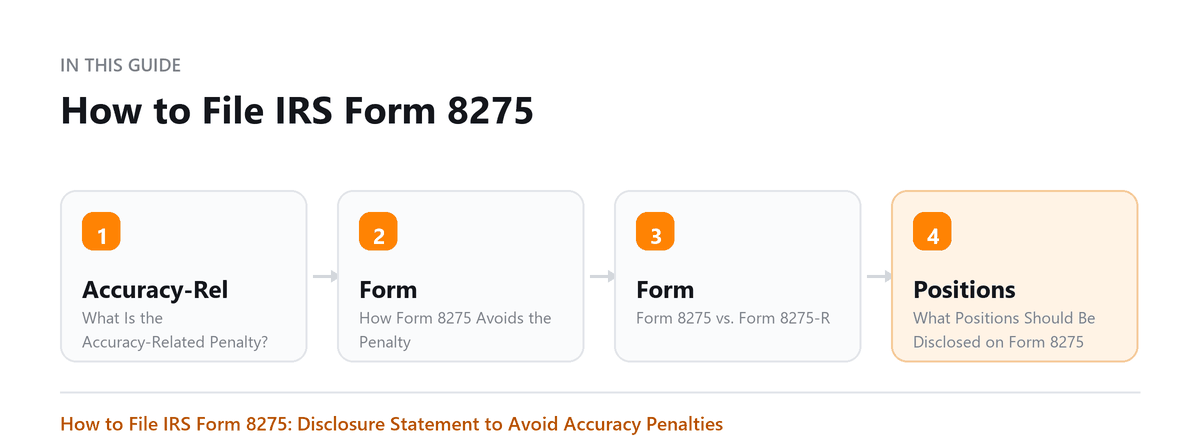
This covers what the penalty it protects against actually is, how disclosure changes the position, the difference between this form and its companion, which positions are worth disclosing, and where disclosure does not help at all.
When you take a tax position that is not frivolous but could be questioned by the IRS, Form 8275 provides a way to disclose it, and by doing so, avoid the 20% accuracy-related penalty even if the IRS ultimately disagrees with your position. This guide explains when to use Form 8275, how it works, and its limitations.
What Is the Accuracy-Related Penalty?
Under Internal Revenue Code Section 6662, the IRS can impose a 20% penalty on the portion of any underpayment attributable to:
- Negligence or disregard of rules or regulations
- Substantial understatement of income tax (understating tax by more than the greater of 10% or $5,000)
- Substantial valuation misstatement
- Transfer pricing misstatement
Form 8275 is specifically designed to avoid the negligence and substantial understatement penalties, not valuation or transfer pricing penalties.
The worry I hear is that disclosing a position invites attention. The alternative is not invisibility, it is the same position with less protection. If a position genuinely needs disclosing, the conversation to have first is about how strong it actually is, and your adviser should be able to explain what it rests on.
Ankit Sarawagi, CPA, CA, MBA · LinkedInHow Form 8275 Avoids the Penalty
Under Section 6662(d)(2)(B), a disclosure of a position reduces the understatement if:
- The item is adequately disclosed on the return or on a statement attached to the return (Form 8275 serves this purpose)
- There is a reasonable basis for the tax treatment adopted (not just a frivolous position)
A disclosed position that has a reasonable basis avoids the 20% penalty even if the IRS challenges it and wins. Without disclosure, the IRS can impose the penalty for any substantial understatement.
Pro Tip: Form 8275 does not prevent the IRS from disallowing the position, it only prevents the accuracy-related penalty if the position has a reasonable basis.
Form 8275 vs. Form 8275-R
| Form | When to Use |
|---|---|
| Form 8275 | Disclosing positions contrary to IRS revenue rulings, notices, or other sub-regulatory guidance, OR positions not contrary to any specific guidance that you want to protect from the substantial understatement penalty |
| Form 8275-R | Disclosing positions contrary to Treasury Regulations (i.e., you are taking a position that is inconsistent with an existing reg) |
Using the wrong form does not invalidate the disclosure, but it creates confusion. Use Form 8275-R whenever the position contradicts a published Treasury Regulation.
What Positions Should Be Disclosed on Form 8275
- Gray areas in the tax law where you have a reasonable basis but the outcome is uncertain
- Positions based on a good-faith interpretation of ambiguous statutory language
- Positions where the IRS has informally signaled disagreement but no formal ruling exists
- Novel or first-impression situations with no existing guidance
- Positions that a tax professional identified as having less than a 50% chance of prevailing if challenged
Do NOT use Form 8275 for frivolous positions, disclosing a frivolous position does not avoid penalties and may trigger the $5,000 frivolous return penalty.
How to Complete Form 8275
| Column | What to Enter |
|---|---|
| Column (a), Rev. Rul., etc. | The specific IRS ruling, regulation, or other authority the position relates to (if any) |
| Column (b), Item or Group of Items | Description of the item on the return (e.g., 'Home office deduction', 'Meals and entertainment') |
| Column (c), Detailed Description | Explain the nature of the disclosure |
| Column (d), Form and Line Number | The line on the return where the item is reported |
| Column (e), Amount | The dollar amount of the item |
| Column (f), Amount as Reported | How the item is treated on the return |
Attach a detailed explanation statement if the columns do not provide enough space to fully describe the position and its legal basis.
Filing Instructions
- Attach Form 8275 to the original return for the year in question
- Form 8275 can also be attached to an amended return (Form 1040-X) if you are disclosing a position on an amended return
- There is no separate deadline, the form is due when the return is due
Limitations of Form 8275
- Does not prevent the IRS from examining or adjusting the position
- Does not provide protection against the fraud penalty (75%)
- Does not protect against penalties for substantial valuation misstatements
- Does not help if the position has no reasonable basis, the standard is 'reasonable basis,' which is above 'non-frivolous' but below 'more likely than not'
The Penalty Standards Hierarchy
| Standard | Description |
|---|---|
| Frivolous | No basis whatsoever, automatic penalties apply |
| Reasonable basis | Lowest standard that avoids penalties with Form 8275 disclosure (~15-20% chance of prevailing) |
| Substantial authority | Avoids penalty even without disclosure (~40% chance of prevailing) |
| More likely than not | Avoids penalty for tax shelters and listed transactions (~50%+ chance) |
| Should | High confidence, standard for opinions (~70%+ chance) |
| Will | Virtual certainty |
Book a free consultation and we will take the return off your desk.
Frequently Asked Questions
Does my tax preparer need to sign Form 8275?
No. Form 8275 is a taxpayer disclosure, it is attached to your return and covered by your signature. However, preparers must separately disclose positions they believe are not supported by substantial authority on Form 8275 to avoid their own preparer penalties.
Can I use Form 8275 to protect a hobby loss deduction?
Yes, if you have a genuine profit motive that you can articulate. The IRS's hobby loss rules create a rebuttable presumption (3-of-5 years profitable), and a well-reasoned disclosure on Form 8275 can help protect against penalties even if the IRS ultimately determines the activity is a hobby.
What if I should have filed Form 8275 but forgot?
You may be able to attach it to an amended return. However, for purposes of the substantial understatement penalty, the disclosure must have been on the original return. Amending to add the disclosure may reduce but may not eliminate all penalty exposure.
Does disclosing a position increase the chance of being examined?
It is a reasonable worry and it is not the right way to frame the decision. The purpose of disclosure is to describe a position fully so that a disagreement about a judgement is not treated as a failure to take care. If a position genuinely needs disclosure, the alternative is not invisibility, it is the same position with less protection. Where a position is strong enough not to need it, that is a conversation to have with your adviser first.
Who decides whether something should be disclosed?
You and your adviser together, and it is a judgement about the strength of the position rather than a mechanical test. A preparer has their own professional standards to meet, which is why they may raise it even when you have not. The useful question to ask them is what the position rests on and how it would be explained if questioned, because that answer usually makes the disclosure decision obvious.

Written by
Ankit Sarawagi, CPA, CA, MBA
Ankit leads the finance team at Profitjets, where he has worked with 500+ businesses across the US on bookkeeping, tax and CFO-level strategy. He writes about the habits that keep small business books accurate all year. Connect on LinkedIn
Free consultation
Want the Filing Handled?
Book a free consultation and we will take the return off your desk.