
When somebody dies and a refund is owed, it does not simply pass to whoever files. Someone has to establish that they are entitled to receive it on the estate's behalf.
This form is how that is done, and the difficulty is rarely the form itself. It is producing the document that proves the entitlement, which differs depending on whether a court has appointed anybody and whether a surviving spouse is involved.
This covers when the form is required and when it is not, the categories of person who can claim, what has to be attached to support it, and how the refund is then paid.
When a taxpayer dies before receiving their federal income tax refund, the refund belongs to their estate or surviving spouse. IRS Form 1310, Statement of Person Claiming Refund Due a Deceased Taxpayer, tells the IRS who is entitled to receive that refund and authorizes the IRS to issue the check or direct deposit accordingly.
When Form 1310 Is Required
Form 1310 is required in most situations where someone other than the deceased taxpayer is claiming a refund on a final individual return. The key exception: if you are a surviving spouse filing a joint return with the decedent, you generally do NOT need Form 1310, you sign the return yourself and note your spouse's death.
- Court-appointed personal representative filing for a sole decedent: may not need Form 1310 if a valid certificate of appointment is attached
- Surviving spouse filing a joint return: no Form 1310 needed, sign on the deceased line with 'Filing as surviving spouse'
- Anyone else (other heir, executor without court appointment, non-spouse): must file Form 1310
This comes up at the worst possible moment for a family, and the practical obstacle is almost never the form. It is establishing who is entitled to act and producing the document that proves it. Find out what will be required before you start, because assembling it is the part that takes the time.
Ankit Sarawagi, CPA, CA, MBA · LinkedInThree Categories of Filer (Part I of Form 1310)
| Category | Who / What It Means |
|---|---|
| A, Surviving spouse | Check box A. File a joint return. No court certificate or bond required. |
| B, Court-appointed personal representative | Check box B. Attach a copy of the court certificate showing your appointment. Form 1310 itself may not be required; attach the certificate to the return instead. |
| C, Other claimant | Check box C. Answer yes/no questions about whether a will exists and whether you are filing on behalf of the estate or yourself. |
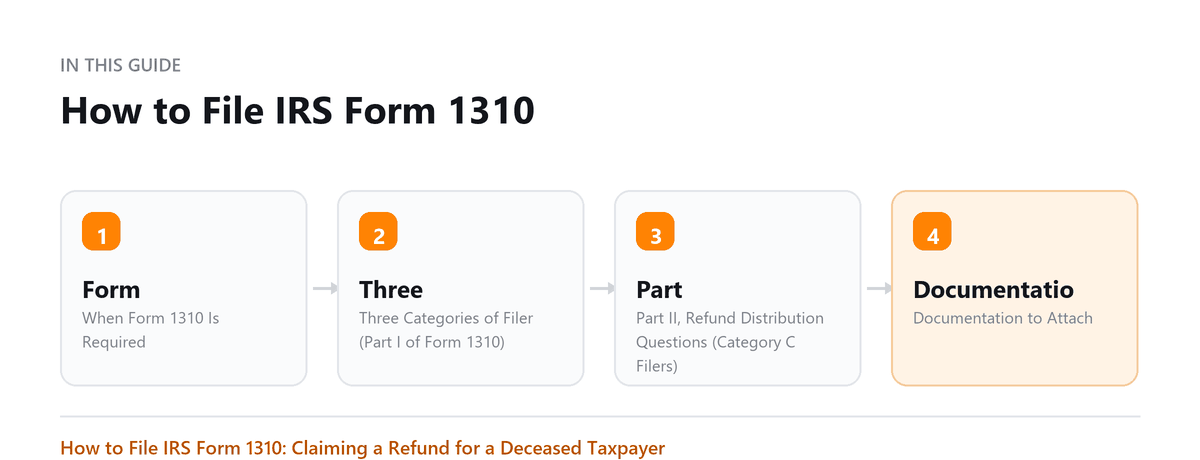
Part II, Refund Distribution Questions (Category C Filers)
If you checked box C, the IRS asks:
- Did the decedent leave a will?
- Has a court appointed a personal representative for the decedent's estate? (If yes, the representative must sign instead.)
- Are you filing Form 1310 for someone who died this year and whose account had a refund?
Documentation to Attach
- Death certificate: Required in most cases; the IRS may request it even if you do not initially attach it
- Letters testamentary or letters of administration: Court document showing you are the authorized estate representative
- Copy of the will (if applicable): Sometimes requested to verify your authority to claim
- Proof of relationship: For surviving spouses, the marriage certificate may be requested
Direct Deposit vs Check
If the original return requests direct deposit, the IRS may honor it, but if there is any uncertainty, the IRS will issue a paper check. A paper check for a deceased taxpayer is made out to 'Estate of [Decedent's Name].' You will need an estate bank account to deposit it; most banks will not deposit an estate check into a personal account.
Pro Tip: Open an estate bank account at a local bank before the refund arrives. Bring the death certificate and letters testamentary. This is often faster than trying to endorse a check as executor.
Where and How to File
Form 1310 is attached to the decedent's final Form 1040. File the entire package, 1040 + 1310 + supporting documents, to the IRS address for the state where the decedent lived. You cannot e-file a return with Form 1310 through most tax software; paper filing is typically required.
Book a free consultation and we will take the return off your desk.
Frequently Asked Questions
What if there is no will and no executor appointed?
A next-of-kin claimant can use Form 1310 (box C) and answer the Part II questions. The IRS will generally honor the claim if the amount is small and the answers are consistent.
Can a surviving spouse claim a refund on a joint return without Form 1310?
Yes. The surviving spouse signs the joint return and writes 'Filing as surviving spouse' next to the decedent's signature line. No Form 1310 needed.
How long does it take to receive the refund after filing?
Paper-filed returns with Form 1310 typically take 6-8 weeks longer than normal e-filed returns. Plan for 3-4 months total.
Does Form 1310 need to be notarized?
No. The IRS does not require notarization of Form 1310, but you must sign it under penalties of perjury.
What if the IRS sends the check to the wrong person?
Contact the IRS immediately. If a refund check was improperly cashed, file a claim for a replacement check with the IRS.

Written by
Ankit Sarawagi, CPA, CA, MBA
Ankit leads the finance team at Profitjets, where he has worked with 500+ businesses across the US on bookkeeping, tax and CFO-level strategy. He writes about the habits that keep small business books accurate all year. Connect on LinkedIn
Free consultation
Want the Filing Handled?
Book a free consultation and we will take the return off your desk.