
Debt that is written off does not simply vanish. As a rule the amount forgiven becomes income, which is an unwelcome surprise to somebody who was already unable to pay it.
There are situations where that amount can be excluded, and this is the form that claims the exclusion. It is not automatic: you claim it, and you have to be able to show the facts as they stood immediately before the cancellation.
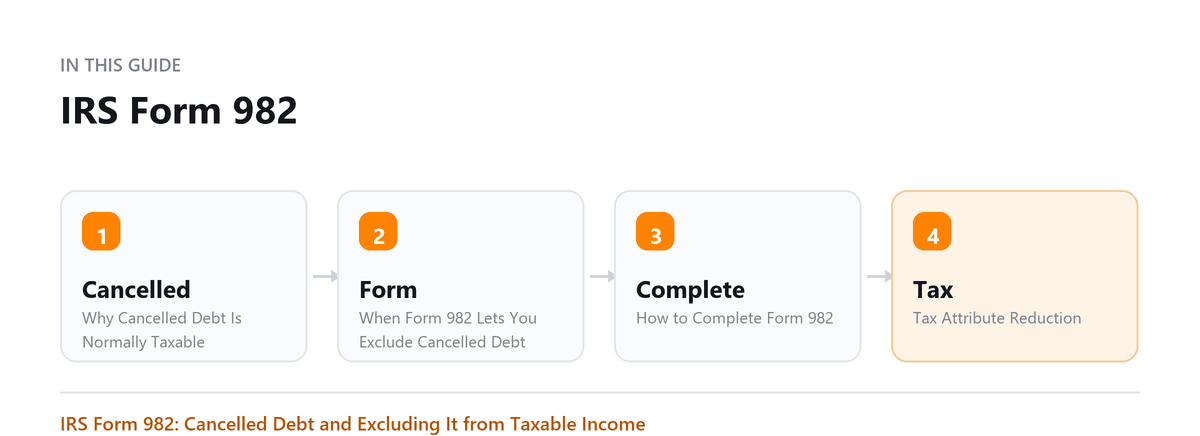
This covers why cancelled debt is normally taxable, the circumstances that allow it to be excluded, how the form is completed, and the trade that comes with the exclusion, which is relief now against less relief later.
When a lender cancels or forgives a debt, the IRS generally treats the forgiven amount as ordinary income, meaning you owe tax on money you never actually received. Form 982 is the mechanism for excluding that cancelled debt from your taxable income when one of the recognized exceptions applies. This guide explains every exclusion, how to calculate insolvency, and how to reduce tax attributes afterward.
Why Cancelled Debt Is Normally Taxable
When you borrow money, you are not taxed because you have an obligation to repay. When the obligation disappears, through forgiveness, settlement, or discharge, the economic benefit is equivalent to income. The lender or creditor typically reports the cancelled amount on Form 1099-C, which you receive (and the IRS receives a copy).
People assume debt written off simply disappears. It usually becomes income, and the relief that removes it is not automatic: you claim it, and you have to be able to show the position as it stood at that moment. Build that picture while the records still exist.
Ankit Sarawagi, CPA, CA, MBA · LinkedInWhen Form 982 Lets You Exclude Cancelled Debt
1. Bankruptcy Discharge (Title 11 Cases)
Debt cancelled in a federal bankruptcy proceeding (Chapter 7, 11, or 13) is fully excluded from income. This is the broadest and most powerful exclusion. Check Box 1a on Form 982 and enter the full excluded amount.
2. Insolvency
You can exclude cancelled debt to the extent you were insolvent immediately before the cancellation. Insolvency means your total liabilities exceeded your total assets at that moment.
- Insolvency calculation: Total Liabilities minus Total Assets = Insolvency Amount. The exclusion is limited to that amount. If the cancelled debt exceeds your insolvency amount, the excess is taxable.
- Example: You have $200,000 in liabilities, $150,000 in assets. You are insolvent by $50,000. If $80,000 of debt is cancelled, you can exclude $50,000; the remaining $30,000 is taxable income.
| Assets to Count for Insolvency Test | Liabilities to Count |
|---|---|
| Cash and bank accounts | Credit card balances |
| Investment accounts (FMV) | Mortgages on all properties |
| Real estate (FMV) | Car loans |
| Retirement accounts (generally included) | Student loans |
| Business interests (FMV) | Medical bills |
| Personal property (cars, jewelry, etc.) | Other debts owed |
3. Qualified Farm Indebtedness
Farmers who have debt cancelled by a qualified lender may exclude it if more than 50% of their gross receipts for the 3 prior tax years came from farming. The exclusion is limited to the taxpayer's adjusted tax attributes plus adjusted basis of qualified farm property.
4. Qualified Real Property Business Indebtedness
A solvent taxpayer who is not in bankruptcy can exclude cancelled debt that was incurred or assumed in connection with real property used in a trade or business. The exclusion is limited to the excess of the outstanding principal over the FMV of the property, and cannot reduce the adjusted basis of the property below zero.
5. Qualified Principal Residence Indebtedness
Cancelled debt on your main home that was used to buy, build, or substantially improve the residence could be excluded. This exclusion was created during the mortgage crisis and has expired and been extended multiple times.
How to Complete Form 982
- Check the applicable box in Part I (bankruptcy, insolvency, etc.).
- Enter the excluded amount on Line 2.
- Complete Part II to reduce tax attributes (see below).
Tax Attribute Reduction
When you exclude cancelled debt under any exception except the qualified principal residence exclusion, you must reduce certain tax attributes (in order) by the excluded amount. This is not optional, it is required.
- Net operating losses (NOLs)
- General business credit
- Minimum tax credit
- Capital loss carryovers
- Basis of depreciable property
- Passive activity loss and credit carryovers
- Foreign tax credit carryovers
Pro Tip: Tax attribute reduction happens at $1 for $1 (except general business and other credits, which are reduced at $1 for every $3 of excluded debt). The IRS requires this to prevent a double benefit.
Book a free consultation and we will take the return off your desk.
Frequently Asked Questions
What if I received a 1099-C but I was insolvent?
Do I still report it? Yes, you report the 1099-C on your return and then use Form 982 to show the excluded amount. Many people make the mistake of simply not reporting the 1099-C, which triggers IRS notices.
Does state tax follow federal rules?
Not always. Some states conform to the federal exclusions; others do not. You may owe state income tax on cancelled debt that is excluded at the federal level. Check your state's conformity rules.
Can both the insolvency exclusion and the bankruptcy exclusion apply?
No. They are mutually exclusive. If you are in a Title 11 bankruptcy case, the bankruptcy exclusion applies and is generally more favorable (unlimited exclusion versus limited to insolvency amount).
What has to be established before claiming an exclusion?
The facts as they stood immediately before the cancellation, supported by contemporaneous evidence. For an insolvency position that means a schedule of everything owned and everything owed at that moment, with values you can support. It is an ordinary balance sheet exercise, but it has to be constructed as at a specific date, and assembling it years later from memory is the weakest version of it.
What is the consequence of claiming an exclusion?
Relief now in exchange for less relief later, which is the trade the mechanism is built around. Excluding the amount from income generally means reducing tax attributes you would otherwise have used in future years, such as losses carried forward or the basis of assets you still hold. It is usually still the right outcome, but it should be understood as a deferral of the cost rather than its removal.

Written by
Ankit Sarawagi, CPA, CA, MBA
Ankit leads the finance team at Profitjets, where he has worked with 500+ businesses across the US on bookkeeping, tax and CFO-level strategy. He writes about the habits that keep small business books accurate all year. Connect on LinkedIn
Free consultation
Want the Filing Handled?
Book a free consultation and we will take the return off your desk.