
There is a limit on how far back a return can be examined, which is reassuring until you look at the circumstances that extend it or remove it entirely.
The standard period is not the only one that matters. Substantial understatements extend it, some situations leave it open indefinitely, and states set their own periods that frequently run longer than the federal one.
This covers the ordinary window, what extends it, the circumstances where no limit applies, how foreign account reporting sits alongside it, and how long records should be kept as a result.
Overview: The IRS Audit Window Is Not Unlimited
Many taxpayers believe the IRS can audit any year at any time. In most cases, that is wrong. The IRS has a limited window to examine your returns, called the statute of limitations for assessment. Understanding this window tells you how long you truly need to worry about a given tax year.
The federal window closing does not mean every window has closed. States set their own periods and several run longer, so a position that is settled federally can still be open where you also file. Check each state rather than assuming the federal answer governs.
Anu Gupta, CA, EA, B.Tech · LinkedInStandard Rule: 3 Years
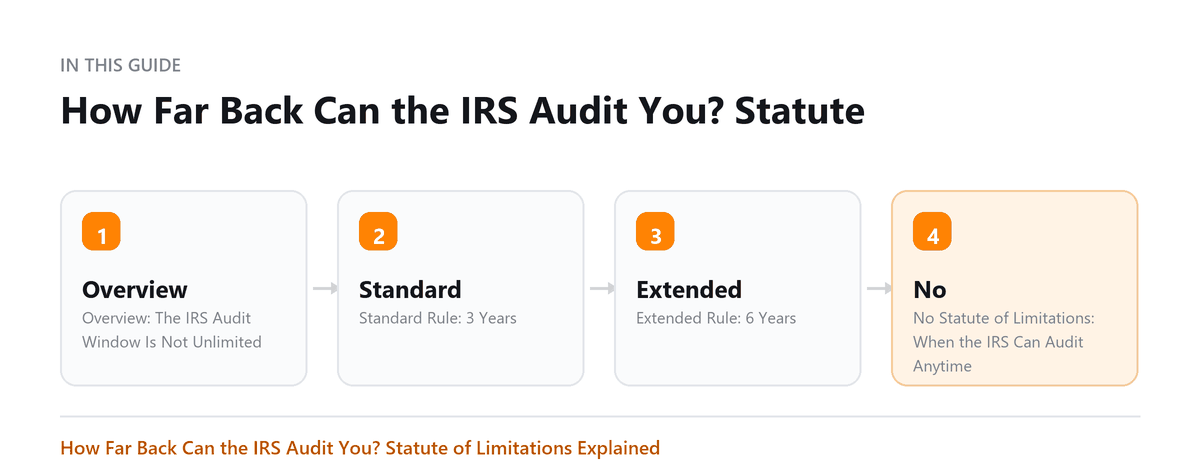
The IRS generally has 3 years from the later of:
- The date the return was due (typically April 15), or
- The date you actually filed the return
Example: If you filed your 2022 return on time on April 15, 2023, the IRS generally has until April 15, 2026 to audit it. If you filed late on June 1, 2023, the window runs until June 1, 2026.
Extended Rule: 6 Years
The IRS has 6 years (rather than 3) to audit if you underreported gross income by more than 25%. This is called the substantial omission rule.
Example: Your gross income was $200,000 but you reported only $140,000 (omitting $60,000 = 30% of $200,000). The 6-year window applies.
No Statute of Limitations: When the IRS Can Audit Anytime
Two situations remove the statute of limitations entirely:
- Fraudulent return: If the IRS can show you filed a fraudulent return (intentional evasion), there is no time limit.
- No return filed: If you never filed a tax return for a given year, the clock never starts. The IRS can assess tax anytime.
State Income Tax Audits
State audit windows vary:
| State Situation | Typical Statute |
|---|---|
| Most states | 3-4 years |
| California | 4 years (or 1 year after federal if federal audit extends to federal 3-year window) |
| States with no income tax | N/A |
| States that follow federal timeline | Varies by statute |
FBAR and Foreign Account Reporting
Foreign Bank Account Reports (FBARs, FinCEN Form 114) have a 6-year civil assessment period. If you have foreign accounts and failed to file FBARs, the IRS and FinCEN have 6 years to assess civil penalties.
Carrybacks and Carryforwards
If a year's return involves a net operating loss (NOL) that you carry back to a prior year, or a credit carryforward, the audit window for the year receiving the carryback/carryforward may be extended to allow the IRS to examine the originating year.
How Long Should You Keep Tax Records?
To be safe:
- Keep returns and supporting documents for at least 7 years
- 7 years covers the 6-year substantial omission window plus a one-year buffer
- Property records: keep until 3 years after you sell the property
- Employment tax records: 4 years
- Records for carryforward items (NOLs, capital losses): keep until 3 years after the carryforward is used
Pro Tip: Store digital copies of all tax returns and supporting documents. Cloud storage (Google Drive, Dropbox) with a folder per year is an easy system.
Book a free consultation and we will take the return off your desk.
Frequently Asked Questions
Can the IRS audit a return from 10 years ago?
Generally no, unless you filed a fraudulent return or never filed at all. Under the standard 3-year rule, a 2015 return filed on time in April 2016 would be beyond the IRS audit window by April 2019.
What triggers the 6-year audit window?
Understating gross income by more than 25%. This is based on what you should have reported, not just what you forgot to report. The IRS must be able to show the 25%+ omission.
Does amending a return reset the statute of limitations?
Filing an amended return (Form 1040-X) does not reset the original 3-year clock on the original return. However, the IRS has at least 60 days from receipt of a timely filed amended return to assess additional tax.
What if the IRS sends a notice past the statute of limitations?
You can raise the expired statute as a defense. An IRS notice does not override the statutory limit. Consult a tax professional or tax attorney immediately.
Does the same window apply to the states?
Not necessarily. States set their own periods and several are longer than the federal one, and some have rules that extend it further in circumstances the federal system treats differently. A federal position that is closed is therefore not automatically closed everywhere. Where you file in more than one state, check each one's period rather than assuming the federal answer governs all of them.

Written by
Anu Gupta, CA, EA, B.Tech
Anu works with US businesses on tax and entity questions at Profitjets, from choosing a structure to the filings that follow it. She writes about the decisions owners make once and then live with for years. Connect on LinkedIn
Free consultation
Want the Filing Handled?
Book a free consultation and we will take the return off your desk.