
How Outsourced Bookkeeping Services for Startups Help Entrepreneurs Stay Audit-Ready
Why startup books break early, what outsourcing fixes, and what investors expect to see when they ask
As businesses scale, complexity increases to manage their financial operations internally. When there is an increase in volume of transactions, expenses are harder to detect with multi verse channels. Outsourced bookkeeping services enable startups with audit-ready records to navigate the financial period.
With financial visibility and clear data, business owners can reflect their decisions to improvise the strategic pillar. This removes the assumptions and equips them with collective records for growth. Through strategic decisions they can navigate the business even further with better productivity and return on investment. Outsourced bookkeeping resolves the challenges efficiently and provides best possible rates compared to the in-house bookkeeping services. Further, it delivers the foundational infrastructure for business owners to plan effectively.
The main reason for outsourced bookkeeping is the accessibility among startups. Businesses are not spending full-time in an accounting hire before they are prepared. Founders can access professional expertise with defined processes and flawless cloud accounting with a lesser cost.
The startups that raise their first round most smoothly are almost always the ones with clean, organised books. Investors do not just look at your product, they look at whether you can run a company. Clean financials are evidence that you can.
Ankit Sarawagi, CPA, CA, MBA · LinkedInIn this article let’s find out how outsourced bookkeeping equips startups and entrepreneurs to improve visibility of their financials, and build a sustainable financial infrastructure for long-term growth.
Why Bookkeeping Matters More for Startups Than Most Founders Realise
For startups, proper bookkeeping is more than just organising receipts and invoices. It plays a critical role in:
- Tracking Financial Health: Understanding exactly where money is going and how much is coming in
- Budgeting and Resource Allocation: Planning for growth and allocating capital effectively
- Investor Confidence: Accurate, organised records build trust with investors and stakeholders
- Tax Compliance: Avoiding penalties by filing accurate returns on time
- Audit Readiness: Being prepared for due diligence, investor review, or regulatory audit at any time
Common Bookkeeping Challenges Startups Face
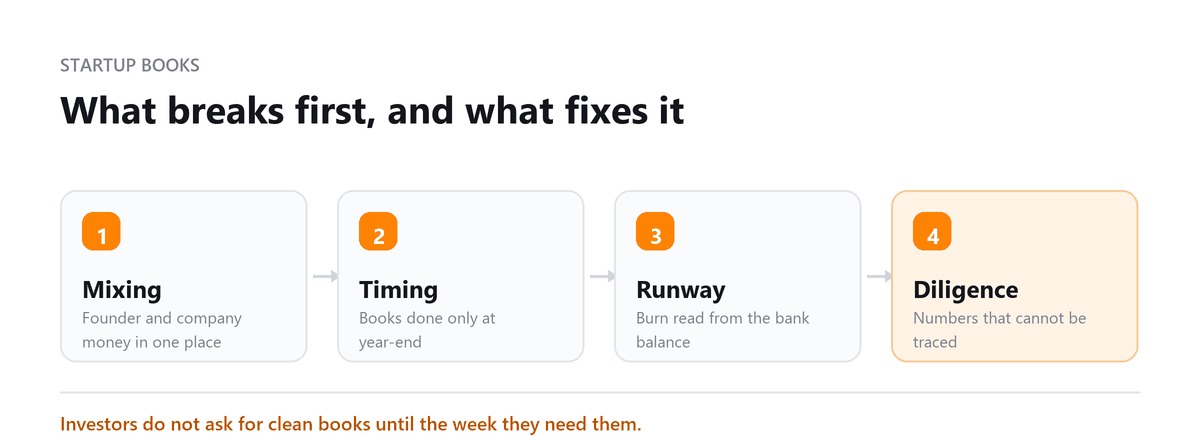
- Lack of accounting expertise: Many founders do not have a finance background, leading to record-keeping errors that compound quickly
- Time constraints: Managing finances takes time away from product development, sales, and customer relationships
- Compliance complexity: Tax law, payroll regulations, and accounting standards are difficult to navigate without specialist knowledge
- Cash flow management: Poor financial tracking is one of the most common causes of startup failure
Benefits of Outsourced Bookkeeping for Startups
1. Saves Time
Founders should be building the business, not reconciling bank statements. Outsourced bookkeeping handles financial records in the background, freeing founder time for the work that creates value.
2. Reduces Costs
A full-time accountant is a significant hire. Outsourcing means paying only for the services you need, a fraction of an employment cost, while getting the same quality of financial management.
3. Ensures Accuracy
Professional bookkeepers use advanced accounting software and established processes to eliminate errors. For startups, where a single financial mistake can have outsized consequences, accuracy matters.
4. Keeps You Audit-Ready
Outsourced bookkeepers maintain thorough, organised records as a matter of course. When an audit, investor review, or due diligence process arrives, and for funded startups, it always does, the records are already in order.
5. Access to Experts
Outsourcing connects startups with professionals who understand startup-specific financial challenges: equity transactions, R&D credits, revenue recognition, and the reporting investors expect.
6. Scalability
Service levels adjust as the startup grows. Adding headcount, new revenue streams, or new markets all increase bookkeeping complexity, an outsourced provider scales with you without a lag.
In-House vs. Outsourced Bookkeeping for Startups
| Factor | In-House Bookkeeping | Outsourced Bookkeeping |
|---|---|---|
| Cost | High, salary, benefits, office | Cost-effective, pay only for what you need |
| Expertise | Depends entirely on who you hire | Industry-specific experts available |
| Time commitment | Requires ongoing management | Frees up your time for core work |
| Scalability | Requires new hires to expand | Easily scales with the business |
| Technology | Requires separate investment | Advanced tools included in service |
What Outsourced Accounting Firms Offer Startups
- Bookkeeping: Organised, accurate financial records from day one
- Payroll management: Accurate, compliant employee pay processing
- CFO services: Strategic financial guidance for growth, fundraising, and planning
- Tax services: Compliance, filing, and deduction optimisation
- Financial reporting: Investor-ready financials on a regular schedule
Book a free consultation and we will get the books diligence-ready.
Frequently Asked Questions
Why should startups outsource their bookkeeping?
Time savings, cost reduction, and accuracy. Startups particularly benefit because they rarely have the volume to justify a full-time hire, but the stakes of inaccurate records, with investors, regulators, and tax authorities watching, are higher than for established businesses.
What is outsourced bookkeeping for startups?
It means hiring an external firm to handle all financial record-keeping responsibilities, transaction tracking, payroll, reporting, and compliance, so founders can focus on building the business rather than managing financial administration.
What services do outsourced accounting firms offer startups?
Bookkeeping, payroll, CFO services, tax preparation and filing, and financial reporting. The best firms offer all of these under one roof so data flows seamlessly between functions.
How does outsourcing bookkeeping help startups stay audit-ready?
Outsourced bookkeepers maintain accurate, organised records as standard practice. Every transaction is categorised, every reconciliation is completed, and every document is filed. When an audit or investor due diligence arises, there is nothing to scramble to prepare.
When should a startup start outsourcing its bookkeeping?
From day one is not too early. Starting with professional bookkeeping avoids the cost and time of cleaning up self-managed books later. At minimum, outsource before your first payroll run, your first investor conversation, or your first significant revenue month.
Conclusion
For startups, outsourced bookkeeping is not a cost, it is insurance. Clean, accurate, audit-ready financial records protect the business when it matters most: during fundraising, due diligence, and regulatory review. Building that foundation early costs far less than repairing disorganised books under pressure later.

Written by
Ankit Sarawagi, CPA, CA, MBA
Ankit leads the finance team at Profitjets, where he has worked with 500+ businesses across the US on bookkeeping, tax and CFO-level strategy. He writes about the habits that keep small business books accurate all year. Connect on LinkedIn
Free consultation
Raising, or About To?
Book a free consultation and we will get the books diligence-ready.