
Excise taxes apply to particular goods, services and activities rather than to profit, and this is the quarterly return that reports them.
Businesses are frequently caught by it without considering themselves part of an excise sector at all. Health plan sponsors and certain service providers are common examples, and the obligation to deposit during the period runs on its own rhythm.
This covers who has to file, the major categories the return covers, how the quarterly cycle works alongside the deposit requirements, and how a return is corrected.
Form 720, Quarterly Federal Excise Tax Return, covers a wide range of federal excise taxes imposed on specific goods, services, and activities. If your business falls into one of the covered categories, you must file Form 720 and pay the applicable excise tax quarterly. This guide walks through who must file, the major excise taxes, the deposit rules, and the filing deadlines.
Who Must File Form 720?
Any business that collects, owes, or is liable for a federal excise tax listed on Form 720. Common filers include:
- Fuel distributors and sellers (gasoline, diesel, kerosene, jet fuel)
- Airlines and transportation companies (air passenger tax, cargo tax)
- Coal producers
- Insurance companies issuing certain policies
- Health insurers and self-insured health plans subject to the PCORI fee
- Indoor tanning service providers
- Fishing equipment and boat manufacturers and importers
Work from the list of taxable activities rather than from an assumption about your industry. The categories catch businesses that would never describe themselves as being in an excise sector, and the obligation to deposit during the period often runs on a different rhythm from the obligation to file.
Ankit Sarawagi, CPA, CA, MBA · LinkedInMajor Excise Taxes on Form 720
Air Transportation Taxes
A 7.5% tax on the price of taxable air transportation (passengers), plus a per-person domestic segment tax. A flat-rate tax applies to international flights. Airlines collect these taxes from passengers and remit them on Form 720.
Fuel Taxes
Excise taxes on diesel fuel, gasoline, kerosene, aviation fuel, and other fuels. Rates vary by fuel type. Fuel distributors and airlines are major filers in this category. Credits for non-taxable uses (farming, off-highway business use) are also claimed on Form 720.
Patient-Centered Outcomes Research (PCORI) Fee
Health insurers and self-insured health plans must pay an annual PCORI fee, reported on the second quarter Form 720 (due July 31). The fee is assessed per covered life. The rate is adjusted annually by the IRS.
| Plan Year Ending | PCORI Fee Rate (Per Covered Life) |
|---|---|
| October 1, 2023 - September 30, 2024 | $3.22 |
| October 1, 2024 - September 30, 2025 | VERIFY current rate |
Indoor Tanning Services Tax
A 10% excise tax on indoor tanning services paid by the customer. Tanning salon operators collect the tax and remit on Form 720.
Coal Excise Tax
Taxes on the sale of coal mined from US mines. Two rates: coal from underground mines (4.4% of sales price, up to $1.10 per ton), and coal from surface mines (4.4% of sales price, up to $0.55 per ton).
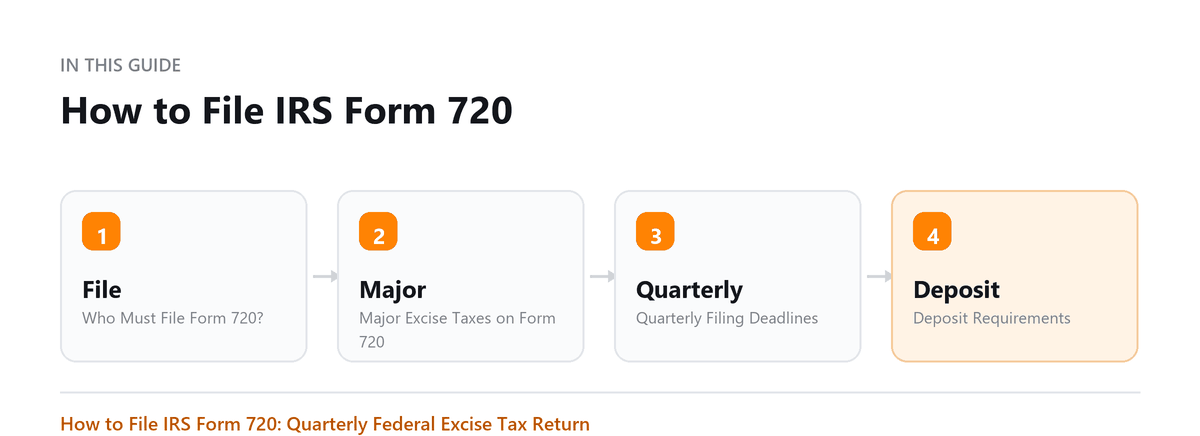
Quarterly Filing Deadlines
| Quarter | Deadline |
|---|---|
| Q1 (January-March) | April 30 |
| Q2 (April-June) | July 31 |
| Q3 (July-September) | October 31 |
| Q4 (October-December) | January 31 of following year |
Deposit Requirements
The deposit rules for excise taxes vary by the type of tax. Some excise taxes must be deposited semi-monthly (within 3 business days of the semi-monthly period). Others can be paid with the quarterly return. Check the specific instructions for each tax on Form 720 to determine the deposit frequency.
Pro Tip: Most excise tax deposits must be made through the Electronic Federal Tax Payment System (EFTPS). Do not mail a check if the deposit rules require electronic payment, penalties apply for improper payment method.
Amending Form 720
Use Form 720-X, Amended Quarterly Federal Excise Tax Return, to correct a previously filed Form 720. You can file 720-X to claim a refund or credit, or to pay additional tax. Note that claims for refunds must generally be filed within 3 years of when the tax was paid.
Book a free consultation and we will take the return off your desk.
Frequently Asked Questions
Do small businesses need to file Form 720?
Only if they have a liability for a federal excise tax covered by Form 720. Most small service businesses and retailers do not deal in the taxable products listed. But if you run a fuel distributorship, tanning salon, or air charter service, yes, you must file.
What happens if we collect excise tax from customers but fail to remit it?
The business is liable for the full excise tax amount, plus penalties and interest. Collected but unremitted excise taxes are treated as trust fund taxes, and responsible persons (officers, owners) can be personally liable for failure to pay.
Is the PCORI fee deductible for the health plan sponsor?
Yes. The PCORI fee is deductible as an ordinary and necessary business expense.
How do we find out whether any of this applies to us?
Work from the list of taxable activities rather than from an assumption about your industry, because the categories are specific and several catch businesses that do not think of themselves as being in an excise sector at all. Health plan sponsors, certain service providers and businesses handling particular goods are common examples. Check the current instructions against what you actually do.
What happens between the quarterly filings?
Deposits, in many cases, which is the part businesses miss when they first become liable. The obligation to pay during the period can run on a different rhythm from the obligation to file, so a business that files correctly every quarter can still be late on payment. Establish both timetables at the point you register rather than after the first notice.

Written by
Ankit Sarawagi, CPA, CA, MBA
Ankit leads the finance team at Profitjets, where he has worked with 500+ businesses across the US on bookkeeping, tax and CFO-level strategy. He writes about the habits that keep small business books accurate all year. Connect on LinkedIn
Free consultation
Want the Filing Handled?
Book a free consultation and we will take the return off your desk.