
This authorises somebody to receive your tax information. It does not authorise them to act on your behalf, and that distinction is the whole point of the form.
It suits a lender, an adviser or a member of staff who needs to see records or monitor an account. Where somebody actually has to argue a position or sign something, a different and broader authorisation is required.
This covers what the authorisation permits, how it differs from the fuller power of attorney, how it is completed and submitted, and how it is ended.
What Is Form 8821?
IRS Form 8821 is a Tax Information Authorization. It allows you to designate a person, organization, or firm to receive your tax information from the IRS. Critically, Form 8821 does NOT authorize the designee to represent you, negotiate with the IRS, or take any action on your behalf, it only gives them the ability to receive and review your tax information.
Grant the narrower authority where it is enough. One of these lets somebody see your information; the other lets them act, agree and sign. Using the lighter one when access is all that is needed is simply good practice.
Ankit Sarawagi, CPA, CA, MBA · LinkedInForm 8821 vs. Form 2848: Key Difference
| Feature | Form 8821 / Form 2848 |
|---|---|
| Purpose | 8821: Receive tax info only / 2848: Represent taxpayer before IRS |
| Can act on taxpayer's behalf? | 8821: No / 2848: Yes |
| Who can be designated? | 8821: Anyone / 2848: Must be a qualified representative (attorney, CPA, enrolled agent, etc.) |
| Revocation effect | 8821: Stops info sharing / 2848: Revokes representation authority |
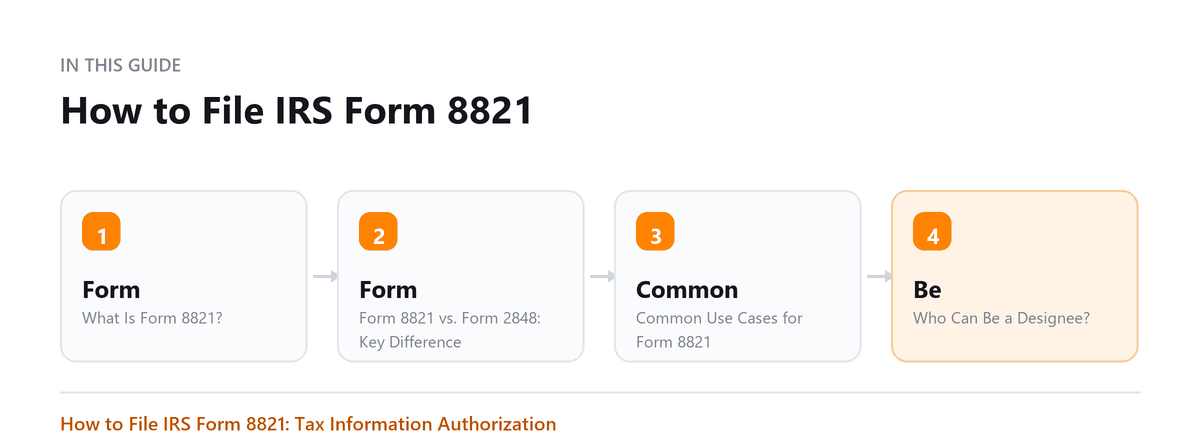
Common Use Cases for Form 8821
- Banks and lenders reviewing a borrower's tax transcripts for a loan application.
- Financial advisors or wealth managers who need to review a client's tax filing history.
- Businesses verifying a contractor's or vendor's tax filing status.
- Insurance companies reviewing tax records for underwriting purposes.
- Business partners doing due diligence before a transaction.
Who Can Be a Designee?
Unlike Form 2848, there are no restrictions on who can be designated under Form 8821. You can authorize:
- Any individual (accountant, attorney, financial advisor, family member).
- Any corporation, organization, or firm.
- Multiple designees on a single Form 8821.
Does Form 8821 Expire?
Form 8821 does not automatically expire unless you specify an expiration date on the form. However:
- You can specify a fixed expiration date if you want the authorization to be time-limited.
- Older Form 8821s filed before January 1, 2009 automatically expired, the IRS no longer honors them.
- You can revoke a Form 8821 at any time by notifying the IRS in writing.
How to Complete Form 8821
- Line 1: Enter your taxpayer information (name, TIN, address).
- Line 2: Enter the designee's name, address, and phone number. Multiple designees can be listed.
- Line 3: Specify the tax matters, indicate the type of tax (income, employment, etc.), tax form number, and the years or periods covered.
- Line 4: Specify specific use if applicable, for example, if authorization is only for a specific purpose.
- Line 5: Retention/revocation, note prior authorizations if applicable.
- Sign and date the form.
How to Submit Form 8821
- Mail to the appropriate IRS campus based on your state (see current IRS instructions for the mailing address).
- Fax to the appropriate IRS fax number.
- Submit online via the IRS Tax Pro Account (for authorized practitioners).
Revoking a Form 8821
To revoke an authorization, write 'REVOKE' across the top of a copy of the original Form 8821 and send it to the IRS. Alternatively, you can file a new Form 8821 and check the box indicating revocation of prior authorizations.
Book a free consultation and we will take the return off your desk.
Frequently Asked Questions
Can someone use Form 8821 to talk to the IRS on my behalf?
No. Form 8821 only allows the designee to receive information. If you need someone to communicate or negotiate with the IRS on your behalf, use Form 2848 (Power of Attorney).
Does the designee need any special credentials?
No. Anyone can be a designee under Form 8821, unlike Form 2848 which requires a qualified representative.
Can a lender get my tax transcript using Form 8821?
Yes. Banks and lenders routinely ask borrowers to sign Form 8821 so the lender can independently order tax transcripts directly from the IRS to verify income.
How long does it take the IRS to process Form 8821?
Processing times vary. Once processed, the designee can access information through IRS systems.
Which of the two authorisations does a given situation need?
It depends on whether somebody needs to see information or to act. An authorisation to receive information lets an adviser or a lender obtain records and monitor an account; it does not let them argue a case, agree a position or sign anything. Where representation is actually required, the other form is the one needed. Using the lighter authorisation where it is sufficient is good practice, because it grants less.

Written by
Ankit Sarawagi, CPA, CA, MBA
Ankit leads the finance team at Profitjets, where he has worked with 500+ businesses across the US on bookkeeping, tax and CFO-level strategy. He writes about the habits that keep small business books accurate all year. Connect on LinkedIn
Free consultation
Want the Filing Handled?
Book a free consultation and we will take the return off your desk.