
How to Start a Business in the USA from India: Complete 2026 Guide
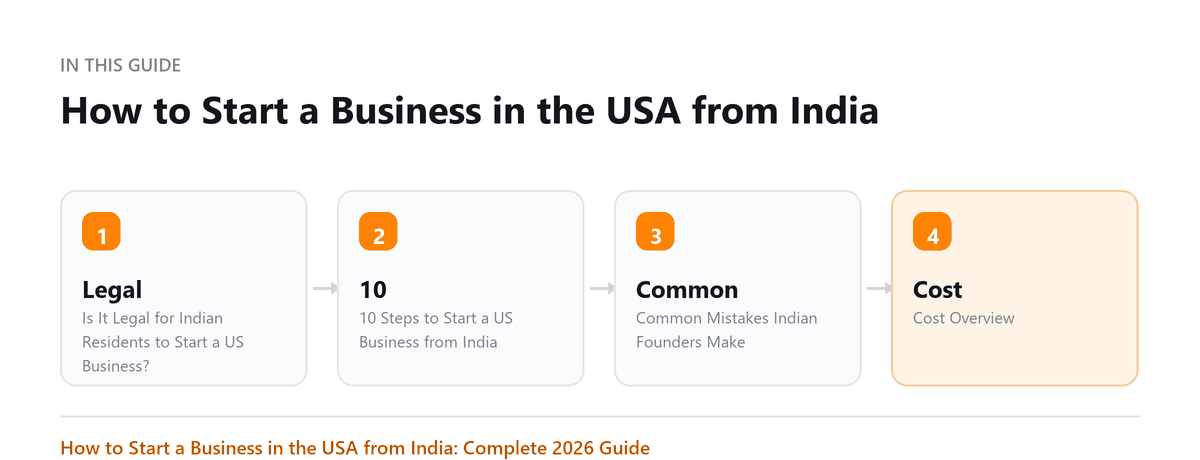
Is It Legal for Indian Residents to Start a US Business and 10 Steps to Start a US Business from India
Starting a US business from India is permitted and well trodden, and most of the difficulty is sequencing rather than eligibility.
Each step depends on the one before it, and one of them takes considerably longer from abroad. Getting the order wrong is what leads founders to sign customers before there is an account to receive the money into.
This covers whether it is allowed, the steps in the order they have to happen, the mistakes Indian founders make most often, and what the process costs.
Is It Legal for Indian Residents to Start a US Business?
Yes. US federal and state laws do not require citizenship or residency for business ownership. An Indian resident can own 100% of a US LLC or corporation. What matters is compliance on both sides: US tax and corporate law, and Indian FEMA/RBI regulations.
Sequence decides the timetable: entity, identifier, bank or payment account, then customers. The common mistake is signing a customer before there is an account to receive the money into, which leaves you invoicing personally and unwinding it later.
Abhinav Gupta, CPA, CA, MBA · LinkedIn10 Steps to Start a US Business from India
Step 1: Choose Your Entity Type
The two most relevant choices for Indian founders:
- Delaware C-Corporation: Required for US venture capital. QSBS benefits (Section 1202). Preferred stock available. Higher annual compliance cost.
- Delaware LLC: Simpler, cheaper to maintain. Better for bootstrapped businesses, no VC plans. Pass-through taxation.
If you are building a SaaS product targeting US customers and might want VC funding: Delaware C-corp. If you are a freelancer or consultant wanting a US billing entity: Delaware LLC.
Step 2: Choose Your State of Formation
Most Indian founders choose Delaware. Reasons:
- VCs expect Delaware C-corps
- Court of Chancery provides predictable case law
- No income tax on out-of-state income
- Best ecosystem for formation services and legal counsel
Wyoming LLC is an alternative for founders who want privacy and low cost without VC plans.
Step 3: File Formation Documents
File online at corp.delaware.gov (for Delaware). Cost: $90-$109 for most entity types. You will need a registered agent with a Delaware address before filing.
Step 4: Appoint a Registered Agent
Required before filing. As an Indian resident, you must use a registered agent service. Cost: $50-$200/year. Harvard Business Services is popular for international founders at $50/year.
Step 5: Get an EIN via Form SS-4
International founders without a US SSN/ITIN must use Form SS-4 by fax. Fax to +1-855-215-1627. IRS calls back within 4 business days with your EIN. Have a working phone number available when you fax.
Step 6: Open a US Bank Account
Best options for Indian founders, fully remote:
- Mercury: Most popular for Indian founders. Free. Requires EIN + formation docs + passport/ID. 1-3 business days.
- Relay: Alternative to Mercury, similar features, also free.
- Wise Business: Good for receiving international payments, not a full banking solution.
Step 7: Set Up US Payment Processing
- Stripe US: Apply at stripe.com with your US entity EIN and bank account
- Brex: Corporate card + USD account, designed for startups
- PayPal Business: Accepts international payments, USD payout to US bank
Step 8: Handle FEMA Compliance (Indian Side)
Before you remit capital from India to your US entity:
- Investments up to $250,000 per year: use LRS route through your AD bank
- Investment qualifies as Overseas Direct Investment (ODI): file Form ODI Part I with your bank before sending money
- File Annual Performance Report (APR) every year your investment is active
- Keep evidence of investment: bank statements, filing receipts
Step 9: Set Up US Payroll If Hiring US Employees
If hiring W-2 employees in the US:
- Register with each state's department of revenue and unemployment agency
- Use a payroll service (Gusto, Rippling, or ADP, all support small startups)
- Withhold and remit federal income tax, Social Security, and Medicare (FICA)
- File employer quarterly returns (Form 941)
Step 10: Appoint a US CPA or Virtual CFO
Non-US founders often underestimate US tax compliance complexity. A US CPA helps with:
- Form 5472 + 1120 (if LLC owned by foreign person)
- Form 1120 (C-corp annual return, due April 15 with extensions)
- Delaware franchise tax (due March 1 for C-corps, June 1 for LLCs)
- Ensuring transfer pricing documentation if you have both Indian and US entities
- Advising on QSBS eligibility and 83(b) elections for C-corps
Common Mistakes Indian Founders Make
- Skipping the 83(b) election: File within 30 days of founder stock grant or lose potentially millions in QSBS benefits
- Not filing Form 5472: $25,000 penalty per year. No exception for zero-revenue entities.
- Remitting capital without ODI filing: FEMA violation with severe penalties
- Not maintaining corporate formalities: Failing to hold board meetings, keep minutes, and maintain separate bank accounts can pierce the corporate veil
- Using personal accounts for business: Comingles assets and destroys limited liability
- Forming after the company already has value: Issue founder shares at formation when the price is still near zero
Cost Overview
| Item | Cost |
|---|---|
| Delaware formation (state fee) | $90-$109 |
| Registered agent (annual) | $50-$200 |
| Stripe Atlas / Clerky (optional) | $500-$2,000 |
| Mercury bank account | Free |
| Delaware franchise tax (C-corp annual) | $400-$5,000+ depending on share count |
| Delaware franchise tax (LLC annual) | $300 |
| US CPA (annual compliance) | $1,000-$5,000 |
Book a free consultation and we will get the numbers straight.
Frequently Asked Questions
Can I run the US company entirely from India?
Yes. As long as your US entity has no physical US presence beyond its registered agent, you do not need to be physically present. Operations can be 100% remote.
Do I need a US visa to own a US company?
No visa is required to own a US company. However, if you physically travel to the US to work for the company (especially as an employee), you may need appropriate work authorization.
How do I receive salary from my US company?
C-corp: you can pay yourself as an employee (needs payroll setup in the state where you are deemed to be working) or as a dividend. LLC: owner's draw. Cross-border payments from US to India: follow FEMA/LRS rules for repatriation.
Will my US company income be taxed in India?
As an Indian resident, your worldwide income is taxable in India. Income from your US entity, whether as salary, distributions, or dividends, must be reported on your Indian tax return. The India-US Double Taxation Avoidance Agreement (DTAA) may provide credit for US taxes paid.
What is the right order to do these steps in?
Entity first, then the federal identification number, then the bank or payment account, then customers. The sequence matters because each step depends on the one before it, and the identification number is the slowest link for a founder abroad. The common mistake is signing a customer or launching a product before there is an account to receive the money into, which leaves you invoicing personally and creating a problem you then have to unwind.

Written by
Abhinav Gupta, CPA, CA, MBA
Abhinav works with business owners across the US on industry-specific bookkeeping, from dental practices and restaurants to construction and e-commerce. He writes about what each trade's books actually need. Connect on LinkedIn
Free consultation
Want Books You Can Rely On?
Book a free consultation and we will get the numbers straight.