
Assets bought for a business are written off over time rather than all at once, and this is the form that reports how.
It also carries the elections that allow a faster write-off, which makes it one of the few forms where a choice made in a single year shapes the position for as long as the asset is held.
This covers who has to file it, what each part deals with, how the accelerated options interact with ordinary depreciation, and the register behind it that has to survive for the life of the asset.
What Is Form 4562?
IRS Form 4562, Depreciation and Amortization, is the form businesses and self-employed individuals use to claim deductions for depreciating assets and amortizing intangibles. Every business that purchases a fixed asset, equipment, vehicles, computers, machinery, or certain intangibles, uses Form 4562 to calculate and report those deductions.
The register behind this form is the single most useful tax record a business keeps. What was bought, when it went into service, the method and life applied, and the depreciation taken each year. It decides the result on disposal, which may be a decade away.
Ankit Sarawagi, CPA, CA, MBA · LinkedInWho Must File Form 4562?
- Any business or individual claiming depreciation on property placed in service during the year.
- Anyone claiming a Section 179 expense deduction.
- Anyone claiming bonus depreciation.
- Anyone claiming amortization of startup costs, goodwill, patents, or other Section 197 intangibles.
- Anyone with a vehicle used for business (listed property).
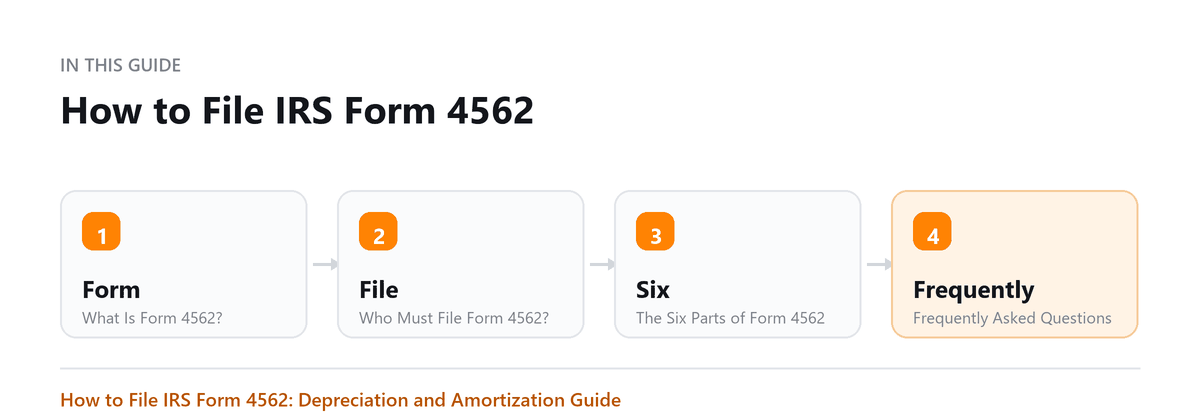
The Six Parts of Form 4562
Part I: Section 179 Expensing
Section 179 allows businesses to immediately deduct (expense) the full cost of qualifying property in the year it is placed in service, rather than depreciating it over multiple years.
| Item | Amount |
|---|---|
| Section 179 deduction limit (2024) | $1,220,000 |
| Phase-out threshold (2024) | $3,050,000 (deduction reduced dollar-for-dollar above this) |
| Qualifying property | Tangible personal property, off-the-shelf software, some real property improvements |
- Section 179 cannot exceed the taxable income from active business (cannot create a loss, unused deduction carries forward).
- Applies to both new and used property.
Part II: Bonus Depreciation
Bonus depreciation allows an additional first-year deduction on qualified property. Under TCJA's phase-down schedule:
| Tax Year | Bonus Depreciation % |
|---|---|
| 2022 and prior | 100% |
| 2023 | 80% |
| 2024 | 60% |
| 2025 | 40% |
| 2026 | 20% |
| 2027+ | 0% (unless Congress acts) |
- Bonus depreciation applies to qualified property (MACRS property with a recovery period of 20 years or less, computer software, and qualified improvement property).
- Unlike Section 179, bonus depreciation CAN create a loss.
- Both new AND used property can qualify (if first use by the taxpayer).
Part III: MACRS Depreciation
Most business assets are depreciated using the Modified Accelerated Cost Recovery System (MACRS). Common asset classes:
| Asset Type | MACRS Recovery Period |
|---|---|
| Computers, light equipment | 5 years |
| Office furniture, fixtures | 7 years |
| Cars and light trucks (business) | 5 years |
| Commercial real property | 39 years |
| Residential rental property | 27.5 years |
| Land improvements (sidewalks, fences) | 15 years |
| Qualified Improvement Property (QIP) | 15 years (bonus-eligible) |
GDS vs. ADS Methods
- General Depreciation System (GDS): Accelerated depreciation, 200% declining balance for most assets. This is the default.
- Alternative Depreciation System (ADS): Straight-line over longer recovery periods. Required for certain property (listed property used 50% or less for business, property used outside the US, tax-exempt use property) and for AMT calculations.
Part IV: Summary
Part IV summarizes total depreciation from Parts I, II, and III and transfers the total to the appropriate form (Schedule C, Schedule E, Form 1120, etc.).
Part V: Listed Property
Listed property (vehicles, computers, and other property that could have personal use) requires special record-keeping and limitations:
- If business use drops to 50% or below, must switch to ADS (straight-line) and may have to recapture prior excess depreciation.
- Vehicles: subject to annual luxury auto limits that cap the annual depreciation deduction.
- Record-keeping: must maintain detailed logs of business vs. personal use.
Part VI: Amortization
Intangibles and startup costs are amortized (not depreciated) over fixed periods:
| Item | Amortization Period |
|---|---|
| Section 197 intangibles (goodwill, customer lists, trademarks) | 15 years, straight-line |
| Startup costs (elected) | 60 months (5 years) |
| Organizational costs (elected) | 60 months (5 years) |
| Research & experimental expenditures (post-2021 law) | 5 years domestic, 15 years foreign |
Book a free consultation and we will take the return off your desk.
Frequently Asked Questions
Should I use Section 179 or bonus depreciation?
Use Section 179 first when you want to maximize current-year deductions but stay within taxable income (Section 179 cannot create a loss). Use bonus depreciation when the amount is too large for Section 179 or you are OK creating a net operating loss.
Do I file Form 4562 if I already fully depreciated all my assets in prior years?
No, not unless you are placing new property in service, claiming new Section 179 deductions, or have new amortization to report.
Can I depreciate land?
No. Land does not wear out and is not depreciable. Only improvements to land (buildings, parking lots, landscaping) are depreciable.
What is Qualified Improvement Property (QIP)?
QIP is interior improvements made to a nonresidential building after the building is placed in service. Under TCJA (a technical correction made by the CARES Act), QIP has a 15-year MACRS life and qualifies for bonus depreciation.
What should be kept for each asset, and for how long?
The purchase invoice, evidence of when it was placed in service, the method and life applied, and the depreciation taken each year. Keep it for as long as you own the asset and for the retention period after you dispose of it, because the figures determine the result on disposal. A fixed asset register that carries this history is the single most useful record a business keeps for tax purposes.

Written by
Ankit Sarawagi, CPA, CA, MBA
Ankit leads the finance team at Profitjets, where he has worked with 500+ businesses across the US on bookkeeping, tax and CFO-level strategy. He writes about the habits that keep small business books accurate all year. Connect on LinkedIn
Free consultation
Want the Filing Handled?
Book a free consultation and we will take the return off your desk.